
An engine misfire usually shows up as a stumble, a shake at idle, or a hesitation when you press the gas. A check engine light often comes with it. A solid light means get the car checked soon. A flashing light means slow down and get service as soon as you safely can.
A misfire means one or more cylinders did not burn their fuel and air properly. This guide explains what that feels like in everyday driving, what typically causes it, and what to do next.
TL;DR
- The most common signs are a rough idle, shaking, hesitation when you accelerate, and a check engine light.
- A flashing check engine light points to a severe misfire. Reduce speed and get service as soon as possible.
- Idle-only misfires and under-load misfires often point to different causes, which helps a technician narrow things down.
- Common causes are worn spark plugs, weak ignition coils, fuel delivery problems, and air leaks.
- A misfire can raise emissions and fuel use, so it is worth fixing early.
Table of Contents
- What an engine misfire is
- The most common engine misfire symptoms
- What a misfire feels like from the driver’s seat
- Misfire at idle versus under load
- What the check engine light is telling you
- Common causes of a misfire
- Can you keep driving with a misfire?
- How a misfire gets diagnosed
- A misfire and your Texas emissions inspection
- Perspective: why we start with the symptoms you describe
- Get a misfire checked in Midlothian
- Tips to help prevent misfires
- FAQ
- Schedule your service
- Sources
What an engine misfire is
Your engine burns a mix of air and fuel in each cylinder, lit by a spark, many times a second. A misfire happens when one of those combustion events fails or is weak. Haynes describes it as one or more cylinders failing to complete combustion.
The engine can still run with a misfire. It just runs unevenly, and the rest of the system has to cope with the fuel that did not burn.
The most common engine misfire symptoms
Not every misfire looks the same. Some feel like a faint flutter. Others feel like the car is bucking. Here are the signs to watch for.
1. A rough or shaky idle
This is the classic sign. At a stoplight or in park, the engine feels uneven, and you may feel a rhythmic shake through the seat, steering wheel, or gear selector. Bumper describes rough idle as the most common misfire symptom.
If your whole car shakes while moving, not just at idle, our guide on car shaking while driving covers other possible causes.
2. Hesitation or stumbling when you accelerate
You press the pedal and the car coughs, stumbles, or surges in a stop-and-go way. KBB lists hesitation that feels like a stop-and-go motion among the symptoms of a random misfire code. We cover this separately in what to check when a car hesitates on acceleration.
3. Loss of power
The car feels weak. You press the pedal further, but the car does not respond with the same urgency. This is most noticeable when climbing a hill, merging, or towing, because the engine needs the most from every cylinder then.
4. A check engine light
Most misfires turn the check engine light on. JD Power notes that most misfires cause the light to illuminate. The engine computer watches how evenly the crankshaft turns. When it sees repeated slowdowns, it stores a misfire code.
5. Poor fuel economy
Unburned fuel goes out the exhaust, and the engine may add more fuel to compensate. Bumper explains that unburned fuel passing through the exhaust can raise fuel consumption. If you are filling up more often with no change in your driving, pay attention.
6. Hard starts or stalling
Longer cranking, a shaky first few seconds after startup, or an engine that dies at a stop can all go with a misfire. Haynes lists difficulty starting or intermittent starting among the signs.
7. Popping sounds and a fuel smell
Unburned fuel can ignite in the exhaust or intake. That can sound like popping or spitting and may bring a raw fuel smell at the tailpipe. JD Power says a misfire may be followed by a jolt or bang when unburnt fuel ignites when it should not.
What a misfire feels like from the driver’s seat
Drivers describe it in plain terms: a cough, a skip, a stumble, or the engine “missing a beat.” JD Power puts it as a coughing or stumbling under the hood. With one cylinder out of four, six, or eight, the engine loses a share of its power on every cycle, so the rhythm changes.
A few things help you describe it to a technician:
- When it happens. At idle, under acceleration, at highway speed, or only on a cold start.
- How often. Constant, or in bursts that come and go.
- What the light does. Off, steady, or flashing.
- Any recent changes. A fill-up at a new station, wet weather, or a recent repair.
Misfire at idle versus under load
Where the misfire shows up can tell you a lot. These are general patterns, not a diagnosis.
| When it shows up | What it feels like | Common areas to check |
|---|---|---|
| At idle only | Rhythmic shaking, uneven RPM at a stop | Air leaks, mixture problems, injectors |
| Under load only | Hesitation, stumbling, power loss when accelerating | Spark plugs, ignition coils, fuel delivery |
| Both | Rough all the time, possibly with a code | Ignition, fuel, compression, or sensors |
| Only at startup | Shaky for the first seconds | Plugs, coils, injectors, cold-start fueling |
Bumper notes that a misfire can be intermittent, present during acceleration and absent at steady speed or idle. That is why a car can seem fine on a short test drive and still have a problem.
The reason is simple. Under load, cylinder pressure rises and the spark has to work harder. A tired plug or coil that copes at idle can fail when you accelerate. At idle, small air leaks change the mixture more, so idle-only roughness often leads a technician to look at air and fuel balance first.
What the check engine light is telling you
The light does not give a full diagnosis. It tells you the computer saw something wrong. Reading the stored code is where the diagnosis begins.
Misfire codes fall in a recognizable range. P0300 means a random or multiple cylinder misfire. P0301, P0302 and so on point to a specific cylinder. O’Reilly lists P0301 to P0312 as the cylinder-specific misfire codes. If you want a plain explanation of how stored and active codes differ, this guide to understanding car fault codes walks through it.
Steady light versus flashing light
This difference matters for what you do next.
- Steady light: The car needs service, but it is not an instant stop. Schedule a diagnosis soon.
- Flashing light: KBB says a severe misfire that can damage the catalytic converter causes the check engine light to flash.
The EPA’s guidance says a blinking light indicates a rather severe misfire. It advises you to reduce speed and seek service as soon as possible. It adds that a severe misfire over even a short period can seriously damage emission-control parts, especially the catalytic converter.
If the light is flashing, ease off the accelerator, avoid hard acceleration and towing, and head for a shop. If the car runs very roughly, stalls, or you smell fuel strongly, pull over safely and call for help rather than keep driving.
Common causes of a misfire
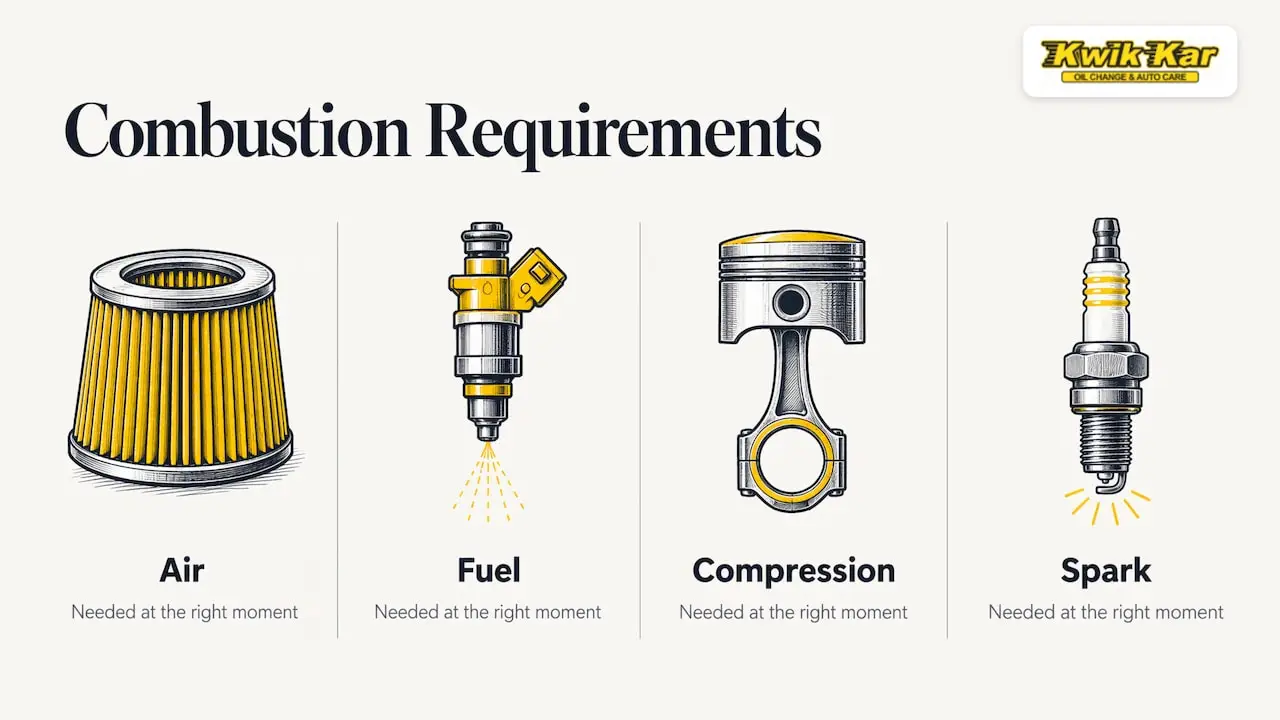
An engine needs air, fuel, compression, and spark at the right moment. A misfire means one of those is off in a cylinder. Most causes fall into a few groups.
Ignition problems
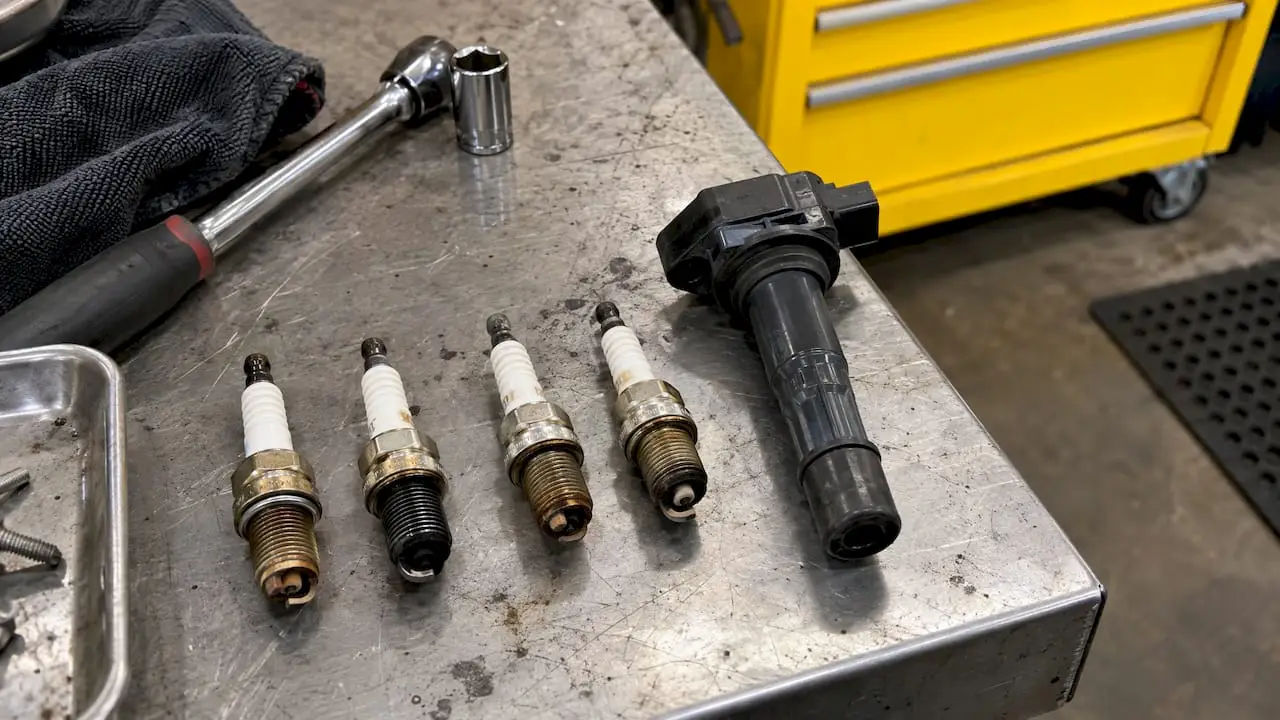
Worn or fouled spark plugs and weak ignition coils are the usual suspects. Motortriage ranks worn spark plugs and failing coils as the most common causes. They tend to cause trouble under load first, then at idle as they get worse.
Fuel delivery problems
A clogged or weak fuel injector, low fuel pressure, or a restricted filter can starve a cylinder. The mixture becomes too lean to ignite well. Our page on fuel system cleaning needs explains how to tell when the fuel side is a likely cause, and our fuel injection service page lists what we look at.
Air and sensor problems
A vacuum leak, a cracked hose, or a faulty sensor can throw off the air-fuel ratio. These often show up most at idle.
Mechanical problems
Low compression from a worn valve, worn rings, or a failing head gasket can also cause a misfire. These are less common than plugs and coils, but they are more serious. Blue smoke, oil use, or coolant loss alongside a misfire suggest a mechanical cause. Our article on blue smoke on startup and the one on a burning oil smell cover those related signs.
Can you keep driving with a misfire?
It depends on the light and the symptoms.
- Steady light, mild roughness: You can usually drive a short distance to a shop. Do not put it off for weeks. A small problem such as a worn plug can grow into a bigger one.
- Flashing light: Slow down and get service promptly, per the EPA guidance above.
- Heavy shaking, stalling, or loss of power in traffic: Do not push it. Stop in a safe place and arrange a tow if needed.
A misfire also puts unburned fuel into the exhaust. That is hard on the catalytic converter, and a damaged converter is a costlier repair. If you have seen a P0420 code, our P0420 code explanation shows how a converter-efficiency code relates to this.
How a misfire gets diagnosed
Good diagnosis starts with the computer and ends with testing, not guessing.
- Read the codes. A scan tool shows whether the misfire is random or tied to a cylinder, and many tools show misfire counts per cylinder.
- Check the basics. Inspect plugs, coils, wires if the engine has them, injectors, filters, and hoses.
- Test the cause. Spark, fuel, compression, and airflow are tested to find which element is missing. A common technique is moving a coil or plug to another cylinder to see whether the misfire follows it.
- Repair and confirm. After the fix, clear the codes and check that the misfire counts stay at zero.
Replacing parts without a test is how drivers end up paying twice. The ALLDATA technical guide on diagnosing misfires lays out the same order: confirm the cylinder first, then test the cause.
Our check engine light diagnostics page explains how we approach this, and our engine repair page covers the repairs that may follow.
A misfire and your Texas emissions inspection
A misfire can cause problems at inspection time. Chase notes that misfires can lead to increased emissions that may cause a car to fail an emissions test. An active check engine light is also a concern for emissions testing.
Here is how Texas inspections work now, because they are often misunderstood:
- Passenger vehicles: Since January 1, 2025, Texas no longer requires a safety inspection for non-commercial vehicles. House Bill 3297 abolished that program.
- Emissions testing: It is still required before registration in certain counties. The TCEQ lists Ellis County in the Dallas-Fort Worth program area, and Midlothian is in Ellis County.
- Commercial vehicles: Commercial vehicles are a separate matter, with their own inspection requirements.
If your registration renewal is coming up and your check engine light is on, get the misfire sorted first. We handle Texas emissions and commercial inspections as well.
Perspective: why we start with the symptoms you describe
We see misfires that began as a small thing. A plug a little past its service life, a coil that only weakens when the engine is working hard. Drivers often tell us it felt fine most of the time, and that detail matters.
That is why we ask you what you noticed before we plug in a scanner. When it happens, how it feels, and what the light is doing all help our ASE-certified mechanics decide where to test first.
We explain what we find in plain terms and give you our recommendation before work begins. You decide what happens next, and we want you to feel informed about it.
Kwik Kar
Get a misfire checked in Midlothian
If your car shakes at idle, stumbles under acceleration, or has a check engine light on, we can read the codes and find the cause. Our team handles check engine light diagnostics, tune-ups, fuel system service, and engine repair, all listed on our services page.

If your light is flashing, slow down and call us right away at (972) 775-5945.
Tips to help prevent misfires
Not every misfire can be avoided, but routine care lowers the odds.
- Follow your maintenance schedule. Spark plugs and filters have service intervals in your owner’s manual. Our manufacturer-scheduled maintenance service follows them.
- Keep up with oil changes. Clean oil protects the engine over the long term. See our guide on how often to change your oil.
- Act on small changes. A slightly rougher idle or a new hesitation is easier and cheaper to deal with early.
- Do not ignore the light. A steady check engine light is a request for service, not something to wait out.
FAQ
What does a misfire feel like when you drive?
Most drivers feel a stumble, cough, or shudder, often when accelerating. At idle, you may feel a steady shake through the seat or steering wheel. Some misfires also bring a loss of power or a pop from the exhaust.
Can I drive with a misfiring engine?
With a steady light and mild symptoms, a short drive to a shop is usually reasonable. With a flashing light, the EPA advises reducing speed and getting service as soon as possible. If the engine runs very rough or stalls, stop somewhere safe and get help.
What are the most common causes of a misfire?
Worn spark plugs and weak ignition coils are the most common. Fuel injector problems, vacuum leaks, and low fuel pressure follow. Mechanical issues such as low compression are less common but more serious.
What is the difference between a misfire at idle and under load?
An idle misfire shows up as shaking while stopped. A misfire under load happens when accelerating or climbing, when the engine works harder. The pattern gives a technician clues about whether to look at air and fuel balance or at ignition first.
Schedule your service
A misfire rarely fixes itself, and it is easier to handle before it affects your catalytic converter or your emissions test. Call Kwik Kar of Midlothian at (972) 775-5945 to set up a visit, and tell us what you felt and when. We will take it from there.
Sources
- KBB: P0300 Code, Random/Multiple Cylinder Misfire Detected
- JD Power: What Happens When a Car Misfires?
- Haynes: 5 Common Engine Misfire Symptoms
- Bumper: Engine Misfire Symptoms
- O’Reilly: Check Engine Light Codes P0301 to P0312
- EPA: Environmental Fact Sheet on Misfire and Check Engine Lights
- Motortriage: Engine Misfire
- ALLDATA: Diagnosing Misfires
- Chase: Engine Misfire Causes and Signs
- TxDMV: Texas Vehicle Inspection Changes
- TCEQ: Vehicle Emissions Inspections in Texas
- Understanding Car Fault Codes