



Fuel system cleaning helps most when it targets real symptoms: a rough idle, hesitation on acceleration, a drop in fuel economy, or hard starting. It also matters for higher-mileage direct-injection engines prone to intake valve carbon. It is not something every car needs on a fixed schedule. A cleaner restores performance that’s been lost to deposits; it will not fix a broken injector, a failing fuel pump, or a bad sensor. Before you pay for it, a shop should show you codes or test results that point to a fuel delivery problem.
TL;DR:
- Fuel system cleaning is most beneficial if you experience symptoms like rough idle, hesitation, poor fuel economy, or hard starting, especially on direct-injection engines with intake valve buildup.
- Different cleaning methods target specific issues; pressurized injector cleaning and ultrasonic soakings are more thorough but cost more than additive treatments, which work gradually over multiple tanks.
- Most cars with no symptoms or diagnostic codes related to fuel delivery do not need cleaning, and repeated treatments without proven issues are often unnecessary.
- Diesel engines and vehicles with ethanol-blended fuel require specialized additives and procedures, so using the wrong product can lead to ineffective results.
- Diagnostic inspections, including code checks and fuel trim data, ensure that cleaning is appropriate, preventing overselling and unnecessary expenses.
Table of Contents
- What Fuel System Cleaning Actually Does
- Signs Your Vehicle May Need Fuel System Cleaning
- Which Cleaning Method Fits Your Problem
- What Cleaning Can and Can’t Fix
- What Fuel System Service Actually Costs
- How to Decide: A Simple Diagnostic Checklist
- What to Expect From Kwik Kar of Midlothian
- Gasoline, Diesel, and Ethanol: Does Fuel Type Change the Approach?
- A Candid Note on Upsells
- Ready to Get Your Fuel System Checked?
- Sources
- FAQ
What Fuel System Cleaning Actually Does
Fuel system cleaning targets deposits that build up in the tank, fuel lines, injectors, throttle body, and, on some engines, the intake valves. Detergents in the cleaner break down varnish and carbon so injectors spray fuel in the fine, even pattern they were designed for. That’s the whole job: restoring normal function, not repairing broken parts. A cleaner can’t fix a cracked injector or a dying fuel pump, only remove the buildup that keeps healthy parts from working right.
Not every method reaches every part of the system. Here’s the general breakdown:
- Tank additives circulate through the entire fuel path and work on lines and injectors gradually, over several tanks of gas.
- Professional pressurized or ultrasonic cleaning forces concentrated detergent through the injectors under controlled pressure, or removes them for a soak.
- Intake valve procedures address carbon that additives never touch, because fuel doesn’t pass over those valves on direct-injection engines.
The detergent chemistry matters too. Polyetheramine (PEA) formulas generally outperform polyisobutylene (PIB) blends at breaking down baked-on carbon deposits, which is why PEA shows up in most corrective treatments rather than the cheapest bottles on the shelf.
Signs Your Vehicle May Need Fuel System Cleaning
A rough or uneven idle is usually the first thing you’ll notice. The engine feels like it’s shaking slightly at a stoplight instead of running smooth. Sluggish acceleration, a noticeable drop in miles per gallon, and harder starts, especially in cold weather, round out the common symptom list.
None of these symptoms point exclusively to a dirty fuel system, though. A vacuum leak, worn spark plugs, or a failing sensor can cause nearly identical problems, which is why diagnosis has to come before treatment.
A few diagnostic clues make fuel delivery issues more likely:
- Lean codes like P0171 or P0174, which suggest the engine isn’t getting enough fuel relative to air.
- Misfire codes, especially ones tied to a specific cylinder rather than random misfires.
- Uneven cylinder performance on a scan tool readout, showing one or two injectors underperforming compared to the rest.
One consideration worth knowing: most cars showing zero symptoms don’t need fuel injection service at all, regardless of mileage or age. Symptoms and diagnostic evidence, not the calendar, should drive the decision.
Which Cleaning Method Fits Your Problem
Different procedures solve different problems, and matching the method to the actual issue saves money.
- Tank additive treatments. Pour a bottle into a full tank and drive normally. These are low-cost, preventive, and work gradually over several fill-ups. They’re a reasonable first move for mild, early symptoms.
- Pressurized injector cleaning. A shop connects a pressurized rig directly to the fuel rail and runs concentrated cleaner through the injectors while the engine idles, bypassing the tank entirely for faster, stronger results.
- Ultrasonic cleaning. Injectors come off the engine and soak in an ultrasonic bath that vibrates deposits loose from the inside. This is more thorough than pressurized cleaning but requires removal and reinstallation.
- Induction and throttle body cleaning. This targets carbon around the throttle plate and intake tract, often improving idle quality and throttle response on its own.
- Walnut blasting. Crushed walnut shell media is blasted against intake valves to remove carbon that fuel-based cleaners physically cannot reach on direct-injection (GDI) engines, since fuel never touches those valves in that design.
Pro Tip: If your car is a gasoline direct-injection model with 60,000+ miles and you’re seeing a rough idle with no fuel-related codes, ask specifically about intake valve carbon before agreeing to an injector service. The symptom might live somewhere additives can’t reach.
What Cleaning Can and Can’t Fix
A cleaning treatment that matches the actual problem tends to deliver noticeable results within a few days to a couple of weeks of driving. You might notice:
- A smoother, more stable idle
- Sharper throttle response off the line
- A modest bump in fuel economy in cases where deposits were genuinely restricting flow
It won’t repair a failed injector, a weak fuel pump, a bad oxygen sensor, or anything mechanical, like worn piston rings or a leaking gasket. If symptoms don’t improve within a couple of weeks, the problem likely sits somewhere cleaning can’t touch, and a repeat treatment isn’t the next logical step. A proper diagnostic check is.
What Fuel System Service Actually Costs
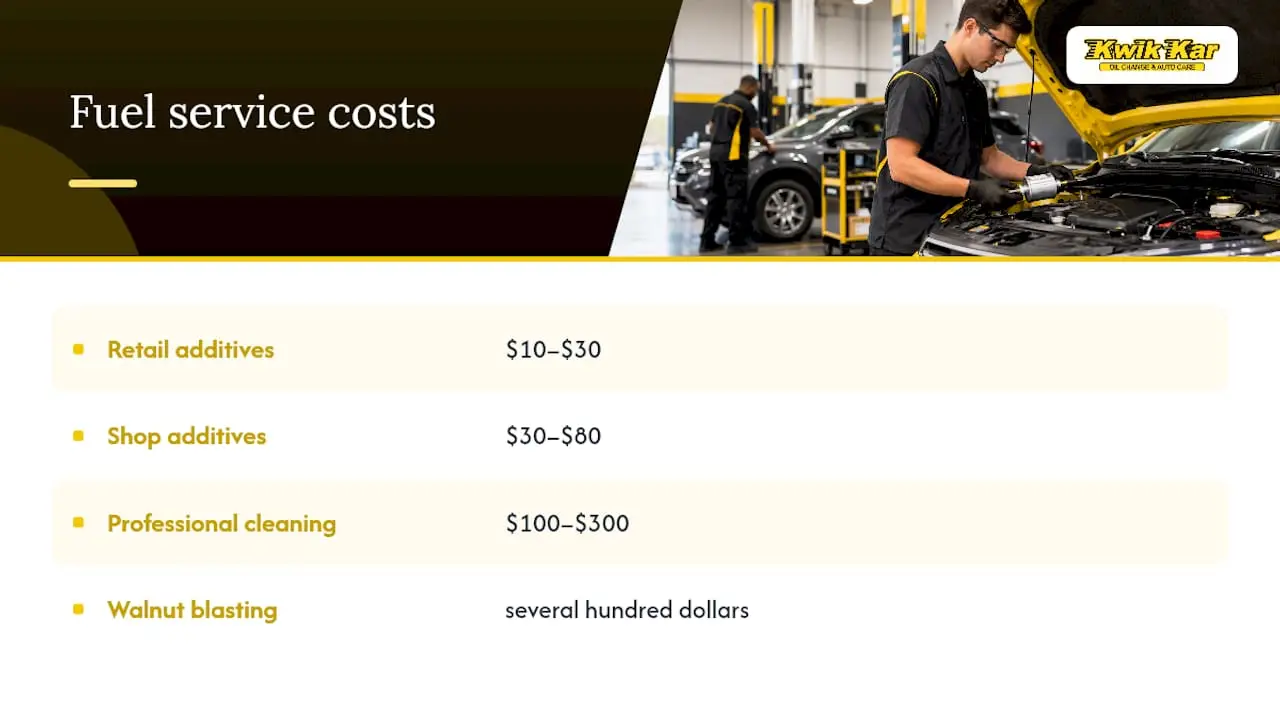
Price tracks pretty closely with how invasive the method is. Retail tank additives typically run $10 to $30 at an auto parts store. Shop-administered additive treatments run higher, roughly $30 to $80, since you’re paying for labor on top of the product.
Professional induction or pressurized injector cleaning generally falls between $100 and $300, depending on the method and how many components get serviced. Walnut blasting for intake valve carbon costs more, often several hundred dollars, because it’s labor intensive and usually requires partial intake disassembly.
A word of caution: a service pitched as a routine, fixed-interval add-on with no diagnostic evidence behind it is rarely a good value. Reputable guidance from automotive publishers generally treats injector cleaning as something you do to correct a documented problem, not something you schedule like an oil change.
How to Decide: A Simple Diagnostic Checklist
Before you approve any fuel system work, walk through this sequence:
- Check your owner’s manual for the manufacturer’s actual maintenance recommendations. Most don’t call for fuel system cleaning on a fixed mileage interval.
- Log your symptoms. Write down when the rough idle happens, how often you notice reduced mileage, or when hesitation shows up. Patterns help a technician narrow the cause.
- Have codes pulled. A scan tool reading takes minutes and tells you whether lean codes, misfire codes, or something unrelated is triggering the check engine light.
- Ask for fuel trim or injector flow data. This is the actual evidence that a fuel delivery issue exists, rather than a guess based on mileage alone.
- Rule out ignition components first. Worn spark plugs or ignition coils cause symptoms that mimic dirty injectors, and they’re cheaper to inspect.
When you talk to a shop, ask directly: What exactly will be cleaned? What test or code supports doing this now? What outcome should I expect, and what happens if symptoms don’t change?
Pro Tip: Be cautious of vague service names on an invoice like “fuel system service” with no breakdown, promises of dramatic MPG gains, or a recommendation made purely because of mileage with no symptoms mentioned. Some experienced technicians openly warn that this service gets oversold more than almost any other maintenance item.
What to Expect From Kwik Kar of Midlothian
The shop relies on certified mechanics who follow a diagnosis-first process for fuel system concerns. That means an inspection, a check for relevant codes, and a plain-language conversation about what those findings mean before any work begins.
You’ll hear what’s being recommended and why, what it’s expected to address, and what your options are, including whether a lower-cost step makes sense before something more involved. That’s the workflow behind every service Kwik Kar of Midlothian offers, whether it’s fuel system work or a routine inspection tied to your regular maintenance schedule.
Gasoline, Diesel, and Ethanol: Does Fuel Type Change the Approach?
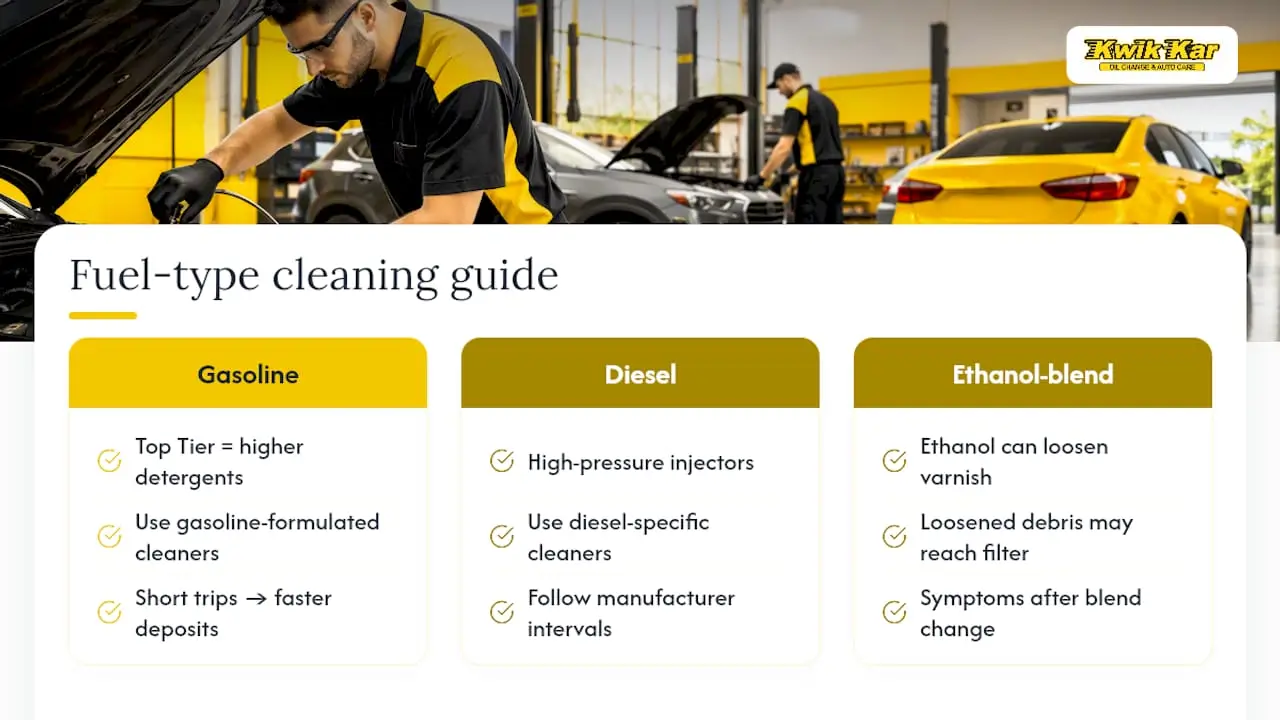
Standard gasoline engines benefit most from routine use of Top Tier gasoline, which contains higher detergent levels than minimum-standard fuel. Vehicles that regularly run on non-Top Tier gas, or that rack up mostly short trips instead of longer highway drives, tend to accumulate deposits faster and are more likely to eventually need corrective cleaning.
Diesel systems work differently. Diesel injectors operate at far higher pressures than gasoline injectors, and the fuel itself behaves differently under heat and injection stress. Diesel-specific cleaners exist for a reason. Using a gasoline-formulated additive in a diesel system isn’t appropriate, and diesel owners should stick to products labeled for diesel use and follow the vehicle manufacturer’s guidance on service intervals.
Ethanol-blended gasoline, common in E10 and increasingly E15 pumps, introduces its own wrinkle. Ethanol can loosen old varnish and residue inside a fuel system that’s built up deposits over years of use, sometimes stirring that debris toward the injectors and filter. This is more of a concern in older vehicles that weren’t originally calibrated for higher ethanol content, or in cars that sit unused for long stretches with ethanol fuel in the tank. If you’re noticing new symptoms after switching fuel brands or blends, that timing itself is a useful diagnostic clue worth mentioning to your mechanic.
Across all three fuel types, the same principle holds: match the cleaner and the method to the fuel system you actually have, and let symptoms and diagnostics, not fuel type alone, drive the decision to treat.
A Candid Note on Upsells
Fuel system cleaning gets oversold more than most maintenance items, often pitched with no symptoms and no evidence behind it. Our position is simple: recommendations should follow diagnostics, not the other way around. If we suggest cleaning, we’ll show you what led us there and walk through your options before touching anything. If you’re not sure whether your car needs it, schedule a diagnostic and let the codes and symptoms guide the conversation.
— Kwik Kar
Ready to Get Your Fuel System Checked?
This shop’s advantage isn’t guessing what your car needs. It pulls codes and checks fuel trims first, so you only pay for work your vehicle actually shows evidence of needing. That diagnosis-first process covers everything from a basic scan to injector flow checks, throttle body service, and intake valve evaluation on GDI engines.

If you’re dealing with a rough idle, lower gas mileage, or hard starts, our service lineup covers the diagnostic work and the cleaning methods that match what your car actually needs, from a simple additive to more involved injector service. Check our current specials before you book, since seasonal offers sometimes apply to maintenance visits. And if it’s been a while since your last checkup, pairing a fuel system inspection with your regular oil change schedule is an easy way to catch small issues early. Give the shop a call or stop by, and they’ll start with a diagnosis, not a guess.
Sources
- Knowing when you need a fuel system cleaner: Signs to watch for — Bell Performance
- Is fuel injection service worth it? — MechanicsRated
- Cars
FAQ
Is a fuel system cleaning worth it?
It’s worth it when you have real symptoms like rough idle, hesitation, or reduced mileage, or when your GDI engine shows signs of intake valve carbon. For a car running fine with no symptoms, routine cleaning generally isn’t necessary.
How much does fuel system cleaning cost?
Retail additives run about $10 to $30, shop-applied additive treatments run $30 to $80, and professional induction or pressurized cleaning typically costs $100 to $300. Walnut blasting for intake valve carbon often costs several hundred dollars due to the labor involved. Current pricing at Kwik Kar of Midlothian is available on our services page.
What does a fuel system cleaning service include?
It typically covers the tank, fuel lines, injectors, and throttle body, with detergents designed to break down varnish and carbon buildup in those areas. On GDI engines with intake valve fouling, a separate walnut blasting procedure may be needed since fuel-based cleaners can’t reach those valves.
How do I know if I need a fuel system cleaning?
Watch for a rough idle, sluggish acceleration, lower fuel economy, or harder starts, then get codes pulled to check for lean or misfire codes before approving any work. A shop that shows you diagnostic evidence, rather than recommending cleaning based on mileage alone, is following the right process.