



Most overheating comes down to a problem in the cooling system: low coolant from a leak, a thermostat that sticks shut, a failing water pump, a clogged radiator, or a fan that does not move air when it should. AAA lists these among the leading reasons a car runs hot. When and where your car overheats tells you a lot about which one it is.
This guide walks through each cause, what the pattern means (at idle, on the highway, with the A/C on, after a coolant flush), what to do the moment the gauge climbs, and what a shop will check.
TL;DR
- Low coolant from a leak is the most common cause. The cooling system is sealed, so coolant that disappears went somewhere.
- Overheating in traffic or at idle often points to the cooling fan, a clogged radiator or low coolant. Overheating at highway speed often points to the thermostat, a restricted radiator or a water pump problem.
- If the gauge reaches the red mark, pull over safely and shut the engine off. Do not open the hood if you see steam, and never open the radiator cap on a hot engine.
- Driving on an overheated engine can lead to a warped cylinder head or a cracked block. Repairs that size cost far more than cooling system maintenance.
- Call us at (972) 775-5945 if your car is running hot. We can inspect the cooling system and explain what we find before any work begins.
Table of Contents
- How your cooling system works
- The most common engine overheating causes
- What the pattern tells you
- What to do the moment your car overheats
- Can you keep driving an overheated engine?
- What a shop checks when your car runs hot
- Our perspective: overheating is usually a maintenance story
- How to prevent overheating
- Overheating service in Midlothian
- FAQ
- Schedule your cooling system check
- Sources
How your cooling system works
Coolant is a mix of water and antifreeze. A pump pushes it through channels in the engine, where it absorbs heat. It then flows to the radiator, where airflow (from driving or from the fan) carries the heat away. AAA describes this loop as a closed system, which is why low coolant means a leak.
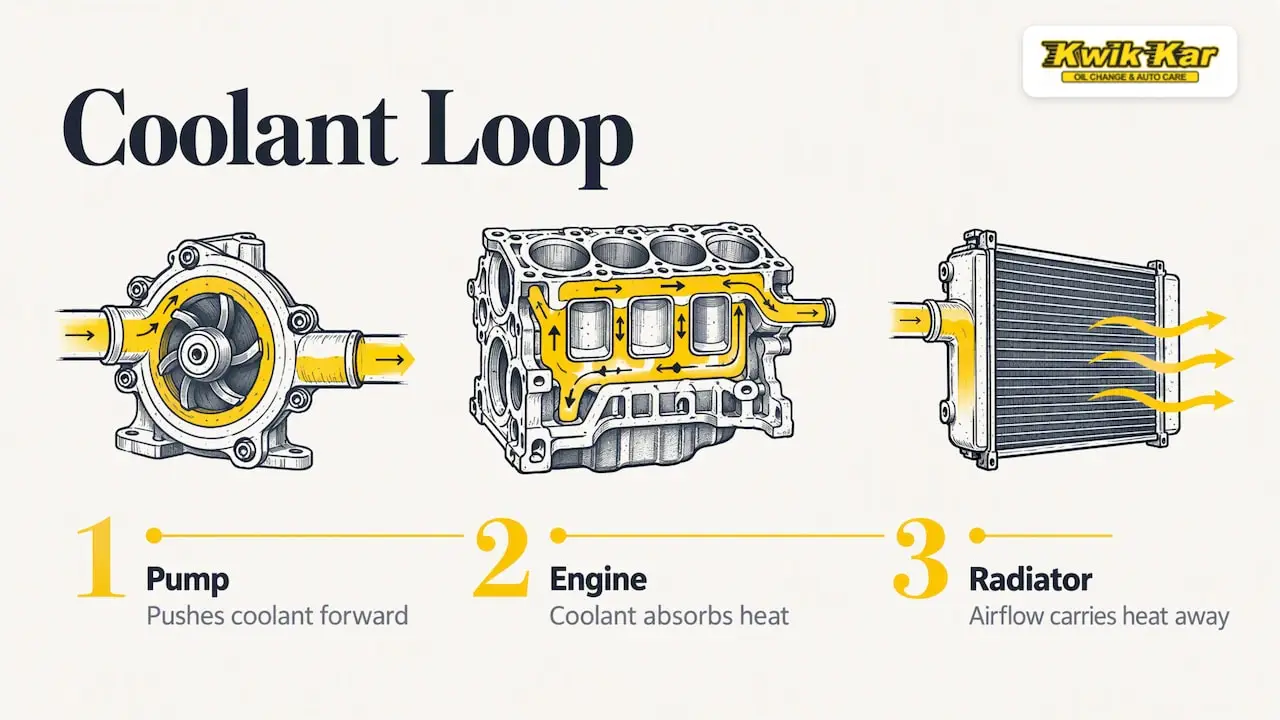
A thermostat controls how much coolant flows, a pressurized cap raises the boiling point, and hoses and belts connect and drive everything. When any one part fails, heat builds faster than the system can remove it.
That is why overheating is rarely a mystery once you know the pattern. Each part fails in its own way.
The most common engine overheating causes
1. Low coolant
This is the first thing to suspect. Coolant levels drop through a leaking hose, a weeping radiator, a worn water pump seal, a bad radiator cap or, in the worst case, a failing head gasket.
Top off the reservoir only when the engine is cold, and treat a refill as a temporary measure. If the level drops again, there is a leak that needs to be found.
A puddle under the car can help. The FTC notes that yellowish-green, pastel blue or fluorescent orange fluid often means a coolant leak, while clear water is usually just condensation from the A/C. Water dripping under the car on a hot day is normal. Brightly colored fluid is not.
2. A thermostat stuck closed
The thermostat opens when the engine reaches operating temperature, letting coolant reach the radiator. If it sticks closed, coolant stays in the engine and temperature climbs quickly, often within minutes of a drive. The upper radiator hose may feel very hot while the lower one stays cooler.
This cause tends to show up at any speed, not just in traffic. It is a relatively inexpensive part, but the damage from ignoring it is not.
3. A failing water pump
The water pump circulates coolant. Bearings wear, seals leak and impellers corrode. Signs include coolant dripping near the front of the engine, a whining or grinding noise, and a temperature gauge that rises even though the coolant level looks fine.
Because a belt usually drives the pump, a loose or broken belt causes the same symptom.
4. A clogged or leaking radiator
Over time, corrosion and mineral deposits can narrow the radiator’s passages so coolant cannot shed heat. Outside, bugs, leaves and road debris can block airflow. A radiator with a leak loses coolant, and one with an internal restriction runs hot even though it is full.
Our radiator and cooling system repair page explains what we inspect and service.
5. Cooling fan problems
At highway speed, air is forced through the radiator. In traffic, the fan has to do that job. If the fan motor, relay, fuse or temperature sensor fails, the engine may be fine on the open road and then overheat when you slow down. If this sounds like your car, read our guide on what to check when a cooling fan won’t run.
6. Worn belts and damaged hoses
A slipping or broken serpentine belt can stop the water pump. A hose that is cracked, brittle or swollen can leak or collapse. The Car Care Council and AAA recommend inspecting hoses and belts for cracking and brittleness at every oil change, which is one of the easiest ways to catch trouble early.
7. A bad radiator cap
The cap holds pressure in the system, and pressure raises the coolant’s boiling point. A cap with a worn seal lets pressure escape, so coolant boils at a lower temperature and may be pushed into the overflow reservoir. It is a small part with a large job.
8. A blown head gasket
The head gasket seals the combustion chambers from the coolant passages. If it fails, hot combustion gases can push into the coolant, or coolant can leak into the cylinders or oil. Warning signs include white exhaust smoke, a milky look on the oil filler cap, coolant that disappears with no visible leak, and bubbling in the reservoir.
A head gasket is often the result of overheating, not just the cause. This is another reason to stop driving as soon as the gauge climbs.
What the pattern tells you
You can narrow things down by noticing when your car runs hot. This table gives likely suspects, not a diagnosis. A shop confirms with a pressure test and inspection.
| When it overheats | Likely suspects |
|---|---|
| At idle or in stop-and-go traffic | Cooling fan, fan relay or sensor, low coolant, clogged radiator |
| At highway speed | Thermostat, restricted radiator, water pump, low coolant |
| Only with the A/C on | Fan not working, radiator or condenser blocked with debris, marginal cooling system |
| In summer heat or on hills | Marginal cooling system that has little reserve, low coolant, aging coolant |
| Soon after a coolant flush | Air trapped in the system, wrong coolant fill, a thermostat or hose disturbed during service |
| Constantly, even with full coolant | Thermostat, water pump, head gasket, internal radiator restriction |
Overheating at idle or in traffic
When the car is stationary, nothing pushes air through the radiator except the fan. If the gauge climbs at a stoplight and drops when you move, the fan is the first suspect. Low coolant and a partly clogged radiator also show up this way.
Overheating with the A/C on
The A/C adds heat in front of the radiator, because the condenser sits there, and it adds load on the engine. A cooling system that is only just coping may tip over. Turning the A/C off, as Honda’s owner guidance suggests, reduces the load. If your A/C also has issues, our guides on A/C that blows cold then warm and low refrigerant symptoms may help.
Coolant boiling in the reservoir
Bubbling or boiling in the overflow tank means the coolant is hotter than the system can handle or that combustion gas is entering it. Common causes are a weak radiator cap, a stuck thermostat, a blocked radiator or a head gasket leak. Do not open the cap or the reservoir while it is hot. If the reservoir is boiling, the engine is already too hot to keep driving.
Overheating after a coolant flush
After a flush or any cooling repair, air can stay trapped in the system. An air pocket near the thermostat or sensor can keep coolant from circulating, and the gauge climbs even though the level seems right. The wrong coolant type or mix can also cause trouble. If your car runs hot soon after service, go back to the shop that did the work and have them check it, and do not keep driving it.
What to do the moment your car overheats
Safety comes first. Your car is hot, the coolant is under pressure and the people in it matter more than the engine.
- Turn off the A/C and, if it is safe, turn on the heater. This moves some heat away from the engine. You will be uncomfortable, but it can buy you a minute or two to reach a safe spot.
- Pull over as soon as you safely can. Choose a flat, safe shoulder or parking lot. The U.S. Fire Administration advises pulling over immediately and turning the engine off if you see steam or spray.
- Keep everyone away from the vehicle. The same guidance recommends staying at least 100 feet away if there is steam, smoke or fire.
- Do not open the hood if you see steam or smoke. It can cause a flare-up or serious burns.
- Never remove the radiator cap on a hot engine. Honda’s owner materials warn that steam and boiling coolant are under extreme pressure. Wait until the engine is fully cool, and use a thick cloth or gloves.
- If there is fire, call 911. Do not go back for belongings.
A hill is different from a breakdown
Honda’s guidance says the gauge can rise a little on a long, steep hill on a very hot day. If you see no steam or spray, turning off the A/C and accessories and idling in park or neutral can help the engine shed heat. If the gauge does not drop to the midpoint after a short time, shut the engine off. If it hits the red, treat it as a stop-now warning.
Can you keep driving an overheated engine?
No. Honda’s owner guidance treats a gauge at the red mark as a reason to stop, because persistent high temperatures can lead to engine damage such as a warped cylinder head or a cracked block. Those are the repairs that turn a modest cooling fix into a major one.
It is the same principle as other vehicle problems that feel survivable until they are not. If you are weighing whether to keep driving with damage, our friends’ guide on driving with a cracked windshield works through the same stop-or-drive question for glass.
Once the engine is cool, check the coolant level only if you can do so safely and the car is on level ground. If it is low, you may add coolant to reach a shop, but the leak is still there. Towing is often the smarter choice than a drive that risks the whole engine.

What a shop checks when your car runs hot
A good diagnosis follows the evidence and does not start by replacing parts. Here is the usual order:
- Visual inspection of hoses, belts, radiator, cap, water pump area and the ground under the car for leaks.
- Coolant condition and level, including color and signs of oil or rust contamination.
- Cooling system pressure test to find leaks that only appear under pressure.
- Radiator cap test to confirm it holds the right pressure.
- Fan operation check to see whether the fan turns on at the right temperature.
- Thermostat check to confirm it opens and the radiator heats up evenly.
- Further testing for combustion gases in the coolant if a head gasket is suspected.
We explain what we find and what we recommend before repairs, so you can decide with the facts in front of you.
Our perspective: overheating is usually a maintenance story
When a car comes in overheated, the cause is most often something that gave warning earlier: a seeping hose, coolant that has been low for months, a belt with visible cracks, a fan that stopped working on a mild day and nobody noticed. Our ASE-certified mechanics see the same pattern repeatedly. The cooling system is quiet until it is not.
The Car Care Council notes that cooling system failure is a leading cause of breakdowns and that a routine flush costs far less than the damage a neglected system can cause. We agree with that, and in our experience the cheapest overheating repair is the one done before the gauge moves.
Our approach is simple. We look at the whole system, tell you plainly what we see, and recommend only what the evidence supports. If your car just needs coolant service, we will say so. If a hose or the water pump is the problem, we will show you why.
— Kwik Kar
How to prevent overheating
- Check coolant regularly, with the engine cold, and follow your owner’s manual for the right type and change interval.
- Replace coolant on schedule. AAA and the Car Care Council are cited as recommending a flush and coolant replacement roughly every two years to limit corrosion, though your owner’s manual sets the interval for your vehicle.
- Inspect hoses and belts at every oil change. Look for cracks, bulges, soft spots and shiny, glazed belts.
- Watch for drips and smells. A sweet smell or bright fluid under the car deserves attention.
- Keep the radiator front clean. Debris between the condenser and the radiator reduces airflow.
- Pay attention to the gauge. If it sits higher than normal, even without reaching red, have the system checked.
- Mention overheating to the shop after any cooling work, especially a flush, so air trapped in the system does not go unnoticed.
Texas summers are hard on cooling systems, and a system with little reserve is the one that fails in July traffic. A check before the heat is easier than a tow in it.
A note on the check engine light
A hot engine can set off warning lights, and a check engine light can point to related problems. In Ellis County, where Midlothian is located, gasoline vehicles between 2 and 24 years old get an emissions test as part of the Texas inspection. That is an emissions requirement, and it is not the same thing as a safety inspection. Fix overheating and any warning lights before your test, since a car that is running poorly is not a good candidate for one.
Overheating service in Midlothian
If your car is running hot, drifting toward the red, or losing coolant, we can inspect the cooling system and walk you through the results. Our radiator and cooling system service covers inspection and repair, and our full list of services includes fluid exchanges, belts and hoses, and A/C work, all of which can affect how your engine handles heat. If your oil smells hot or you see smoke, our guides on burning oil smell and blue smoke on startup may also help you describe symptoms.
FAQ
What is the most common reason for an engine to overheat?
Low coolant is the most common, and it usually means a leak somewhere in the system. Thermostat failure, a bad water pump, a damaged radiator and a faulty fan follow closely. AAA places coolant issues first on its list of causes.
Why does my car overheat at idle but not when driving?
At idle, nothing pushes air through the radiator except the fan. If the fan is not working, or the radiator is partly blocked, the temperature climbs when you stop and falls when you move. Low coolant can show the same pattern, so have it checked rather than guessing.
Is it OK to drive if the engine overheats?
No. Pull over safely and shut the engine off. Continuing to drive with the gauge in the red can cause costly damage such as a warped cylinder head or cracked block. Wait for the engine to cool, and consider a tow.
Can I add water instead of coolant?
In an emergency, adding water to a cool engine may get you to a shop, but it dilutes the coolant and does nothing to fix the leak. Never open a hot radiator cap to add it. Have the system checked and filled with the type your manufacturer specifies.
Schedule your cooling system check
A car that runs hot is telling you something. Call us at (972) 775-5945 to schedule a cooling system inspection, and we will help you find the cause before it becomes an engine repair.
Sources
- Car Overheating: 8 Causes and Solutions, AAA
- Vehicle Fire Safety, U.S. Fire Administration
- If Your Engine Overheats, Honda owner’s manual
- If Your Engine Overheats, Honda owner’s manual (gauge and engine damage)
- Motorist Checklist for Fall Car Care Month, Car Care Council
- Auto Repair Basics, Federal Trade Commission
- Inspection Criteria for Emission Inspection, Texas DPS