




A burning oil smell most often means engine oil is reaching hot components, usually the exhaust manifold or pipes, and vaporizing into an acrid odor, according to Garageboy’s breakdown of common causes. Check your dipstick first, and stop driving if the level is dangerously low or you see thick smoke. If the smell followed a recent oil change, it’s often just spilled oil burning off over a few drives. A recurring smell with no service history points to an active leak that needs a look.
TL;DR:
- Blue or gray tailpipe smoke points to oil burning inside the engine, while thin vapor without smoke usually signals an external leak.
- Stop driving and arrange a tow if you see visible smoke, an oil pressure warning, or a dipstick reading near empty.
- With the engine cool, check the dipstick and inspect the valve cover, filter housing, oil pan, and heat shields for fresh, wet oil.
- If fumes build inside the cabin, switch off recirculation, bring in outside air, and crack a window; children and people with asthma may react sooner.
- When a leak is hard to see, mechanics can add ultraviolet dye to the oil and use a special light to trace its source.
Table of Contents
- What Causes a Burning Oil Smell
- Reading the Smell: Timing, Smoke Color, and Location
- Quick Self-Check Before You Head to a Shop
- What a Mechanic Checks and Repairs
- Preventing Burning Oil Smells Down the Road
- Does Burning Oil Smell Affect the Air Inside Your Car
- Gasoline vs Diesel: Does the Smell Differ by Engine Type
- What We Look for First at Kwik Kar Midlothian
- Get Your Burning Oil Smell Diagnosed the Right Way
- FAQ
- Sources
What Causes a Burning Oil Smell
Most burning oil smells trace back to oil escaping its normal path and landing on something hot. A few spots cause this more than others.
- Valve cover gasket: This gasket sits on top of the engine and seeps oil slowly, so you often get the smell without ever seeing a puddle underneath the car.
- Oil filter housing: A loose drain plug or a filter that wasn’t seated right during your last service can leak oil onto nearby exhaust parts, which is why the smell sometimes shows up right after an oil change.
- Oil pan or front main seal: Leaks lower on the engine tend to drip onto the exhaust pipe or catalytic converter rather than the manifold, so the smell can feel like it’s coming from under the car instead of the engine bay.
- PCV system problems: A clogged or failing PCV valve raises pressure inside the crankcase, which can push oil past seals and gaskets that would otherwise hold tight.
- Overfilled oil or spilled oil during service: Neither of these points to a mechanical failure. Excess oil can splash onto hot surfaces, and a careless top-off during a service visit does the same thing without any damage behind it, as Garageboy notes.
Worn piston rings or valve seals can also let oil burn inside the engine itself, which usually shows up as blue exhaust smoke rather than an outside leak.
Reading the Smell: Timing, Smoke Color, and Location
The smell often shows up after about 10 minutes of driving, once the engine and exhaust system have had time to heat up enough to vaporize any oil sitting on them. Where the smell seems to come from, and what color smoke comes with it, tells you a lot.
- Blue or gray smoke from the tailpipe usually means oil is burning inside the engine, which is a more serious internal issue.
- A thin, acrid vapor with no smoke usually points to an external drip landing on a hot surface, according to the smell and smoke matrix in Howtofixcar.
- Smell coming through the vents suggests oil near the intake or front of the engine, while a smell noticed mainly outside or under the car points toward the pan or exhaust.
- A closed garage turns a minor leak into a bigger risk, since oil vapor near hot exhaust in an enclosed space raises fire risk, a point Garageboy flags directly.
Stop driving and call for a tow if you notice visible smoke, an oil pressure warning light, or a dipstick reading near empty. Those are the conditions Garageboy lists as red flags that mean the car shouldn’t move under its own power.
Quick Self-Check Before You Head to a Shop
A few minutes of careful checking can save you a diagnostic fee and give your mechanic a head start. Let the engine cool first, and never do this inside a closed garage.
- Pull the dipstick and check the level against the markings, noting how much you’ve had to add recently.
- Look around the valve cover, filter housing, oil pan, and heat shields for fresh, wet oil rather than old grime.
- Watch the exhaust at startup and again under load for smoke color, and think back to whether the smell started right after an oil change.
- Write down what you find: the date, how much oil you topped up, and when the smell shows up during a drive.
Pro Tip: Snap a photo of any wet spots you find before wiping them clean. A tech can often narrow down the source faster with a picture than with a verbal description.
What a Mechanic Checks and Repairs
A shop visit usually starts with a visual inspection, then moves to more precise tools if the leak isn’t obvious. Technicians often rely on UV dye added to the oil, which glows under a special light and reveals slow leaks that leave no visible puddle.
- UV dye and a black light to trace oil back to its exact source.
- A PCV system check to see if crankcase pressure is pushing oil past seals.
- A test drive to reproduce the smell under the same conditions you described.
- Common repairs include replacing the valve cover gasket, resealing the oil filter housing, swapping a cracked PCV valve or hose, or replacing the oil pan gasket.
Mechanics also compare your oil consumption and service dates to tell a one-time spill from an ongoing leak. If your oil level was fine and the smoke was thin with no warning lights, a short drive to the shop is usually safe. Thick smoke, a near-empty dipstick, or a dash warning light calls for a tow instead.
Preventing Burning Oil Smells Down the Road
Most of what causes this smell is preventable with routine attention.
- Stick to your recommended oil-change interval rather than stretching it, since fresh gaskets and properly torqued fittings are less likely to seep. Our guide to oil-change intervals in Midlothian breaks down how to set that schedule.
- Ask your technician to coat the filter gasket and torque the drain plug every time, since these are the most common spots for a post-service leak.
- Replace a cracked or brittle PCV valve or hose as soon as you notice it, since a failing PCV system raises the odds of an external leak.
- Keep a simple log of oil top-ups and service dates so you can spot a pattern before it becomes a bigger repair.
Does Burning Oil Smell Affect the Air Inside Your Car
Oil vapor that drifts through the intake or heater vents does more than create an unpleasant smell. Breathing in fumes from burning oil over a long drive can leave you with a mild headache or a scratchy throat, especially in a car with the windows up and the recirculation setting on.
The concentration you’re exposed to in a passenger cabin during a short commute is generally much lower than what a technician working directly over an open engine bay might encounter, but repeated exposure on long trips is still worth avoiding. If you notice the smell strengthening inside the cabin rather than fading, switch your ventilation to pull in outside air instead of recirculating, and crack a window if you’re stuck in traffic with the odor building.
Kids and anyone with asthma or other respiratory sensitivities tend to notice the effects of oil fumes sooner than other passengers, so treat a smell that’s noticeably stronger inside the car than outside it as a reason to get the leak looked at soon rather than waiting. This is also where a cabin air filter check can help, since a clogged filter can let more outside fumes through than usual. If you’ve dealt with an unrelated cabin odor before, our guide to tracking down an air conditioning smell walks through a similar room-by-room approach to isolating where an odor is actually coming from.
Gasoline vs Diesel: Does the Smell Differ by Engine Type
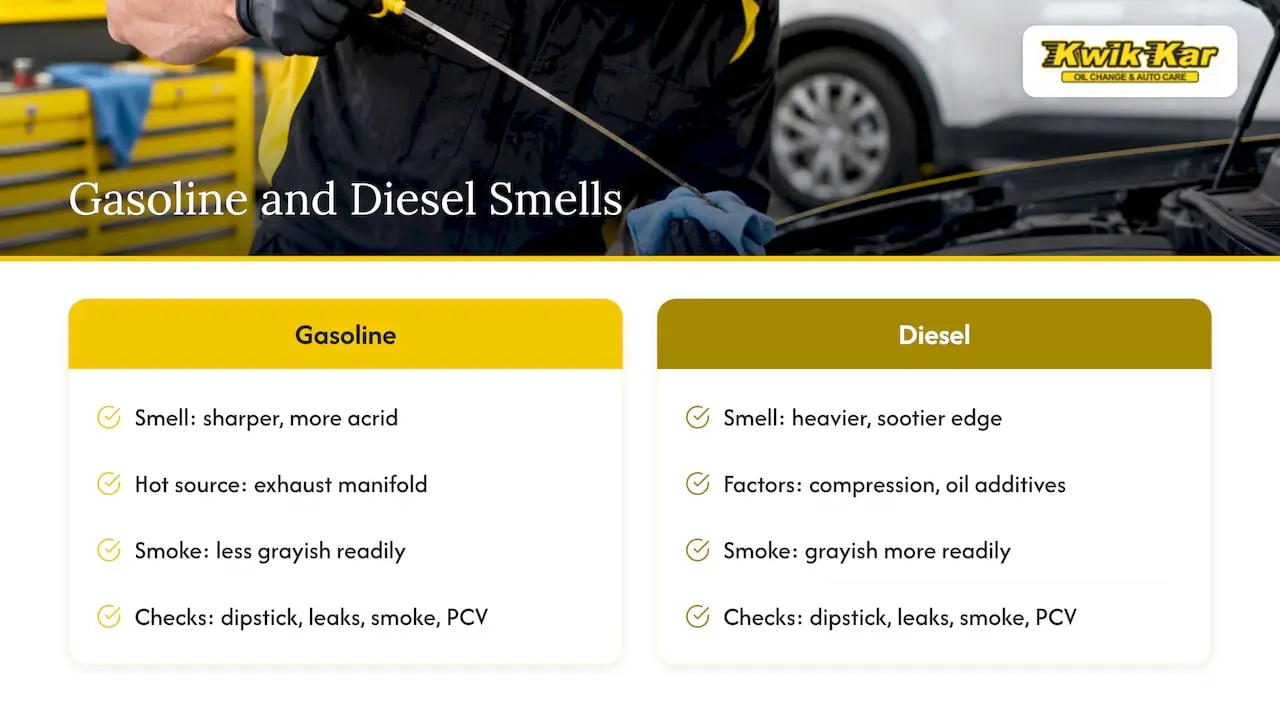
Both gasoline and diesel engines produce a burning oil smell the same basic way: oil contacts a hot surface and vaporizes. The exhaust temperatures and oil formulations involved give each a slightly different character.
Gasoline engines tend to produce a sharper, more acrid smell when oil hits the exhaust manifold, since gasoline exhaust systems run hot close to the engine. Diesel engines often run with higher compression and different oil additive packages, which can give a burning oil smell a heavier, slightly sootier edge, especially if the smell is coming from oil mixing with diesel exhaust rather than sitting purely on a hot pipe.
In either case, the diagnostic approach is the same: check the dipstick, look for visible leaks around the valve cover and filter housing, and pay attention to smoke color. A diesel engine burning oil internally tends to show grayish smoke more readily than a gasoline engine under the same conditions, simply because diesel exhaust already carries more visible particulate. That difference is more about what you see in the tailpipe than about where you should look for the leak itself, and the same gasket, seal, and PCV checks apply regardless of engine type.
What We Look for First at Kwik Kar Midlothian
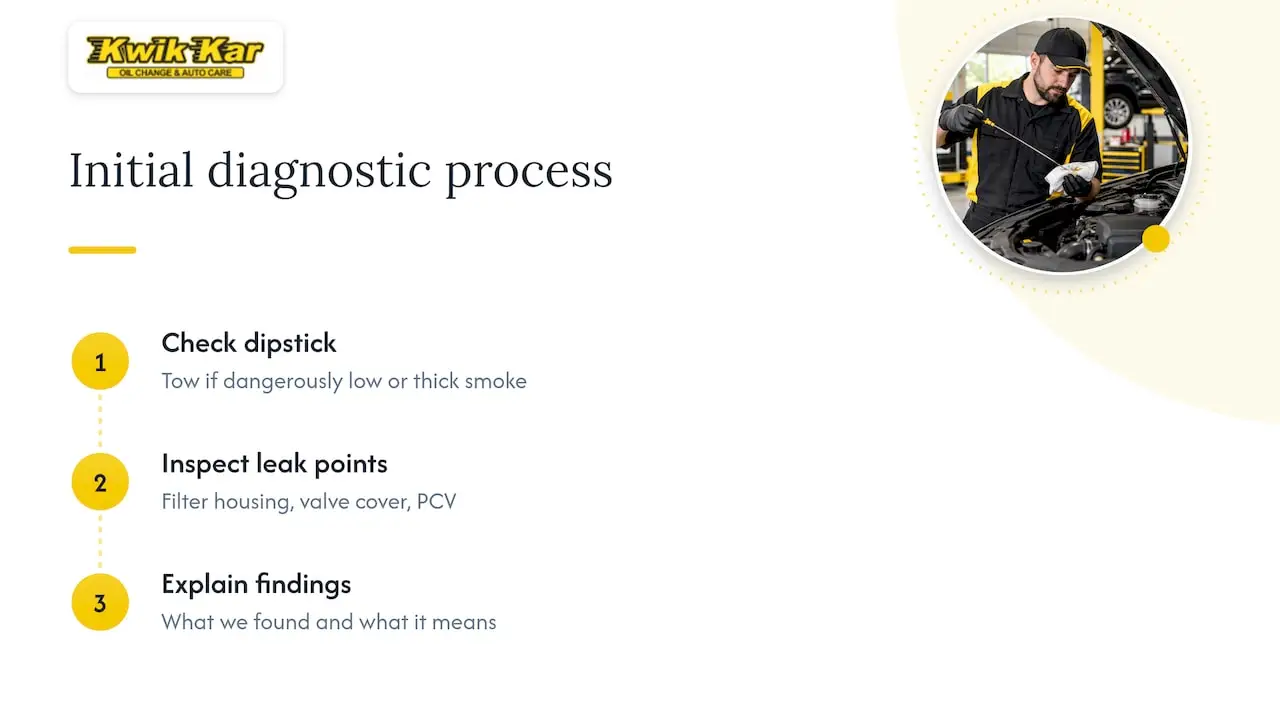
When a car comes in with a burning oil smell, we start exactly where we’d tell you to start: the dipstick. If the level is dangerously low or there’s thick smoke, we recommend stopping and arranging a tow rather than risking the drive in.
From there, our mechanics check the filter housing, valve cover, and PCV system for signs of a leak before looking anywhere else. We walk you through exactly what we found and what it means for your car, so you’re never guessing at the next step.
— Kwik Kar
Get Your Burning Oil Smell Diagnosed the Right Way
A burning oil smell that keeps coming back deserves a proper look rather than a guess, and that’s where our team comes in. We handle diagnostic and repair work this kind of smell usually calls for.

- Oil change and leak diagnosis to pinpoint whether you’re dealing with a spill, an overfill, or an active leak.
- Gasket replacement for valve covers, oil pans, or filter housings showing wear.
- PCV system service when crankcase pressure is pushing oil past seals.
- General maintenance and repair for anything else the inspection turns up.
Bring in your notes on when the smell shows up, any oil you’ve added, and receipts from your last service if you have them. It gives us a faster start on finding the source. Browse our full list of services or head straight to our oil change and preventive maintenance page to schedule a visit, or just contact us and we’ll get you on the schedule.
FAQ
What does it mean when you smell burnt oil?
It usually means oil has found its way onto a hot part of the engine, most often the exhaust manifold, and is vaporizing into an acrid odor, as Garageboy explains. Common sources include a seeping valve cover gasket, a loose oil filter housing, or oil spilled during a recent service.
Can I still drive my car if it smells like burning oil?
A short, careful drive to a shop is usually fine if your oil level is adequate and you don’t see thick smoke or warning lights. Stop driving and arrange a tow if the dipstick reads dangerously low or you notice heavy smoke, since those are signs the issue needs immediate attention rather than a drive-in visit.
How do I fix a burning oil smell?
The fix depends on the source: a seeping valve cover gasket, filter housing seal, or oil pan gasket typically needs replacement, while a PCV valve or hose that’s cracked needs swapping out. If the smell followed a recent oil change and your level is fine, it may just be spilled oil burning off over a few drives rather than something that needs repair.
Is burning oil smell bad for you?
Breathing in oil fumes over a long drive can cause mild symptoms like a headache or scratchy throat, particularly with the windows up and recirculation on. Switching to outside air and getting the leak checked sooner rather than later helps limit how much you and your passengers are exposed to it.
How long does a burning oil smell last after an oil change?
A smell from oil spilled during a service typically fades within a few drives as the residue burns off, according to discussion among mechanics on this exact question. If the smell is still there after several trips, or it comes and goes, that pattern points to an active leak rather than leftover spill.
Sources
- Why Does My Car Smell Like Burning Oil? Causes and Fixes (2026)
- Howtofixcar
- If you smell burning oil, should you continue to use your vehicle?