



A P0420 code means your car’s computer has decided the catalytic converter is not cleaning the exhaust as well as it should. The official wording is Catalyst System Efficiency Below Threshold (Bank 1). It does not always mean the converter itself has failed. A worn oxygen sensor, an exhaust leak or an engine problem upstream can set the same code.
This guide explains what the code says, which symptoms to watch for, what usually causes it, whether you can keep driving, and how a good shop finds the real problem before you spend money on parts.
TL;DR
- P0420 means the catalyst system on bank 1 is converting exhaust pollutants less efficiently than the computer expects.
- The converter is only one possible cause. Oxygen sensors, exhaust leaks, misfires and fuel or oil problems can all trigger it.
- A steady Check Engine light means get it checked soon. A flashing light means reduce driving to a minimum.
- An unresolved P0420 is likely to cause a failed emissions test where emissions testing applies.
- Ask for a diagnosis before a converter replacement. Replacing the part without finding the cause can lead to a repeat failure.
Table of Contents
- What the P0420 code means
- Symptoms of a P0420 code
- Common causes of P0420
- Can you drive with a P0420 code?
- P0420 and your emissions test
- How a shop diagnoses P0420
- What does a P0420 repair cost?
- Preventing a repeat P0420
- Our perspective: diagnose first, replace second
- Check engine light diagnostics in Midlothian
- FAQ
- Sources
What the P0420 code means
P0420 is a generic OBD-II code, so it has the same meaning on most gasoline vehicles built since 1996. Your car has two oxygen sensors on each exhaust bank. One sits before the catalytic converter (upstream) and one sits after it (downstream).
The upstream sensor switches rapidly as the engine adjusts the fuel mixture. The downstream sensor should read much steadier, because a working converter stores and uses oxygen as it cleans the exhaust. When the downstream signal starts to look too much like the upstream one, the computer concludes the converter is not doing its job and stores P0420.
Two parts of the name are worth knowing:
- Bank 1 is the side of the engine that holds cylinder number one. On a four-cylinder engine there is only one bank, so it simply refers to the whole engine.
- Below threshold means the efficiency reading fell under the limit the manufacturer set. It does not tell you how far below, or why.
A related code, P0430, is the same test on bank 2, which exists on V6 and V8 engines.
Symptoms of a P0420 code
Many drivers notice nothing except a light on the dash. AutoZone notes that the Check Engine light is often the first sign and that the car may drive normally. When symptoms do appear, they usually look like this:
- Check Engine light. This is the most common and sometimes the only symptom. It is steady in most P0420 cases.
- Lower fuel economy. If the cause is an engine or sensor problem, you may fill up more often than usual.
- Reduced performance. Edmunds lists reduced engine performance among the symptoms. A restricted converter can feel like weak acceleration, and UnderhoodService explains that a severely restricted one can even make the engine stall.
- Sulfur or rotten-egg smell. This smell from the exhaust is another sign Edmunds lists.
- Emissions test failure. Often this is how drivers first learn about the problem.
If you also notice rough idle or hesitation, mention it when you book. Those details help the technician narrow down the cause.
Common causes of P0420
The converter itself does wear out, but it is not the only suspect. AutoZone’s guide to P0420 lists a range of possible causes, including:
- A damaged or failed oxygen sensor
- Damaged wiring or connectors on an oxygen sensor
- Leaks or damage in the converter, exhaust manifold, muffler or exhaust pipe
- Retarded spark timing or a cylinder misfire
- Oil contamination
- High fuel pressure or a leaking fuel injector
- A faulty engine coolant sensor
Several of these point back to the engine, not the exhaust. Misfires dump unburned fuel into the converter. Burning oil coats the catalyst. A coolant sensor that reads wrong can make the engine run rich. Vehicle Service Pros notes that replacing a converter without fixing upstream problems such as misfires or oil burning can lead to the new one failing too.
If you have been noticing oil trouble, these two pages help you check: a burning oil smell and blue smoke on startup. Either one can be connected to a converter that has been contaminated.
Companion codes tell a story
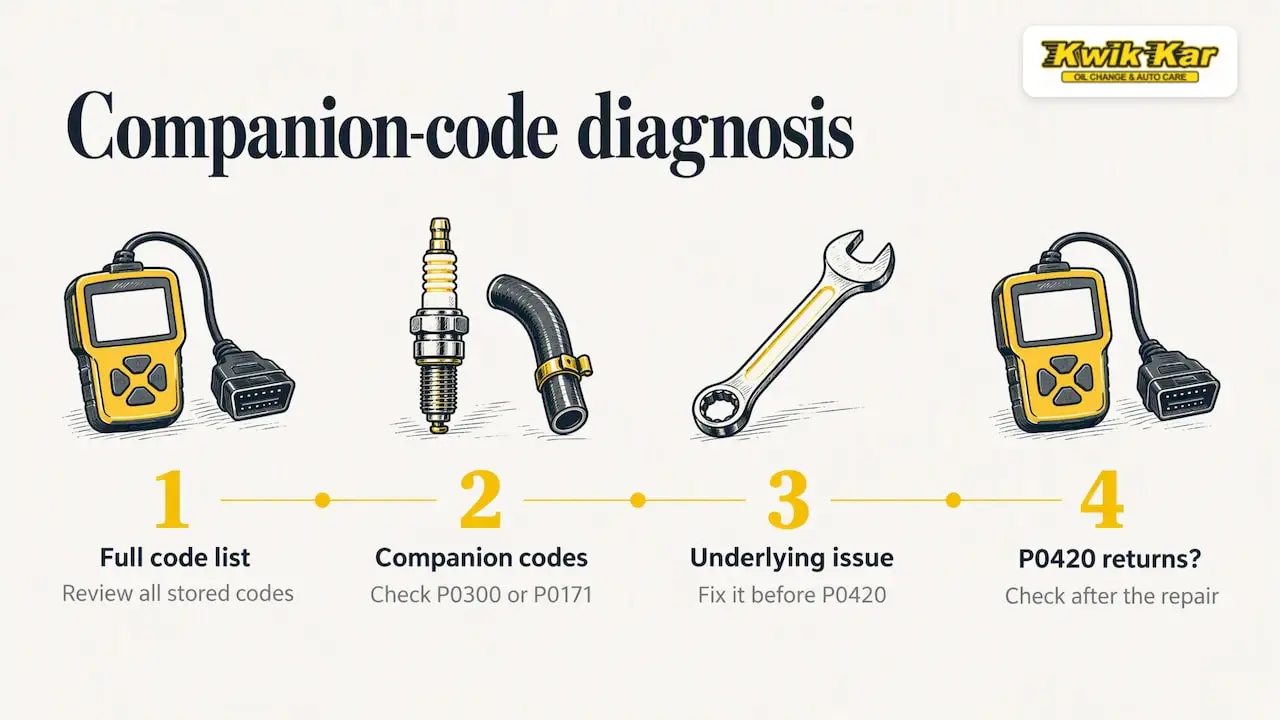
P0420 rarely tells the whole story alone. If the scan also shows a misfire code such as P0300, or a lean code such as P0171, the catalyst code may be a symptom of the bigger issue. Fix that first, then see whether P0420 returns. Always ask for the full list of stored codes, not only the one that triggered the light.
Aftermarket exhaust parts
If your vehicle has a performance downpipe, a catalytic converter delete or other exhaust changes, P0420 is a common result because the sensors no longer see what the computer expects. Owners of modified performance cars can read this check engine light after a downpipe checklist, which covers comparing oxygen sensor readings to judge how the catalyst is performing.
Can you drive with a P0420 code?
Short-term, usually yes. Edmunds says short-term driving may be possible, but it advises against driving for an extended period and recommends prompt attention. The EPA’s guidance for drivers explains the difference between the two types of warning light: a steady malfunction light generally means the vehicle should be serviced soon, while a blinking light can indicate a severe misfire that damages the catalyst and calls for keeping time on the road to a minimum.
Here is a practical way to think about it:
- Steady light, car drives normally: Schedule a diagnosis in the next few days. Avoid long trips or heavy towing until you know the cause.
- Flashing light, shaking or loss of power: Slow down and get the car checked right away. A misfire can overheat and ruin the converter.
- Rotten-egg smell or sluggish acceleration: Do not wait. A clogged converter can make the engine work harder and may cause stalling.
Waiting also has a cost. The EPA explains that onboard diagnostics are designed to catch small problems such as a faulty oxygen sensor early, before they lead to costlier damage like complete converter failure. A sensor is usually a smaller repair than a converter.
P0420 and your emissions test
Because the code is about emissions, it matters at inspection time. Edmunds says that in regions with strict emissions testing, an unresolved P0420 is likely to fail the test. A lit Check Engine light with a stored catalyst code is generally enough to fail a plug-in OBD-II test.
In Texas, it helps to keep two ideas separate:
- Emissions testing checks how clean your vehicle’s exhaust system is. It applies to gasoline vehicles in certain counties, and the requirement depends on where the vehicle is registered.
- Safety inspections are a different matter. Ordinary passenger vehicles do not have an annual Texas safety inspection requirement. Safety inspections apply to certain commercial vehicles.
If you are unsure which rules apply to your vehicle, check with your county tax office or the Texas Department of Public Safety. Our Texas emissions and commercial inspections page explains what we handle. If your light is on, get the cause diagnosed and fixed before you go for the test, so the visit is not wasted.
How a shop diagnoses P0420
A scan tool reads the code, but the code is where the diagnosis starts, not where it ends. A thorough process looks like this, based on how Vehicle Service Pros describes the diagnostic approach:
- Review the history and all stored codes. Past repairs, other codes and how long the light has been on all matter.
- Check freeze-frame data. This is a snapshot of engine conditions at the moment the code set.
- Look at monitor test data. Professional scan tools show how close the catalyst test came to passing, which helps tell a marginal converter from a failed one.
- Check for software updates and bulletins. Some manufacturers publish fixes for specific models. One example is a Hyundai bulletin for certain Sonata models that calls for an engine computer update and catalyst replacement when P0420 is present.
- Inspect the exhaust for leaks. A leak between the engine and the downstream sensor can let in outside air and fool the sensor.
- Test the oxygen sensors. On live data, the upstream sensor should switch quickly while the downstream one stays comparatively flat. If the two look alike, the converter is probably not storing oxygen as it should.
- Rule out engine causes. Misfires, fuel trim problems and oil consumption need to be dealt with before a new converter goes on.
Only after those steps does it make sense to condemn the converter. That order protects you from paying for a part you did not need.
What does a P0420 repair cost?
There is no single number, because the repair depends entirely on the cause. Edmunds gives no price figure for the same reason. A loose exhaust connection, a replaced oxygen sensor, a spark plug and ignition repair and a new converter are very different jobs.
What you can control is the order of the work:
- Ask for the diagnosis findings in plain terms before approving any repair.
- Ask which parts are being replaced and why.
- Ask whether other codes or engine conditions could damage a new converter.
- Check your paperwork. Some emissions parts may be covered by a manufacturer or federal warranty depending on your vehicle’s age and mileage, so look before you pay.
We do not publish repair prices online, and we will not quote a number before we have looked at your vehicle.
Preventing a repeat P0420
You cannot make a converter last forever, but you can avoid the things that shorten its life:
- Keep up with oil changes. Oil that burns in the engine can foul the catalyst. Our guide on how often to change your oil can help you set a schedule.
- Replace spark plugs on schedule. A tune-up helps prevent the misfires that overheat converters.
- Do not ignore a flashing light. That one is urgent.
- Watch the fuel system. Injector and fuel pressure problems can send extra fuel into the exhaust. See our page on fuel system cleaning needs.
- Watch for overheating. An engine that runs hot can cause damage that leads to more problems. Read about engine overheating causes.
For a longer list of habits, see 12 habits that extend the life of your car.
Our perspective: diagnose first, replace second
When a customer comes in with a catalyst code, the code tells us where to start looking, not what to sell. We have seen many cases where the light on the dash was the end of a chain that began with a worn sensor, an exhaust leak or an engine that was not running right.
Our approach follows the way we work on everything: certified mechanics, clear communication and honest recommendations. Our team is ASE-certified, and we explain what we find, what it means and what needs attention now versus what can wait. You should know why a part is being recommended before you agree to it.
The best thing you can do with a P0420 is to treat it as a prompt for a proper inspection. Do not clear the code and hope. It will return, and the readiness monitors your emissions test depends on will not be complete.
— Kwik Kar
Check engine light diagnostics in Midlothian
If your light is on, we can read the codes, look at the full picture and talk you through the options. Learn more about our check engine light diagnostics, or browse the full list of services we offer. If you need an emissions inspection, we can help with that as well. You can also check our specials page for current coupons.
FAQ
What is the most common cause of a P0420 code?
There is no single cause. A worn catalytic converter is the one people expect, but failing oxygen sensors, exhaust leaks, misfires and oil or fuel problems can all set the code. That is why a diagnosis should come before any part replacement.
Can I clear the code and keep driving?
Clearing the code turns the light off, but it does not fix anything. If the problem is still there, the light will come back, and the emissions monitors will not be ready for a test. Use the code as a starting point for a diagnosis instead.
Will a P0420 code go away on its own?
Sometimes the light goes out if the computer’s tests pass several times in a row, but that does not tell you why it came on. If a real fault is behind it, the code will likely return. It is worth having the stored data checked even if the light has gone off.
Is a P0420 code the same as a bad catalytic converter?
Not necessarily. The code says the catalyst system is measuring below the efficiency threshold. The converter may be the cause, or the sensors and engine conditions around it may be giving the computer the wrong picture. A shop needs to test those before concluding the converter is bad.
Sources
- Edmunds: P0420 Catalyst System Efficiency Below Threshold (Bank 1)
- AutoZone: P0420 and P0421 catalyst efficiency
- AutoZone: P0420 Catalyst System Efficiency Below Threshold
- UnderhoodService: Diagnosing P0420 or P0430
- Vehicle Service Pros: Examining the root cause of P0420 and P0430 failures
- EPA: Do you drive a 1996 or newer car or light truck?
- EPA: OBD Frequently Asked Questions
- NHTSA: Hyundai service bulletin for P0420
- Check engine light after a downpipe checklist
If your Check Engine light is on and you are seeing P0420, call us at (972) 775-5945 to schedule a diagnosis. We will find out what is behind the code before recommending any repair.