
Routine maintenance is the scheduled care your car needs at set mileage or time intervals. A tune-up is narrower and older: service aimed at engine performance, such as ignition parts, filters and a check of the systems that affect how the engine runs. On most modern cars the two overlap so much that the useful question is not “which one do I need?” but “what is actually due on my car right now?”
This guide explains what each term means today, what a tune-up usually includes, what it costs, and how to use your owner’s manual to decide. A short checklist is included so you can walk into any shop knowing what to ask.
TL;DR
- Maintenance follows the schedule in your owner’s manual: oil and filter changes, fluid checks, tire rotations, brake inspections and more.
- A tune-up focuses on engine performance and efficiency. Today it usually means either a scheduled service visit or an inspection with replacement of worn parts.
- An oil change is not strictly a tune-up, but many drivers have both done in the same visit.
- Tune-up pricing in the U.S. varies widely, from roughly $160 to $360 in one estimate to $200 to $600 in another, depending on engine, parts and shop.
- Start with your manual and your service history, then add diagnostics if you notice symptoms.
Table of Contents
- What a tune-up meant, and what it means now
- What routine maintenance covers
- Tune-up vs. maintenance side by side
- Is an oil change the same as a tune-up?
- What a tune-up usually includes
- Are tune-ups still necessary?
- How to decide what your car needs
- A car tune-up checklist you can bring to the shop
- What does a tune-up cost?
- Our perspective
- Get the right service at Kwik Kar
- Texas inspections: don’t mix them up with a tune-up
- Tune-up and maintenance questions drivers ask
- Ready to schedule?
- Sources
What a tune-up meant, and what it means now
Years ago, a tune-up meant adjusting the engine so it ran the way it was designed to. Mechanics replaced spark plugs, ignition points, the distributor cap and rotor, and adjusted timing and the carburetor. Cars needed it often because those parts wore quickly and had to be set by hand.
Modern engines are controlled by computers and use long-life parts. According to Kelley Blue Book, the traditional tune-up for engine timing and spark plugs is a thing of the past for modern vehicles. The word has stuck around, though, and shops use it in different ways.
Kelley Blue Book’s tune-up guide says that on modern cars a tune-up usually means one of two things: a scheduled maintenance visit based on your owner’s manual, or an inspection plus replacement of wear items that affect performance, safety or efficiency.
That is why the same word can describe a $150 visit at one shop and a much bigger job at another. When someone offers you a “tune-up,” ask what is on the list.
A tune-up is not engine tuning
A tune-up should not be confused with engine tuning. Engine tuning means modifying an engine to perform better than the original specification. A tune-up does the opposite: it uses maintenance to keep the engine running the way the manufacturer intended.
What routine maintenance covers
Routine maintenance is the broader category. It is the work scheduled by the manufacturer at specific mileage or time intervals, and it covers the whole vehicle, not only the engine.
The Kelley Blue Book maintenance schedule page describes a typical maintenance visit as including:
- An oil change with a new oil filter.
- A check of parts like the brakes for wear.
- Tire rotation.
- A scan with a diagnostic computer to check internal functions and look for error codes.
Other items usually appear on the schedule as mileage climbs: fluid exchanges, air and cabin filters, belts and hoses, battery testing, and wiper blades. The California Bureau of Automotive Repair lists oil changes, brake checks, tire rotations and battery tests as common maintenance services, with fluid top-offs and engine tune-ups also counted as part of regular maintenance. It advises drivers to follow the owner’s manual and use the vehicle’s built-in service reminder.
In short, a tune-up fits inside maintenance. Maintenance does not fit inside a tune-up.
Tune-up vs. maintenance side by side
| Routine maintenance | Tune-up | |
|---|---|---|
| Main goal | Keep the whole vehicle reliable and safe | Keep the engine running efficiently |
| Driven by | Owner’s manual schedule (miles or time) | Schedule, symptoms or inspection findings |
| Typical items | Oil and filter, fluids, tire rotation, brake inspection, battery test | Spark plugs, air and fuel filters, ignition or emissions parts, hose and belt checks |
| How often | Several times a year for some items | Less often than routine service, based on parts and symptoms |
| Triggered by symptoms? | Not usually | Often: hard starts, poor fuel economy, stalling, slow acceleration |
The frequency row comes from Berryman Products, which explains that an auto tune-up is performed less often than regular service and is needed when the engine requires fine-tuning, for example with hard starts, bad fuel mileage, stalling, difficulty shifting or slow acceleration.
Is an oil change the same as a tune-up?
No. AutoZone says an oil change is not strictly part of a tune-up, though many drivers have one done during the same visit. Oil changes happen far more often than tune-ups.
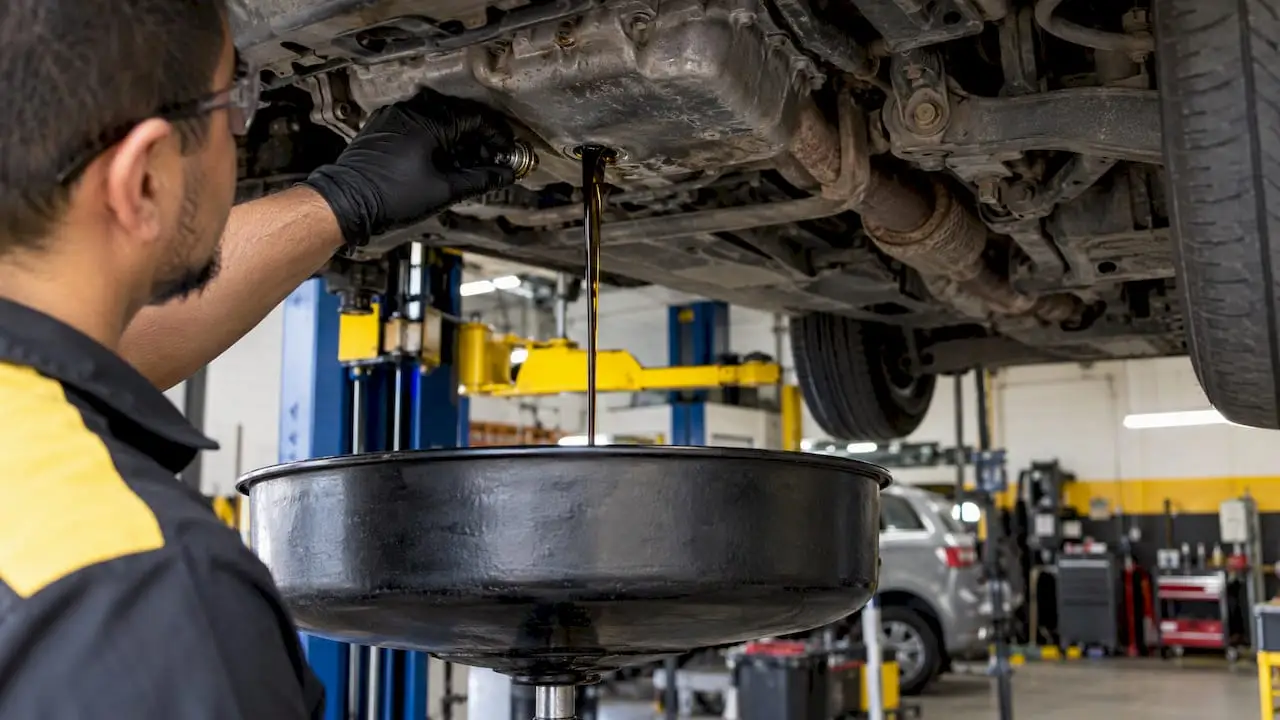
How often depends on your car. A USA Today report on AAA findings found that 45% of survey respondents still believed oil should be changed every 3,000 miles, while most cars built in the past decade recommend 5,000 to 7,000 miles. Your manual has the number for your engine and oil type.
If you want more detail, our guide on how often to change your oil walks through the factors that move that interval.
What a tune-up usually includes
There is no single legal or industry definition, so the list changes by shop and by vehicle. Kelley Blue Book notes that services which may be part of a tune-up include:
- An oil change
- Spark plugs
- Filters
- Belt and hose inspections
- Diagnostic scans when warning lights or symptoms appear
- Fluid checks
- Battery testing
- Brake inspections
- Tire checks
- Alignment, if needed
Not every item happens on every visit. The Car Care Council’s Auto Care Guide describes typical tune-up service as replacing spark plugs (intervals range from 30,000 to 100,000 miles depending on plug type), replacing other ignition or emissions parts as needed, and replacing fuel and air filters.
That guide also makes a point worth remembering. Modern engines compensate for worn parts to a degree, which can give drivers the false sense that everything is fine. Keeping the engine in good condition restores normal operation and supports fuel economy and emissions performance.
Signs your engine may be asking for attention
These symptoms often point toward engine-related service. None of them means a specific part has failed, but each is a reason to have the car inspected:
- Hard starting. The engine cranks longer than it used to.
- Worse fuel economy. You are filling up more often with no change in driving.
- Rough idle or stalling. The engine shakes at a stop or cuts out.
- Slow or hesitant acceleration. The car feels flat when you press the pedal. We cover this in five safe checks for hesitation.
- A check engine light. A diagnostic scan reads the stored codes so the cause can be found before parts are replaced.
If the light is flashing, or the car is running very roughly, stop driving as soon as it is safe and have it looked at.
Are tune-ups still necessary?
Yes, in the sense that the work still needs to get done. No, in the sense of a fixed yearly ritual. According to Kelley Blue Book’s January 2026 guidance, on most modern vehicles a tune-up is no longer a once-a-year, one-size-fits-all service. Maintenance is based on the time and mileage intervals in the manufacturer’s schedule and on what inspections find.
For most newer cars, that translates into three habits:
- Follow the factory maintenance schedule.
- Get periodic inspections to catch wear items early.
- Use diagnostics when symptoms appear.
The Car Care Council’s executive director, speaking in a fall car care release, said a routine maintenance program makes financial sense because it extends vehicle life and helps avoid costly repairs later.
How to decide what your car needs
You do not have to guess. Work through these steps in order.
- Open the owner’s manual. Find the maintenance schedule for your mileage. Many cars also have a service reminder in the dashboard display.
- Gather your service history. Receipts and records show what was done and when. If you bought the car used, you may be missing part of that record.
- List any symptoms. Note when they happen: cold starts, highway speeds, A/C on, and so on. Specific details help the technician.
- Ask for an inspection and a written list. A good list separates what is due now from what can wait.
- Approve work item by item. You should know what each item is and why it is recommended.
If your car is under warranty or you want to follow the manufacturer’s plan exactly, our factory scheduled maintenance service is built around that schedule.
Does service at an independent shop affect your warranty?
Many drivers think they must use a dealership. The same USA Today report notes that AAA found 31% of poll respondents believe this, but the group said owners can get service wherever they want. It recommends keeping documentation of all work in case you need it for a future warranty claim.
Record keeping matters just as much when you buy a used car. This walkthrough of verifying service records shows what to look for in a car’s history before you buy.
A car tune-up checklist you can bring to the shop
The Car Care Council has long recommended a set of basic maintenance checks. Its list covers fluids, hoses and belts, the battery, brakes, the exhaust system, the engine tune-up itself, the heating and cooling system, steering and suspension, tires, and wipers and lighting. Use this version as a conversation starter with your technician:
Engine and ignition
- Spark plugs and ignition components, as the schedule or symptoms call for
- Air filter and fuel filter
- Belts and hoses
- Scan for stored trouble codes
Fluids
- Engine oil and filter
- Coolant, brake fluid, power steering and transmission fluid levels and condition
Electrical
- Battery test and terminal condition
- Alternator and starter performance
Safety and ride
- Brake pads, rotors and lines
- Tire tread, pressure and wear pattern, and alignment if the car pulls
- Steering and suspension components
- Exterior lights and wiper blades
Comfort
- A/C and heating performance
Not every line needs replacement. Many are simple checks that take little time and show you what condition the car is in.
What does a tune-up cost?
Prices differ a lot because the word covers different jobs. These national figures give you a sense of the range. They are not Kwik Kar prices, and your own estimate depends on your vehicle and the work needed.
| Source | Reported range | Notes |
|---|---|---|
| Synchrony | About $160 to $360 | Varies by make and model, location and services included |
| Real Repair Cost | $200 to $600 at most shops | Most drivers pay about $300 for a four-cylinder; V6 engines that need the intake plenum removed can run $450 to $800 |
Real Repair Cost, published September 30, 2026, breaks a typical four-cylinder job into parts of $60 to $200 and labor of $140 to $400. It also reports that independent shops charge $200 to $420 for a four-cylinder, against $260 to $550 at dealers.
Individual items vary too. Synchrony lists spark plug replacement at $110 to $370, air filter replacement at $20 to $60 and fuel filter replacement at about $220.
What moves the price
- Engine type. A V6 or V8 with hard-to-reach plugs takes more labor.
- Which parts are replaced. Plug type and filter choice change the parts bill.
- What is bundled. An oil change, fluid service or alignment adds to the total.
- Where you go. Dealers, independent shops and chains price differently.
The best way to compare is to ask for the same written scope from each place. A low price for a short list is not the same as a fair price for a full one.
Our perspective
We hear the question “Do I need a tune-up?” from drivers who are really asking whether their car is in good shape. Our answer starts with your owner’s manual, not with a standard package.
At Kwik Kar, we focus on reliable maintenance and repair, with ASE-certified mechanics who explain what they see in plain language. We believe you should know what is due, what can wait and why, before you approve any work.
That is how we approach tune-ups, factory scheduled maintenance and everyday service like oil changes. Each one gets the same transparent communication, honest recommendations and warranty-backed repairs. Our goal is for you to leave feeling comfortable and informed about your car.
Kwik Kar
Get the right service at Kwik Kar
If you are not sure whether your car needs a tune-up, scheduled maintenance or both, we can help you sort it out. Our tune-up service covers ignition and engine-performance needs, and our full list of services includes oil changes, filters, fluid exchanges, battery, alternator and starter service, belts and hoses, fuel system service and check engine light diagnosis.

Bring your service records and a note of any symptoms. Check our specials page for current coupons, since offers change.
Texas inspections: don’t mix them up with a tune-up
Inspections are a separate topic from tune-ups, and they cause confusion. Ordinary passenger vehicles in Texas do not require annual state safety inspections. Emissions testing is a different requirement that applies in certain counties, and commercial vehicles have their own safety inspection rules. A tune-up is not a state inspection, and a passed inspection does not mean your car has been serviced.
If you are unsure which rules apply to your vehicle, ask us when you call. We offer Texas emissions and commercial inspections, and we can tell you what applies to your situation.
Tune-up and maintenance questions drivers ask
Are maintenance and service the same thing?
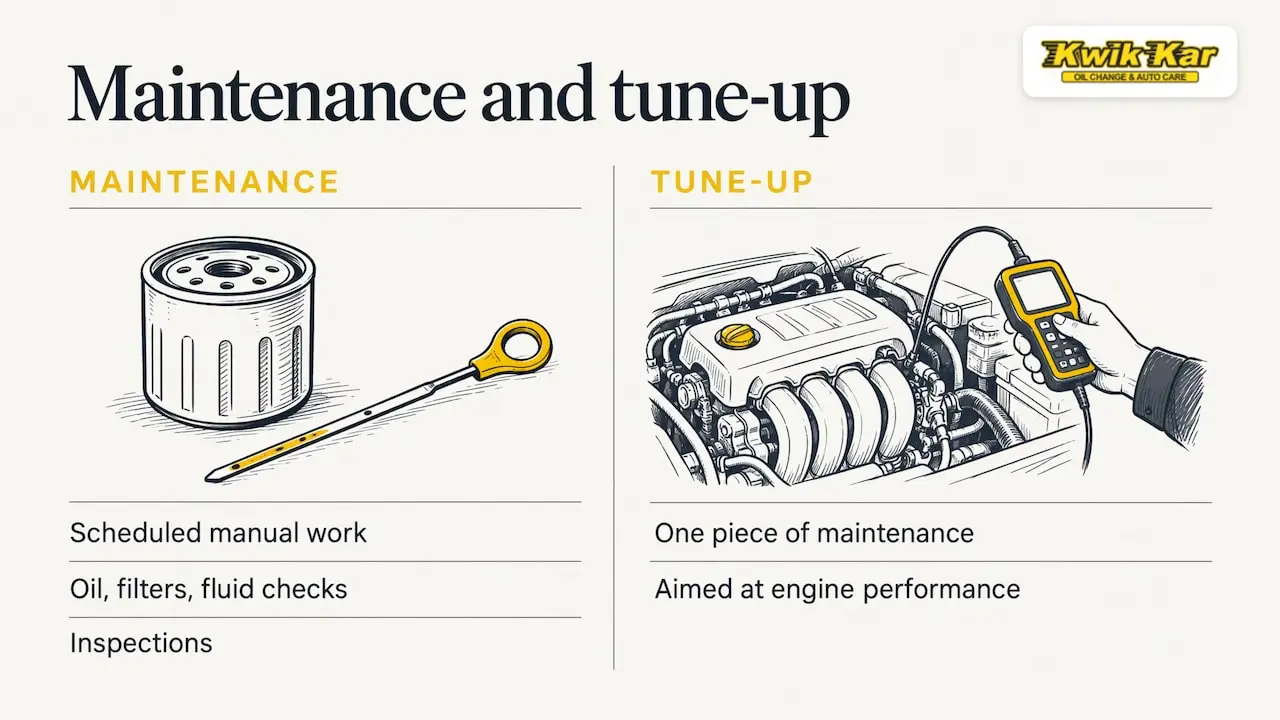
In everyday shop talk, yes. Both usually mean the scheduled work in your owner’s manual, such as oil changes, filters, fluid checks and inspections. A tune-up is one piece of that, aimed at engine performance.
Is an oil change the same as a tune-up?
No. An oil change is routine maintenance that happens more often. Many drivers combine it with a tune-up, and our oil change service can be paired with other items on your list.
How often should I get a tune-up?
There is no single interval. Follow the schedule in your owner’s manual, and consider an inspection when you notice hard starts, rough idle, poor fuel economy or slow acceleration. Spark plug intervals alone range from 30,000 to 100,000 miles depending on plug type, according to the Car Care Council guide.
Will a tune-up improve my gas mileage?
It can help if worn parts or dirty filters are the cause. The EPA, as cited in the Car Care Council guide, says a well-maintained car is more fuel-efficient, more reliable and safer. A tune-up will not fix a problem it does not address, so a diagnosis first is the right move.
What should I do first if I am unsure?
Check your owner’s manual and service history, then call a shop you trust with your mileage and any symptoms. Ask for a written list that separates urgent items from ones that can wait.
Ready to schedule?
Whether you need a full tune-up, a factory scheduled visit or just a second look at what your car is due for, our team is ready to help. Call us at (972) 775-5945 to schedule service, and we will help you decide what your car actually needs.
Sources
- Kelley Blue Book: Car Tuneup, What They Mean and When You Need One
- Kelley Blue Book: Car Maintenance Pricing & Service Schedules
- Wikipedia: Service (motor vehicle)
- California Bureau of Automotive Repair: Maintenance and repairs
- Berryman Products: Regular Car Service vs. Auto Tune-Up
- AutoZone: Tune-Up Cost Guide
- USA Today: 5 myths about maintaining your car that experts have busted
- Car Care Council Auto Care Guide
- The Auto Channel: Fall into a Vehicle Maintenance Program
- Synchrony: Car Tuneup Costs and FAQs
- Real Repair Cost: Tune-Up Cost (2026)