
A failing ignition coil usually shows up as a misfire: the engine shakes, hesitates or loses power, and the check engine light comes on. If that light is flashing or the engine is bucking, stop driving and have the car looked at. Unburned fuel can damage the catalytic converter. Otherwise, a coil problem is a common, well-understood repair. This guide covers the signs, the causes, how a shop confirms the problem, and what you can expect to pay.
TL;DR
- Typical signs of a bad coil: misfires, rough idle, weak acceleration, worse fuel economy, hard starting and a check engine light.
- A flashing check engine light or a shaking engine means stop driving. Unburned fuel can overheat and damage the catalytic converter.
- A misfire code points to a cylinder. It does not prove the coil is the culprit, since spark plugs, wiring and other parts cause the same code.
- CarMD’s 2024 U.S. average to replace ignition coil(s) was $218.25. Replacing coils and spark plugs together averaged $399.59.
- Worn spark plugs and oil leaks often cause the coil to fail, so fixing the cause matters as much as the new part.
Table of Contents
- What an ignition coil does
- Signs of a failing ignition coil
- When it is not safe to keep driving
- What makes ignition coils fail
- How a shop confirms it is the coil
- Coil pack vs. coil-on-plug
- How much ignition coil replacement costs
- Replace one coil or all of them?
- Keeping a new coil from failing
- Our perspective
- Get a misfire checked in Midlothian
- FAQ
- Schedule your service
- Sources
What an ignition coil does
Your engine needs a very high voltage to jump the gap at the spark plug. The battery supplies about 12 volts. The ignition coil is a small transformer that steps that up to thousands of volts at the exact moment each cylinder needs a spark.
When a coil weakens, the spark gets weak or disappears. The fuel in that cylinder does not burn properly. You feel it as a stumble, and the engine computer sees it as a misfire.
Signs of a failing ignition coil
Most coil failures announce themselves in a few familiar ways. UnderhoodService lists engine misfires, rough idle, a drop in power under acceleration, poor fuel economy and a check engine light as signs of a failed coil. Here is what each one feels like from the driver’s seat.
- Engine misfires or shaking. The engine stumbles, shudders or feels like it is skipping a beat, often most noticeably at idle or under load.
- Rough idle. The steering wheel or seat vibrates while you sit at a light, and the RPM needle may bounce.
- Weak acceleration. The car feels flat when you merge or climb a hill. If this is your main complaint, our guide on a car that hesitates on acceleration covers other causes to rule out.
- Worse fuel economy. Unburned fuel is wasted fuel, so you fill up more often than usual.
- Hard starting or stalling. Haynes lists backfires, a reluctance to start, lower power and the smell of unburned fuel among the effects of a faulty coil. If the engine will not start at all, see reasons a car won’t start for how to sort the possibilities.
- Check engine light. A steady light means the computer has logged a fault. A flashing light means an active misfire that needs attention right away.
- Fuel or exhaust smell. A raw-fuel odor from the tailpipe can follow a misfire because fuel passes through unburned.
On modern cars with one coil per cylinder, only one cylinder may be affected. Haynes notes that in a car with computer-triggered ignition, one plug could be affected, or two if they share the same coil. That is why a single bad coil can feel milder than you might expect, and why many drivers put off the repair.
When it is not safe to keep driving
A mild stumble at idle is one thing. A hard misfire is another.
Stop driving, or limit yourself to a short, gentle trip to a shop, if:
- The check engine light is flashing.
- The engine is shaking or bucking badly.
- The car loses power in traffic or stalls.
- You smell raw fuel or something burning.
The reason is the catalytic converter. Edmunds explains that with a coil fault code, unburned fuel can enter the exhaust system and potentially overheat and damage the catalytic converter. Edmunds also says prolonged misfires can damage other engine components. A catalytic converter costs far more to replace than a coil. If you have already seen a catalyst code, our P0420 code guide explains what it means.
A flashing light with heavy shaking is not something to drive across town with. Pull over somewhere safe and call a shop.
What makes ignition coils fail
Coils do wear out with age and heat. But they often fail early because of something else in the engine. Fixing only the coil without finding that cause is how people end up replacing the same part twice.
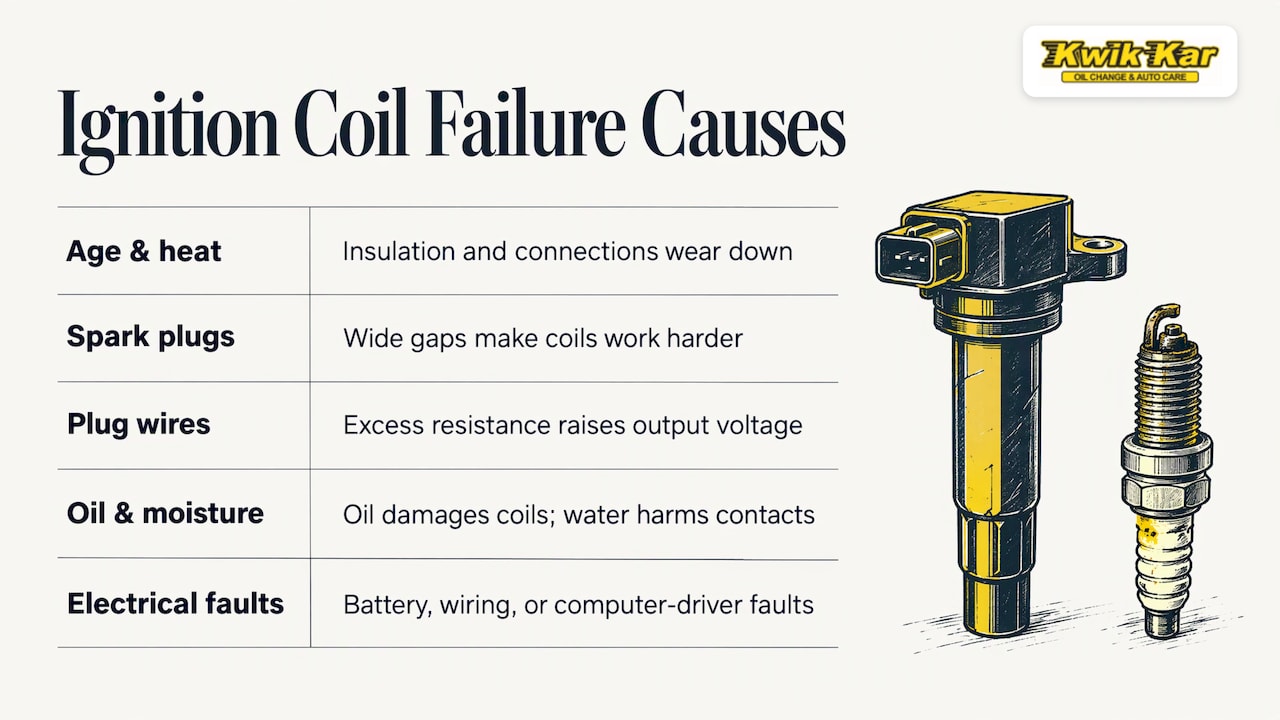
Worn or wide spark plugs. UnderhoodService explains that as the gap between the plug electrodes grows, the coil has to work harder and generates more heat. That repeated heating can crack the coil’s epoxy, let moisture in, and eventually break down the windings.
Bad plug wires. On systems that use them, a wire with excess resistance forces the coil’s output voltage up. Delphi says that if that voltage passes 35,000 volts, it can damage the coil’s internal insulation and cause a short.
Oil leaks. A leaking valve cover gasket can let oil pool in the spark plug wells and soak the coil. DENSO names oil from the valve cover gasket as the usual source of mechanical damage to coils. If you notice that smell, our burning oil smell guide shows what to check first.
Moisture. DENSO also lists water getting into the spark plug recesses as a cause of contact failure. Delphi mentions moisture from oil leaks or A/C condensation.
Heat and vibration. Long hours of engine heat and vibration age the insulation and the connections.
Electrical supply problems. HELLA lists a weak battery or faulty wiring among the fault categories, along with rodent damage. If your battery light has been on, read our page on the battery light while driving.
Engine computer faults. UnderhoodService warns that a failed driver circuit in the computer can take out a coil. When a computer is replaced for that reason, it says the coil should be replaced too.
How a shop confirms it is the coil
The check engine light tells you something is wrong. It does not tell you which part to buy.
On cars built after 1996, the onboard system logs misfire codes in the P030X family. Per Haynes, the X is the number of the cylinder that is misfiring. P0301 points to cylinder 1, P0302 to cylinder 2, and so on.
That code narrows the search to one cylinder. It does not name the failed part. EDIAGTOOL makes the same point: a misfire code helps locate the investigation but does not identify the failed part by itself. DENSO adds that a coil code can also come from ignition circuit problems, a bad plug or wire, a damaged wiring harness or connector, a vacuum leak, or carbon buildup in the throttle body.
A careful diagnosis usually includes:
- Reading the codes and any stored data from the engine computer.
- Inspecting the coil, connector and wiring for oil, cracks, corrosion or rodent damage.
- Pulling the spark plug from that cylinder and checking its condition and gap.
- Testing the coil and circuit with the right tools, rather than guessing.
- Checking for vacuum leaks or other causes if the ignition parts test fine.
One caution for do-it-yourselfers: UnderhoodService warns that swapping coils between cylinders to chase a misfire can lead to damage in other driver circuits on the vehicle. A proper diagnosis avoids that risk. Our check engine light diagnostics page explains how we approach the process.
Coil pack vs. coil-on-plug
The two common designs work the same way but fail a little differently.
| Coil-on-plug (COP) | Coil pack | |
|---|---|---|
| Layout | One coil sits directly on each spark plug | One pack holds several coils, often fed by plug wires |
| Plug wires | Not needed | Usually used |
| Sparks per coil | One plug per coil | Each coil fires two paired plugs at once |
| When one fails | Usually one cylinder misfires | Can affect two cylinders that share the coil |
The pairing in a coil pack is specific. A Ford service manual describes it this way: in a coil pack, each coil fires two plugs at once, one on the compression stroke and the other on the exhaust stroke. In its COP system, each coil mounts right on its own plug and no plug wires are needed.
You can often tell which you have by looking under the hood. If you see a plastic or metal block with thick wires running to each plug, it is likely a coil pack. If you see individual small modules with a connector on top of each plug, it is coil-on-plug. Your owner’s manual or a quick look by a technician will settle it.
How much ignition coil replacement costs
Cost depends on your engine, how many coils fail and how hard they are to reach. The best national figure comes from the CarMD Vehicle Health Index, which covers repairs completed in 2024:
| Repair | 2024 U.S. average |
|---|---|
| Replace ignition coil(s) | $218.25 |
| Replace ignition coil(s) and spark plug(s) | $399.59 |
CarMD also found that ignition coil replacement was the sixth most common check-engine-light-related repair, at 4.37% of repairs. That tells you how routine this job is.
These are averages across the country, not a quote. Costs run higher on engines where the coils sit under an intake manifold, and on V6 and V8 engines with more cylinders. We do not publish prices for this service, so the best way to know your number is to have the car diagnosed and get an estimate before any work begins.
Replace one coil or all of them?
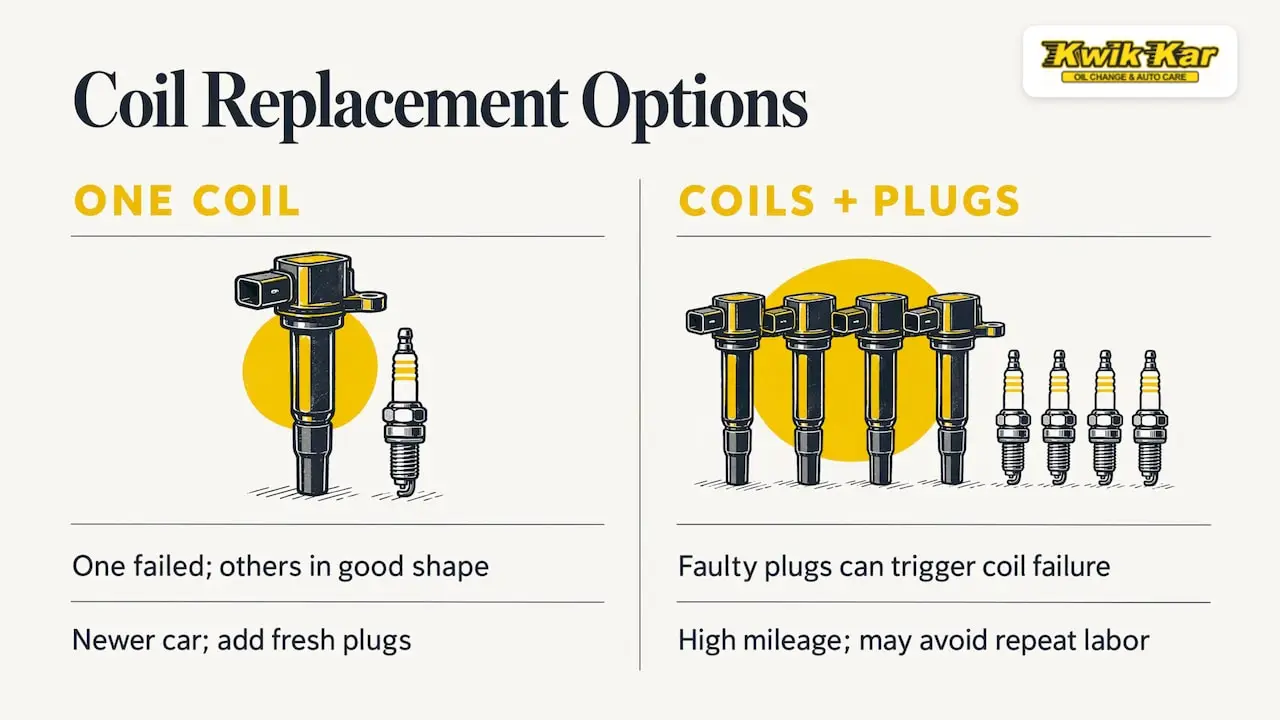
You can replace a single coil when only one has failed and the rest are in good shape. Many owners and technicians choose to do more, for two reasons.
First, the plugs. CarMD notes that faulty spark plugs can trigger coil failure, which is why the two are often replaced at the same time. Delphi also recommends replacing all the spark plugs when you replace a coil. If old plugs killed the first coil, they can kill the new one.
Second, the age of the other coils. If your car has high mileage and one coil has failed, the others have seen the same heat and vibration. UnderhoodService notes that original equipment coils are known for high failure rates. Replacing a set can save a second labor charge if another one goes next month.
If the car is newer and only one coil has failed, a single-coil repair with fresh plugs can be a sound middle path. A technician who has inspected your plugs and coils can tell you which makes sense.
Keeping a new coil from failing
A good repair addresses why the coil failed. Delphi recommends these steps after installing a coil:
- Apply dielectric grease to the coil’s foot and electrical socket.
- Replace all the spark plugs at the same time.
- Tighten the bolts to the recommended torque.
- Clear the fault codes with a diagnostic tool.
- Road test the car.
Beyond that, fix any valve cover gasket leak that is putting oil in the plug wells, and keep up with spark plug service at the interval in your owner’s manual. Routine maintenance is the cheapest protection a coil has. A regular tune-up and maintenance visit is a good time to have the plugs and wiring looked at.
Our perspective
Most coil jobs we see are not really about the coil. They are about the thing that stressed the coil: old plugs, a small oil leak, a loose connector. If a shop swaps a part and sends you off, you can end up back in the same spot a few months later.
That is why we focus on finding the cause first and explaining it plainly. Our mechanics are ASE-certified, and we walk you through what we found and what we recommend before any repair begins. You decide what happens next.
If your check engine light is on and the car is running rough, do not wait for it to get worse. A misfire caught early is usually a smaller repair than one that has been driven on for weeks.
Kwik Kar
Get a misfire checked in Midlothian
If your engine is stumbling, idling rough or showing a check engine light, we can find out whether it is a coil, a plug, a wire or something else. Our team handles check engine light diagnostics, along with engine repair when the diagnosis calls for it. You will get a clear explanation of what we find before work starts.

See everything we offer on our services page.
FAQ
How do I know if an ignition coil is bad?
The usual signs are a misfire, rough idle, weak acceleration, poor fuel economy and a check engine light. A scan tool reading a P030X code will point to the cylinder, but a technician still needs to test the coil, plug and wiring to confirm the part at fault.
Can I drive with a bad ignition coil?
A short, gentle trip may be possible with a mild misfire, but it is not a good idea to keep going. If the check engine light is flashing or the engine is shaking, stop driving. Unburned fuel can overheat and damage the catalytic converter, which is a much larger repair.
How much does it cost to replace an ignition coil?
CarMD’s 2024 U.S. average was $218.25 for replacing ignition coil(s) and $399.59 when spark plug(s) were replaced too. Your price depends on your vehicle, the number of coils and how much labor it takes to reach them.
Can I replace just one coil?
Yes, if the others are healthy. Many technicians recommend replacing the spark plugs along with it, since worn plugs can cause coil failure. On high-mileage engines, replacing the full set can prevent a repeat visit.
Is a coil pack the same as coil-on-plug?
No. Coil-on-plug uses one coil on each spark plug. A coil pack groups coils together, and each coil fires two paired plugs. Both do the same job of producing the spark, but the layout and the parts you replace differ.
Schedule your service
If your car is running rough, give Kwik Kar Lube & Tune a call at (972) 775-5945 and let us get you on the schedule. We will find the cause, explain your options and help you get back on the road with confidence.
Sources
- A Closer Look: Ignition Coils, UnderhoodService
- What Kills An Ignition Coil?, UnderhoodService
- Ignition Coil Packs: A Simple Guide, Haynes Manuals
- P0351 Ignition Coil “A” Primary/Secondary Circuit, Edmunds
- How to service ignition coils, Delphi
- Causes of ignition coil failure, DENSO
- Ignition coil: checking, measuring, faults, HELLA
- Bad Ignition Coil Symptoms: Checks Before Replacement, EDIAGTOOL
- Check Engine Light Repair Trends, CarMD Vehicle Health Index
- Integrated Electronic Ignition System, 2016 Ford Explorer service manual