



The best way to extend the life of your car is to follow the maintenance schedule in your owner’s manual, fix small problems before they grow, and drive it regularly. Most cars on the road today can reach 200,000 miles or more when they are looked after. Consumer Reports notes that modern vehicles can last 200,000 miles or more when they are properly maintained, and that how long yours lasts depends on the make, the model and how closely you follow the service intervals.
None of this takes special tools or a big budget. It takes a routine. Below you will find the habits that matter most, what to check yourself, what to hand to a technician, and how to decide when a repair no longer makes sense.
TL;DR
- Follow the service schedule in your owner’s manual, not a guess or a sticker from years ago.
- Oil and filter changes, correct tire pressure, healthy brakes and a good battery do the most to protect a car long term.
- Act on small warning signs (a squeal, a rattle, a new dashboard light) early, because small problems tend to pull other parts down with them.
- Drive the car regularly and keep fluids fresh, especially in Texas heat.
- Texas no longer requires safety inspections for ordinary passenger cars, but emissions tests still apply in Ellis County, and commercial vehicles still need safety inspections.
Table of Contents
- Start with the owner’s manual
- 12 habits that add years to a car
- A simple routine you can follow
- Don’t forget about Texas inspections
- What we have seen: our perspective on keeping cars on the road
- When is it time to repair, and when to replace?
- How Kwik Kar can help
- FAQ
- Ready to give your car more years?
- Sources
Start with the owner’s manual
Your owner’s manual is the most useful maintenance document you own. It lists how often to change the oil and other fluids, which specifications your car needs, and what to do under harder driving conditions. The Georgia Attorney General’s consumer division makes the same point: the manual sets out the recommended frequency for oil changes and other maintenance, along with the parts and products to use.
If you have lost yours, the manufacturer’s website usually has a digital copy. Look for two schedules: a normal one and a “severe” one. Short trips, stop-and-go traffic, towing, dusty roads and summer heat all count as harder use. Many Texas commuters fall into the severe category without realizing it.
If you want a technician to handle this for you, our factory scheduled maintenance service is built around what the manufacturer recommends for your vehicle at each mileage point.
12 habits that add years to a car
1. Change the oil and filter on schedule
Oil reduces friction between moving engine parts and carries heat away. As it ages it breaks down and collects debris. Consumer Reports calls regular oil and filter changes the foundation of engine longevity, and says to follow the manufacturer’s schedule or the severe-duty schedule when conditions are tough.
The right interval depends on your engine and the oil it uses. We cover the details in our guide to how often to change your oil. If you just bought a car, our checklist for the first oil change on a new car shows what to confirm.
2. Keep your tires inflated to the right pressure
Use the number on the placard in the driver’s door jamb or in the manual, not the maximum printed on the tire sidewall. The sidewall figure is a limit for the tire, not a recommendation for your car, as the Georgia consumer guidance explains.
Check pressure monthly when the tires are cold. The U.S. Department of Energy says correct inflation improves gas mileage by 0.6% on average, and up to 3% in some cases. Each 1 psi drop across all tires lowers mileage by about 0.2%.
Pressure is also a safety matter. NHTSA warns that poor tire maintenance can lead to a flat, a blowout or tread separation. Rotate tires on the schedule in your manual so they wear evenly. If you see cracking on the sidewalls, our page on spotting tire dry rot explains what to look for, and a tire that keeps losing air may have a slow leak worth tracking down.
3. Keep the wheels aligned
Hitting a pothole or curb can push alignment out of spec. A car that pulls to one side, or a steering wheel that sits off-center on a straight road, is the usual clue. Poor alignment wears out tires faster and puts extra load on steering and suspension parts.
4. Take brake noise seriously
Brake pads are made to wear down. The problem comes when they wear all the way and metal meets metal, which damages rotors and costs more to fix. Squealing, grinding, a soft pedal or a longer stopping distance are all reasons to have the brakes looked at. Our guide to the signs your brakes may need service walks through each one.
Brake fluid also ages. It absorbs moisture over time, and checking it is quick, as we explain in our article on the brake fluid change interval. When pads or shocks are replaced, do them in pairs. Consumer Reports advises that replacing wear items such as brake pads, shocks and struts in pairs keeps handling balanced and wear even. Our brake repair page lists what we handle.
5. Look after the battery and charging system
Heat is hard on batteries, and a Texas summer can shorten their life. Slow cranking, dim lights or a battery warning light are signs to get the battery, alternator and starter tested before you are stranded. If your battery keeps dying overnight, a hidden electrical load may be the cause, which we describe in our piece on parasitic battery drain. A lit warning light while driving deserves quick attention, so see what the battery light means. We test and repair these parts under our battery, alternator and starter service.
6. Replace filters before they clog
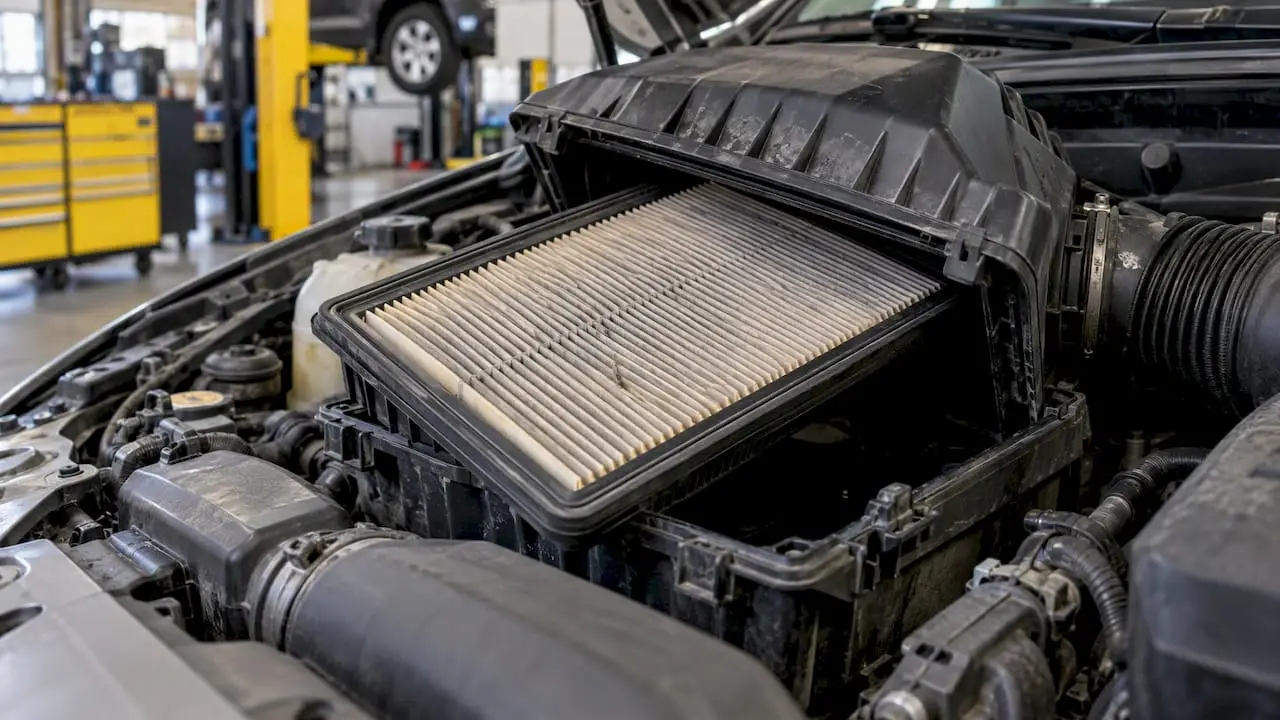
The engine air filter keeps dust out of the engine, and the cabin filter keeps the air inside the car cleaner. A clogged filter makes the engine work harder. Swapping an engine air filter is often a short job, and our page on the engine air filter change explains when to do it yourself and when to call a professional.
7. Service the other fluids
Oil gets the attention, but a car relies on several fluids: coolant, transmission fluid, brake fluid, power steering fluid and more. Each one breaks down on its own timeline. Transmission repairs are among the costliest, so it pays to follow the manual. Our article on the transmission fluid change covers the wide range of intervals manufacturers set.
8. Keep the cooling system healthy
Overheating can warp an engine in minutes. Coolant that is old or low, a weak radiator cap or a leaking hose are common causes. Have the coolant and hoses checked on the schedule in your manual, and never open a hot radiator cap.
9. Keep the A/C working
In North Texas, A/C is a comfort and a safety feature. Weak cooling or odd noises are worth checking early. If yours is not blowing cold, how to describe the problem to your mechanic helps speed up the diagnosis, and a hissing noise has its own checklist.
10. Don’t ignore warning lights or changes in performance
John Ibbotson, chief mechanic at Consumer Reports’ Auto Test Center, stresses that the key to longevity is proactive maintenance rather than reactive repairs. A slight rattle or squeal is easier and cheaper to deal with than the failure it can lead to.
A check engine light, rough idle or hesitation when you accelerate is your car telling you something. Our guide to a car that hesitates on acceleration lists safe checks you can run before you book.
11. Drive it regularly
Cars are not built to sit. Fluids circulate, and rubber seals and gaskets stay supple, when the car is used. Consumer Reports’ experts note that a car left dormant for long periods can develop flat spots on the tires, a drained battery and dried-out seals. If you drive rarely, take a longer trip now and then so the engine reaches full operating temperature.
12. Drive smoothly
Hard acceleration, hard braking and heavy loads wear everything faster. Smooth driving is free, and it protects the engine, transmission, brakes and tires at the same time.
A simple routine you can follow
You do not need to remember every item. Break it into three layers.
- Monthly, at home: check tire pressure when the tires are cold, look at tread and sidewalls, and confirm all lights work.
- Every oil change: have the fluids, belts, hoses, tires and brakes looked over while the car is up.
- By the manual’s mileage points: book the larger services, such as transmission fluid, coolant, spark plugs and any timing belt replacement.
Keep your receipts in one place. A service history helps you spot what is due and shows the next owner the car was cared for.

Don’t forget about Texas inspections
A common question is whether Texas inspections affect how you care for your car. The rules changed, so here is what the state says.
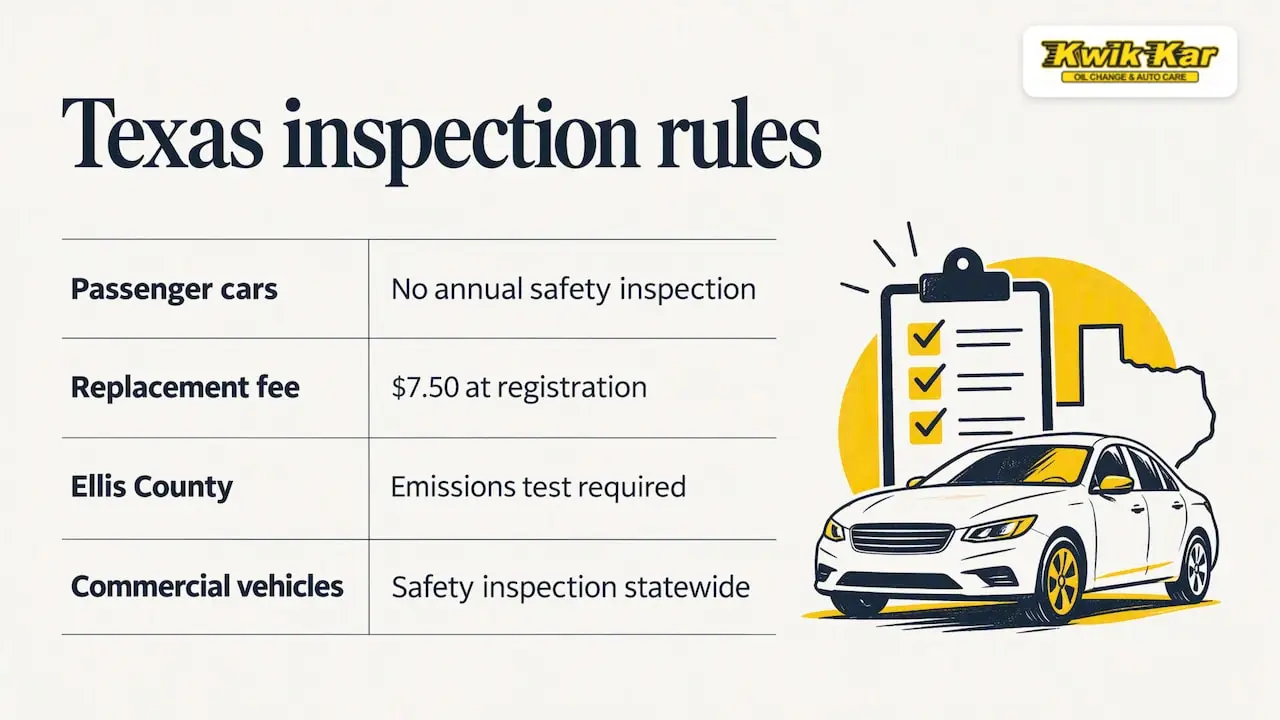
The Texas Department of Public Safety reports that House Bill 3297 ended the safety inspection requirement for non-commercial vehicles starting Jan. 1, 2025. Ordinary passenger cars no longer need an annual safety inspection before registration. Those vehicles pay a $7.50 inspection program replacement fee at registration instead.
Emissions are separate. DPS lists Ellis County, where Midlothian sits, among the counties where emissions tests are still required. The price of an emissions test varies by vehicle and county. Commercial vehicles in every county still need a passing safety inspection.
The same DPS notice reminds drivers that regular service keeps headlights, taillights, the horn, mirrors, wipers and tires working, and that driving without many of these in working order is against the law. So even without a yearly safety check, you are responsible for keeping those items in shape. Our technicians can handle lighting, wiper blades and the Texas emissions and commercial inspections we offer.
What we have seen: our perspective on keeping cars on the road
We work on everyday vehicles for busy families, commuters, first-time car buyers and local fleets. The pattern is consistent: the cars that last are not the ones with the most expensive care. They are the ones where someone paid attention early.
Here is how we think about it:
- Small things first. A worn wiper blade, a dim bulb or a slow tire leak is cheap to fix. Left alone, each one can lead to something bigger or to an unsafe drive.
- Explain before you fix. You should know what is wrong, why it matters and what your options are before any work begins. Our ASE-certified mechanics aim to keep that conversation clear and honest.
- Follow the manufacturer. We build maintenance around what the manufacturer specifies, not a one-size-fits-all interval.
- Recommend what is needed. If something can wait, we say so. If it affects your safety, we say that too.
A car is a long-term investment, and steady, boring maintenance is the cheapest way to protect it.
— Kwik Kar
When is it time to repair, and when to replace?
Even well-kept cars eventually reach the point where a big repair bill raises the question. A popular guideline is the “$3,000 rule”: if yearly repair costs go above the value of the car or above $3,000, it may be time to think about replacing it. Consumer Reports suggests a more useful comparison, annual repair cost against the cost of a new car loan.
Some questions to ask:
- Is the problem one repair, or the first of several?
- Is the frame or body in good shape, or is rust a concern?
- Does the car still feel safe and reliable for your daily drive?
- What would a replacement truly cost per month, including insurance?
An honest inspection from a technician gives you real numbers to work with, instead of guesses.
How Kwik Kar can help
We offer oil changes, tire services, alignments, brake service, A/C and radiator service, fluid exchanges, tune-ups, battery and charging system work, filters, lighting, wiper blades, steering and suspension repair, check engine light diagnosis and manufacturer-scheduled maintenance. We also serve fleets. You can see the full list on our services page, start with an oil change and preventive maintenance visit, or check our current specials before you come in. Our fleet maintenance and repair service covers work vehicles.
FAQ
How can I make my car last 300,000 miles?
There is no guarantee, but the odds improve if you start with a model known for reliability and stay on top of the manual’s schedule. Consumer Reports says the better strategy is to start with a model with a strong reliability record and keep it properly maintained. Fix small problems early and keep records.
How long can a car sit without being driven?
It depends on the car, but problems can start sooner than people expect. Batteries discharge, tires can develop flat spots and seals can dry out. If you will not drive for a while, take it out regularly for a longer drive, and have the battery tested if it struggles to start.
Does my car need a Texas safety inspection every year?
Not if it is an ordinary passenger vehicle. Texas ended safety inspections for non-commercial vehicles on Jan. 1, 2025. Emissions tests still apply in counties such as Ellis, and commercial vehicles still need a safety inspection.
Is full synthetic oil worth it?
That depends on what your manufacturer specifies. Use the oil type and viscosity listed in your manual, and follow the interval for your driving conditions. If you are unsure, ask a technician to confirm what your engine needs.
Ready to give your car more years?
If you are not sure what your car is due for, bring it in and we will go through it with you in plain language. Call us at (972) 775-5945 to schedule service, and let’s keep your car running well for the long haul.
Sources
- What Is a Reasonable Life Span for a Modern Car? (Consumer Reports)
- How to Make Your Car Last 200,000 Miles and More (Consumer Reports)
- Consumer Reports’ Guide to Car Maintenance
- Long-Lasting Cars Proved to Get to 200,000 Miles and Beyond (Consumer Reports)
- Maintenance (Georgia Consumer Protection Division)
- Gas Mileage Tips (FuelEconomy.gov)
- Tire Safety (NHTSA)
- Vehicle Safety Inspection Changes Take Effect January 2025 (Texas DPS)