
A fouled spark plug usually shows up as a rough idle, a hard start, a jerk when you accelerate, or mileage that quietly gets worse. The plug is coated in deposits, so it can’t fire cleanly. The coating is a clue to a bigger problem, such as a rich fuel mixture, oil getting into the cylinder, or short trips that never let the engine warm up. If your car is doing any of this, our team at Kwik Kar in Midlothian can find out which cause you’re dealing with. Call us at (972) 775-5945.
TL;DR
- The most common signs are misfires, rough idle, slow or long cranking, weak acceleration, poor fuel economy and a check engine light.
- Dry, sooty black plugs point to carbon fouling. Wet, shiny black plugs point to oil.
- A fouled plug is a symptom. Replacing it without fixing the cause usually means it fouls again.
- Several other problems feel the same, including bad ignition coils, fuel system trouble and faulty sensors.
- Persistent symptoms deserve a proper diagnosis, and we can do that at the shop.
Table of Contents
- What spark plug fouling actually is
- The symptoms of a fouled spark plug
- What black spark plugs mean
- Dry black soot: carbon fouling
- Wet and oily plugs: oil fouling
- Why spark plugs keep fouling
- What you can safely check yourself
- Carbon fouling and short-term clearing
- Promo: spark plug and ignition service in Midlothian
- Our view on fouled plugs
- FAQ
- Sources
What spark plug fouling actually is
A spark plug creates a small spark across a gap at the tip. That spark ignites the fuel and air in the cylinder. Fouling means deposits, such as carbon, oil or fuel, have built up on that tip.
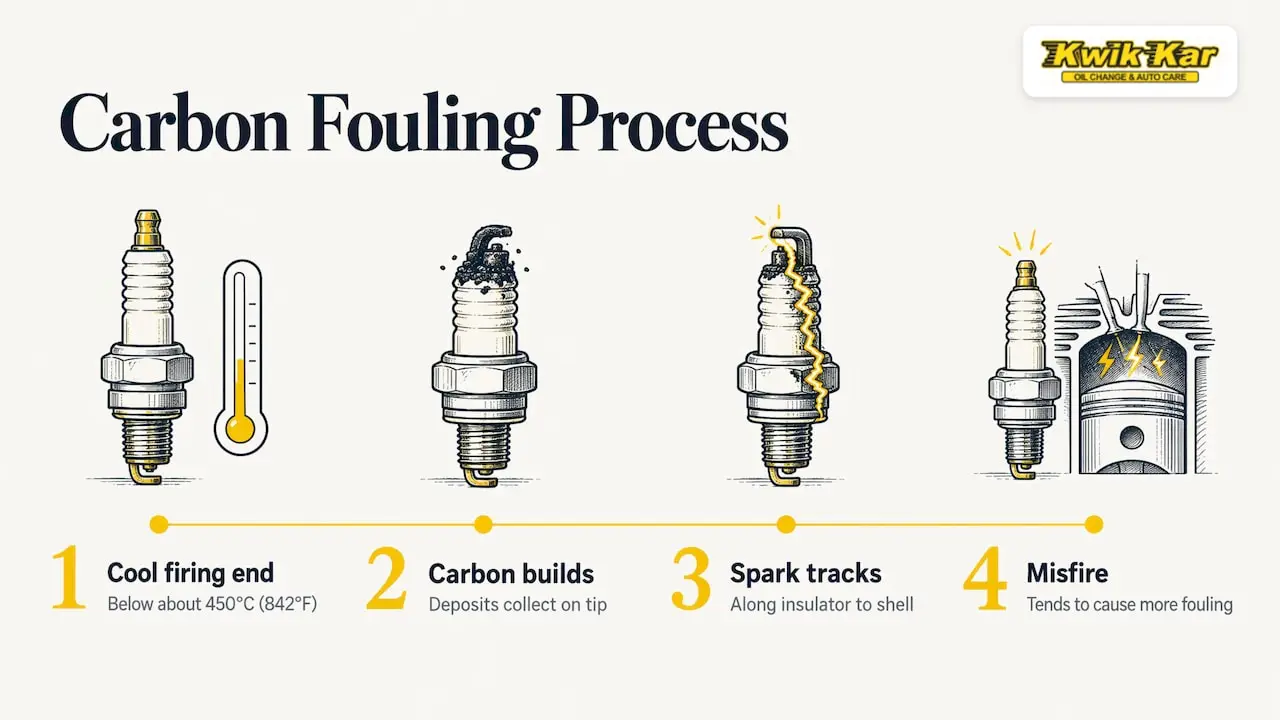
A clean plug burns off light deposits on its own. NGK explains that carbon burns off once the firing end reaches its self-cleaning temperature of about 450°C (842°F). If the plug stays cooler than that, carbon builds up. Enough of it can let the spark travel along the insulator to the metal shell instead of across the gap. The result is usually a misfire, which tends to cause more fouling.
An engine misfire simply means a cylinder didn’t burn its fuel properly on that cycle. If you want a deeper look at how that feels, see our guide to engine misfire symptoms.
The symptoms of a fouled spark plug
No single sign proves a plug is fouled. You’re looking for a pattern. These are the ones that show up most often, based on Autolite’s guide to bad and fouled plugs.
-
Misfires and jerking when you accelerate. The engine stumbles or hesitates because one cylinder isn’t contributing. It’s often most noticeable when you press the pedal to merge or pass.
-
A check engine light. Constant misfires can trigger the light. A flashing light means an active, serious misfire, so don’t keep driving hard on it. Codes in the P0300 to P030x range point to misfires, and the last digit tells you which cylinder. Innova notes that P030(x) codes are common with fouled plugs.
-
Rough idle, popping or sputtering. The engine shakes at a stoplight, or you hear popping from the exhaust. Newer engines can compensate for a weak cylinder, so the roughness may be milder than you’d expect.
-
Long cranking, especially on cold mornings. A fouled plug struggles to light the mixture. You may need extra seconds of cranking, or the engine may start and stall.
-
Weak acceleration on hills or when passing. The engine feels flat when you ask for power.
-
Worse fuel economy with no other explanation. If you’re filling up more often and nothing else changed, deposits may be part of the story.
Ignition coils, the fuel system and engine sensors can cause the same symptoms. Spark plugs are usually the first thing to check because they’re the easiest to inspect. If the plugs look fine, the next suspect is often a coil, which we cover in ignition coil failure: symptoms, causes and repair cost.
When it’s a starting problem
Slow or no starting has many possible causes, from the battery to the fuel pump. Our guide to reasons a car won’t start helps you sort out which one you have. If the problem shows up mainly when the engine is hot, this hot start diagnosis guide explains how cranking, fuel and engine control causes are ruled out one by one.
What black spark plugs mean
Black deposits are the classic sign of fouling, but black doesn’t always mean the same thing. The type of deposit tells you where to look.
| What you see | Likely type | What it can point to |
|---|---|---|
| Dry, soft, sooty black | Carbon fouling | Rich fuel mixture, weak ignition, plugs too cold for the engine, lots of short trips |
| Wet, shiny, oily black | Oil fouling | Worn piston rings, valve guides or seals, head gasket trouble, crankcase ventilation problems |
| Wet with a gasoline smell, dries off quickly | Fuel fouling | Too much fuel that never ignited, such as repeated pumping of the pedal while starting |
| Light tan or gray | Healthy | Normal operation |
The light tan or gray color is what NGK describes as a healthy engine at the right operating temperature. DENSO describes carbon fouling as dried, soft black carbon that causes poor starting, misfiring and weak acceleration. It describes oil fouling as black and lustrous with wet, oily deposits.
Color is a clue, not a verdict. Look at the whole plug, how the car has been driven recently, and what other tests show.
Dry black soot: carbon fouling
Carbon fouling is the most common kind. The engine is making soot faster than it can burn it off. NGK lists these causes:
- Continuous low-speed driving and short trips
- A heat range that is too cold for the engine (the heat range is how quickly a plug sheds heat)
- An overly rich air-fuel mixture
- Worn piston rings or cylinder walls
- Ignition timing that is too far retarded
- Ignition system wear
For many Midlothian drivers, short trips are the obvious one. Quick runs to school and back, or a few miles to the grocery store, may never get the plugs hot enough to clean themselves. A restricted air filter can also push the mixture rich. Our engine air filter change guide covers how simple that check is.
A rich mixture can also come from leaking injectors, excess fuel pressure or sensors giving the computer bad readings. When that’s the suspect, a look at the fuel system comes next. See how to diagnose fuel system cleaning needs or our fuel injection service page.
Wet and oily plugs: oil fouling
Oil on a plug tip is a different story. It means oil is getting into the combustion chamber. Innova lists the usual suspects:
- Worn valve guides or intake valve seals
- Worn or broken piston rings
- A blown head gasket
- A clogged crankcase ventilation system
- Too much oil in the engine
Location matters. Oil on the tip suggests oil entering the cylinder. Oil only on the outside of the plug, the threads or the boot often means a leaking valve cover gasket or plug tube seal, and that is a smaller repair. Either way, check the level before you drive. Our guides to blue smoke on startup and a burning oil smell walk through what to look for. If your oil pressure light is on, read about low oil pressure and stop driving until you know why.
One point matters most here. Mobil warns that new plugs won’t fix a worn piston ring. The mechanical problem has to be repaired first, then the plugs replaced.
Why spark plugs keep fouling
If a new set fouls again quickly, something upstream is still wrong. A few patterns help narrow it down:
- All plugs look the same. Think engine-wide causes: a dirty air filter, a rich mixture, a thermostat that keeps the engine cool, or constant short trips.
- One plug looks different. Think about that cylinder: its injector, coil, compression or oil entry. Mobil advises checking every plug, since a serious problem can be developing in just one cylinder.
- Plugs foul within days with drivability problems. Don’t wait. That calls for a diagnosis rather than another set of plugs.
Overheating can also damage plugs. DENSO says an overheated plug shows a scorched, extremely white insulator with small black deposits, and it can cause power loss at high speed or under load. If your temperature gauge has been climbing, see engine overheating causes.
What you can safely check yourself
You don’t need to pull plugs to learn something.
- Look at the dash. Note whether the check engine light is steady or flashing. Flashing means a severe misfire. Reduce load and get the car looked at promptly.
- Think about your driving. Mostly short trips? Idling for long stretches? Towing? All of these can leave carbon behind.
- Check the oil level and look for leaks. Look around the valve cover and plug area for oil. Make sure the level isn’t too high or too low.
- Check the air filter. A badly clogged one is a simple, common cause of a rich mixture.
- Write down when it happens. Cold start, hot start, hills, idle? That detail helps a technician a lot.
Pulling the plugs, running compression and leak-down tests, and reading codes properly is work for a shop. A compression test can show worn rings or valve guides, and a leak-down test helps show whether valve seals, the head gasket or cylinder walls are at fault, as Innova explains.
Carbon fouling and short-term clearing
Sometimes a plug with light carbon deposits recovers once the engine runs hot enough. That’s the self-cleaning effect described above. It only works when the root cause is mild, such as a stretch of short trips. If misfires, codes or hard starting keep coming back, a longer drive won’t solve it. The plugs are telling you something else needs attention.
Promo: spark plug and ignition service in Midlothian
When the symptoms point to the ignition system, our tune-up and ignition service is the place to start. Our Check Engine Light service covers the code reading and diagnosis side. We also offer fuel system and fuel injection service, and oil changes. Our mechanics are ASE-certified, and we aim to explain what we find clearly before any repair. You can see everything we do on our services page, and any current coupons on our specials page.

If you’re not sure whether you need a tune-up or just routine maintenance, our guide to tune-up vs. maintenance explains the difference.
Our view on fouled plugs
A fouled plug is a message, not the problem. When someone comes in with a rough idle and a pair of black plugs, the useful question is why they’re black.
That’s why we start with the symptoms and the codes, then work toward the cause. Carbon, oil and fuel each point to a different system. Swapping plugs without finding the cause often just resets the clock.
Our approach is built on clear communication. We want you to understand what’s happening with your engine and what your options are, and our repairs are warranty-backed. If your car has been misfiring, hesitating or hard to start, call us at (972) 775-5945 and we’ll help you figure out the next step.
Kwik Kar
FAQ
How do I know if a spark plug is fouled?
The signs are misfires, rough idle, slow starts, weak acceleration, worse mileage and sometimes a check engine light. The only sure way to confirm it is to pull the plug and look at the tip. Gray or tan is healthy, while black soot, wet oil or a white scorched look signals a problem.
What happens if oil gets on a spark plug?
Oil on the electrode can interrupt the spark and cause a misfire, power loss, rough idle and lower fuel efficiency. Oil on the tip suggests it’s entering the cylinder. Oil only on the outside of the plug often comes from a leaking valve cover gasket or tube seal. A technician can tell which one you have.
Why do my spark plugs keep going bad so fast?
Repeat fouling means an underlying cause hasn’t been fixed. Common culprits include a rich mixture, short trips, a plug heat range that doesn’t suit the engine, and oil entering the cylinder. A proper diagnosis finds the cause so new plugs last.
Can black spark plugs always be cleaned and reused?
Not as a rule. Cleaning removes the deposit but not what caused it, and plugs that are worn or damaged still need replacing. Have the cause checked first, then replace the plugs if they’re due.
Sources
- Spark Plug Basics, NGK Spark Plugs
- How do I read a spark plug? NGK Spark Plugs
- Troubleshooting spark plugs, DENSO
- Signs of Bad and Fouled Spark Plugs, Autolite
- Oil on the Spark Plug, Innova
- How to check spark plugs, Mobil