
A failing EVAP purge valve usually shows up as a check engine light, a rough idle, or an engine that is hard to start right after you fill the tank. The valve is a small part, and the repair is often one of the more affordable ones. The trick is that the symptoms look a lot like other problems, so the right diagnosis matters more than the part. If your car is doing any of this, our certified mechanics at Kwik Kar can read the codes and find the real cause. Call us at (972) 775-5945.
TL;DR
- The most common sign of a bad purge valve is a lit check engine light, often with a code in the P0440 range such as P0441.
- A valve stuck open tends to cause hard starts after refueling, rough idle and stalling. A valve stuck closed tends to cause emissions problems and a failed emissions test.
- You can usually keep driving for a short time, but a strong raw gasoline smell, stalling or a flashing check engine light means get the car looked at right away.
- A national 2024 repair study put the average cost of this repair at $143.77, parts and labor combined. Your price depends on the vehicle and what the diagnosis finds.
- Similar symptoms come from ignition, fuel and vacuum problems, so a scan and a proper test should come before replacing parts.
Table of Contents
- What the purge valve does
- Common bad purge valve symptoms
- Stuck open vs. stuck closed
- Why the same symptoms point to other problems
- How a purge valve gets tested
- Can you drive with a bad purge valve?
- Why it matters for emissions testing in Ellis County
- What it costs to fix
- Our perspective
- Getting it checked at Kwik Kar
- Keeping the EVAP system healthy
- FAQ
- Schedule your check
- Sources
What the purge valve does
Your gas tank gives off fuel vapor. Instead of venting it into the air, the EVAP (evaporative emission) system traps it in a charcoal canister. The purge valve is the gate between that canister and your engine.
When the engine is off, the valve stays closed and holds the vapors in. Once the engine is warm and running, the engine computer opens the valve in short pulses so the stored vapor gets pulled into the intake and burned. J.D. Power’s explanation of the part describes it as sitting between the fuel tank and the intake manifold and being controlled by the powertrain control module, which is the car’s main computer.
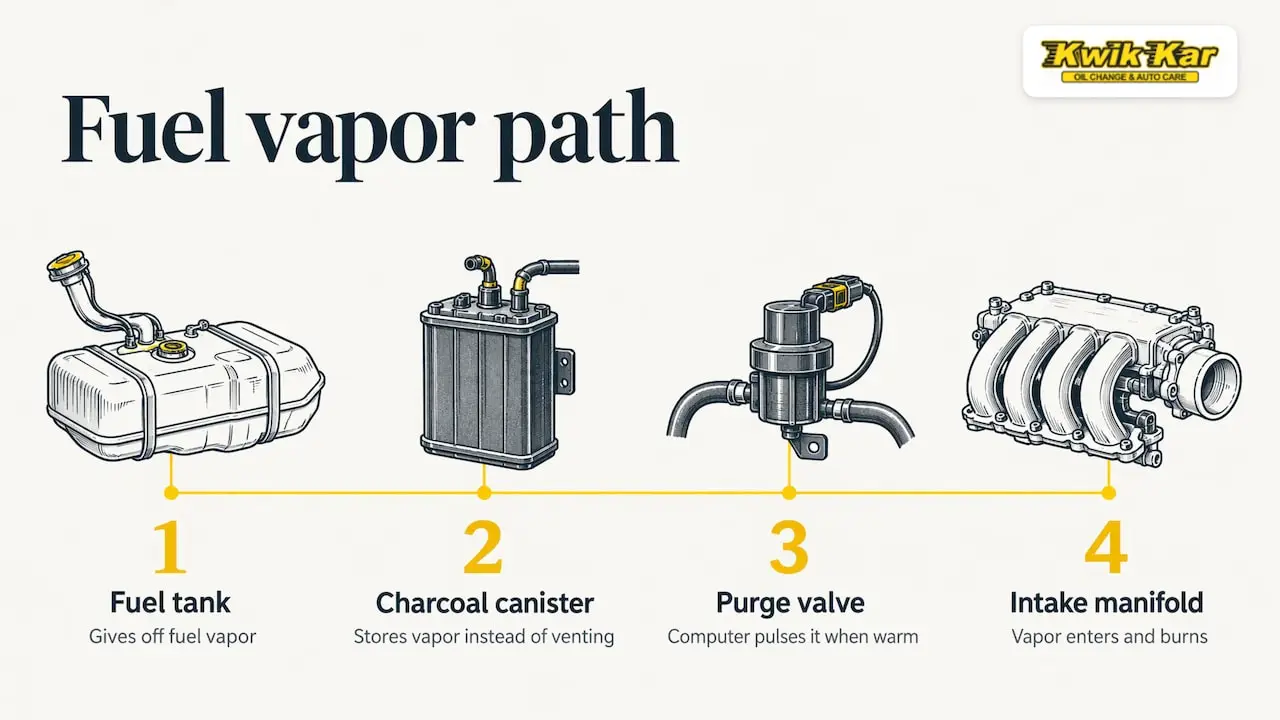
In plain terms, the valve keeps gasoline vapor out of the air and gives it a second job as fuel. When it sticks or stops responding, the engine gets the wrong amount of vapor at the wrong time.
Common bad purge valve symptoms
A purge valve can fail in two basic ways: stuck open or stuck closed. Each causes a different mix of symptoms. Here are the signs in the order most drivers notice them.
1. Check engine light
This is the most common sign. The computer monitors purge flow, and when the flow is wrong, it stores a trouble code and turns on the light. Foxwell’s guide lists codes such as P0441, P0443, P0455, P0456 and P0496 as typical of a failed valve.
A code does not always name the purge valve. A leaking or restricted valve can set a general EVAP leak code instead, which points the wrong way. That is one reason we start with a full scan rather than a guess. Our check engine light diagnostics cover exactly this.
2. Hard starting after you fill the tank
This one is a strong clue. If the valve is stuck open, fuel vapor can flow into the engine when it should not. Innova’s overview says an open valve can flood the engine with vapor, causing stalling or rough running, especially after filling up.
An automotive trade magazine’s import specialist makes the same connection. In a Motor magazine technical column, a leaking purge solenoid caused no-start and hard-start complaints after refueling on certain Audi and Hyundai models. The specialist advises treating a complaint about symptoms after refueling as a red flag for a leaking purge solenoid.
If your car cranks longer than normal only after a fill-up, mention that when you call. It narrows the search quickly.
3. Rough idle or stumbling
A valve that will not close fully acts like a small air leak once the extra vapors are gone. The same Motor article describes lean conditions, rough or erratic idle and light-throttle surge. You may feel a shake at stoplights or a stumble when you ease onto the gas.
If the rough running feels more like a single cylinder missing, that may be something else. Our guide to engine misfire symptoms helps you tell the difference.
4. Stalling
An open valve at idle can send too much vapor to the engine, and the engine may die when you slow down or come to a stop. Stalling is not something to wait on. If it happens repeatedly, have the car checked before it happens in traffic.
5. Worse fuel economy
When the valve sticks open, the engine runs on a mixture the computer did not plan for, and fuel economy can drop. J.D. Power notes reduced fuel efficiency as a symptom of a stuck-open valve. The change is gradual, so many drivers only notice it when they compare fill-ups.
6. A gasoline smell
If vapors cannot be routed properly, you may smell fuel around the car, especially after it has been parked. Innova mentions this as a sign of a malfunctioning valve. A faint smell near the car is worth a check. A strong raw gasoline smell is a different level of concern, covered below.
A smell does not always come from the EVAP system. If you want to understand how to trace the source of an odor before anything else, a guide on how to find the source of car odors gives a useful way to think about it. For fuel smells in particular, bring the car in rather than chasing it yourself.
7. Failing an emissions test
A stuck-closed valve means vapors build up and are not burned off. J.D. Power says this raises hydrocarbon emissions. Even without a noticeable drivability problem, an active EVAP code can keep a car from passing an emissions test.
Stuck open vs. stuck closed
| Stuck open | Stuck closed | |
|---|---|---|
| What happens | Vapor enters the engine when it should not | Vapor stays trapped in the canister |
| What you may notice | Hard start after fueling, rough idle, stalling, lower fuel economy | Few drivability changes, check engine light, higher emissions |
| Likely codes | P0441, P0443, P0455 and others | P0441, P0446 and others |
Codes can overlap, and the same code can come from several faults. Treat the table as a guide to what to tell your mechanic, not a way to skip the diagnosis.
Why the same symptoms point to other problems
Rough idle, hesitation, hard starts and a check engine light are among the most common complaints a car can have. A bad purge valve is one candidate. Others include:
- A loose, damaged or wrong gas cap
- A cracked EVAP hose or a leaking canister
- A vacuum leak elsewhere in the engine
- Worn spark plugs or a failing ignition coil
- Fuel delivery problems
The Motor article gives a good example of how misleading it can get. A purge valve restricted by debris from a breaking-down hose or canister kept the system from building vacuum, so the computer stored a general leak code rather than a purge valve code. The specialist advises replacing the purge hose along with the valve in that case.
If your car hesitates when you accelerate, our page on hesitation on acceleration covers other common causes. If the car will not start at all, see reasons a car won’t start.
How a purge valve gets tested
A good test checks three things: the electrical side, the sealing ability and the flow.
- Scan for codes and look at the full picture. Companion codes and freeze-frame data (a snapshot of conditions when the fault set) show whether the valve is the likely cause.
- Check the circuit. The valve is an electric solenoid. Technicians check its coil resistance and whether it gets power when the scan tool commands it on. An open circuit means a failed solenoid.
- Command the valve and watch the response. With the engine warm and idling, the scan tool opens the valve. A working system shows a brief change in idle and fuel trim. No change suggests a stuck-closed valve or a blocked hose.
- Confirm it seals when closed. GoTech’s test guide stresses that a valve can click and still leak, so clicking alone proves little.
- Check the hoses and vacuum supply. If the valve itself passes, the fault may be in the wiring, the hose path or elsewhere in the EVAP system.
This is why we do not recommend swapping the part based on a code alone. The goal is to replace what is actually broken, once.
Can you drive with a bad purge valve?
For a short time, usually yes, but do not let it drag on. Foxwell says an EVAP leak generally does not threaten short-term driving safety and recommends addressing it within one to two weeks. The longer an EVAP fault stays active, the more likely you are to run into poor performance, wasted fuel and a failed emissions test.
Some situations should not wait:
- A strong raw gasoline smell inside the cabin. Foxwell’s EVAP leak guide says to stop right away, because it can indicate a fire risk. Park safely, turn the engine off and call for help.
- Liquid fuel under the car or near the tank.
- A flashing check engine light. This usually signals a misfire that can harm the catalytic converter.
- Stalling or very poor running after refueling.
If the engine was flooded with raw fuel because of a stuck-open valve, there can be a second concern. Snap-on’s technical focus on the EVAP system says a hard start from raw fuel entering the combustion chambers can leave the oil fuel-saturated, and its technician recommends changing the oil afterward. If that sounds like what happened, an oil change alongside the repair is worth asking about.
Why it matters for emissions testing in Ellis County
Midlothian is in Ellis County, which is one of the counties covered by the Dallas-Fort Worth emissions inspection program. According to the Texas Department of Public Safety’s inspection manual, that program applies to designated gasoline vehicles from 1996 and newer using an on-board diagnostics test. When the car’s computer detects an emissions control malfunction, the dashboard light illuminates.
In practice, a lit check engine light from an EVAP fault is something to resolve before your emissions test. That is separate from commercial vehicle safety inspections, which follow their own rules. We handle Texas emissions and commercial inspections, and for the current requirements for your specific vehicle, check with the Texas DPS.
What it costs to fix
The purge valve is usually a modest repair compared with many engine jobs. The CarMD Vehicle Health Index looked at 2024 U.S. repairs and found that replacing the EVAP canister purge control valve was the fifth most common check engine light repair, at an average of $143.77 for parts and labor. It accounted for 4.43% of the repairs needed.
That is a national average, not a quote. Your cost depends on:
- Where the valve sits. It is often on or near the intake manifold or firewall, and some are easy to reach while others take more time.
- Whether the hose or canister also needs work. Debris or damage there can add to the bill.
- What diagnosis finds. If the valve passes, the real fault may be a hose, a wiring issue or something else entirely.
We do not publish set prices for this service, so the best way to know your number is to bring the car in. Our specials page lists any current coupons.
Our perspective
Most people come in because a light came on or the car acts strange after a fill-up. They have usually already read that the purge valve is cheap and easy to swap, and sometimes that is exactly right.
What we have found matters most is the order of work. A scan comes first, then testing, and only then a repair recommendation. Our mechanics are ASE-certified, and we explain what we find and why before any work begins, so you decide with the full picture.
The same symptoms can come from a hose, a vacuum leak, a spark plug or an ignition coil. Fixing the right thing the first time saves you a second trip. When we replace parts, our repairs are warranty-backed.
If your check engine light is on, our diagnostics are the right place to start.
Kwik Kar
Getting it checked at Kwik Kar
If your car shows any of these signs, we can diagnose the cause and talk you through the options. Our services include check engine light diagnostics, fuel injection and fuel system service, tune-ups and Texas emissions inspections. You can see everything on our services page.

If you are not sure whether your symptoms are a purge valve problem or a sign of something else, such as fuel system buildup, our article on fuel system cleaning needs can help you sort it out. For a related code, see what P0420 means.
Keeping the EVAP system healthy
You cannot prevent every failure, but a few habits help:
- Tighten the gas cap until it clicks. A loose cap is a common cause of EVAP codes.
- Stop filling at the first click of the pump. Topping off can push liquid fuel into the vapor system.
- Keep up with scheduled maintenance. Ignition and fuel parts that are in good shape make symptoms easier to read. Our tune-up vs. maintenance guide explains what to do and when.
- Act on the first light. A light that comes on today is cheaper to look at than a problem that has grown.
FAQ
What does a purge valve do on a car?
It controls when stored fuel vapor travels from the charcoal canister into the engine to be burned. It stays closed with the engine off and opens in pulses when the engine is warm and running. This keeps vapor from escaping into the air.
What are the symptoms of a purge valve stuck open?
Common signs are hard starting after refueling, rough idle, stalling, hesitation and a check engine light. Fuel economy may drop as well. These symptoms overlap with other problems, so a scan and test are the way to confirm the cause.
Is it expensive to fix a purge valve?
Usually not compared with other engine repairs. A national study of 2024 repairs found an average of $143.77 for parts and labor. Your total depends on your vehicle, access to the valve and whether hoses or other parts need attention.
Can I drive with a bad purge valve?
Short-term driving is usually possible, but schedule a check soon. Stop driving if you smell strong raw gasoline in the cabin, see fuel leaking, or the check engine light is flashing. Stalling after fueling is also a reason to get the car looked at promptly.
Where is the purge valve located?
It sits between the fuel tank and the intake manifold in the vapor line, and on many vehicles it is on or near the intake manifold or firewall. The exact spot varies by make and model, so a mechanic looks it up for your vehicle.
Schedule your check
A light on the dash or a car that struggles after a fill-up deserves a proper look. Call Kwik Kar of Midlothian at (972) 775-5945 and we will get you on the schedule, so you can get back to driving without the guesswork.
Sources
- What Is A Purge Valve? (J.D. Power)
- Purge Valve: Symptoms, Testing, Live Data Analysis (Foxwell)
- Common Symptoms of a Bad EVAP Purge Control Valve (Innova)
- Foreign Service (Motor magazine)
- How to Test an EVAP Purge Valve (GoTech)
- Can You Drive with an EVAP Leak? (Foxwell)
- Technical Focus: Evaporative Emission Control System (Snap-on)
- Texas DPS Vehicle Inspection Operations and Training Manual
- CarMD Vehicle Health Index, check engine light repair trends
- Diagnose the source of car odor