
Blue smoke at startup means a small amount of engine oil is getting into the combustion chamber and burning. A brief puff after the car sits overnight often points to worn valve stem seals. Smoke that keeps going, or shows up with a dropping oil level, points to something bigger. Either way, it is worth checking soon.
This guide explains what causes the smoke, how to tell the causes apart, what you can check in your driveway, and when a shop visit makes sense.
TL;DR
- Blue or blue-gray smoke is burning engine oil, not fuel or coolant.
- A short puff right after a cold start is most often linked to worn valve stem seals or valve guides. Oil seeps past them while the engine is off.
- Smoke that continues while driving, or comes with a falling dipstick level, can point to worn piston rings or a clogged PCV system.
- Check your oil level first. Low oil with smoke is a reason to stop driving and get the car looked at.
- Passenger vehicles in Texas no longer need an annual safety inspection, but Ellis County still requires an emissions inspection, and an oil-burning engine can make that harder to pass.
Table of Contents
- What blue smoke really tells you
- Common causes of blue smoke at startup
- Match the pattern to the likely cause
- What about blue smoke after idling?
- Five things you can check in the driveway
- Blue smoke versus white and black smoke
- Is it safe to keep driving?
- Our perspective: start with the cheap checks
- What a shop visit looks like for blue smoke
- Buying a used car? Cold starts tell you a lot
- If the car has been sitting for weeks
- Texas inspections and oil-burning engines
- Frequently asked questions
- Schedule a check before a puff becomes a problem
- Sources
What blue smoke really tells you
A healthy engine burns fuel and air. Oil stays in the crankcase, the valve cover area and the oil passages. When oil leaks into the cylinders, it burns along with the fuel and leaves the tailpipe as a thin blue or blue-gray haze.
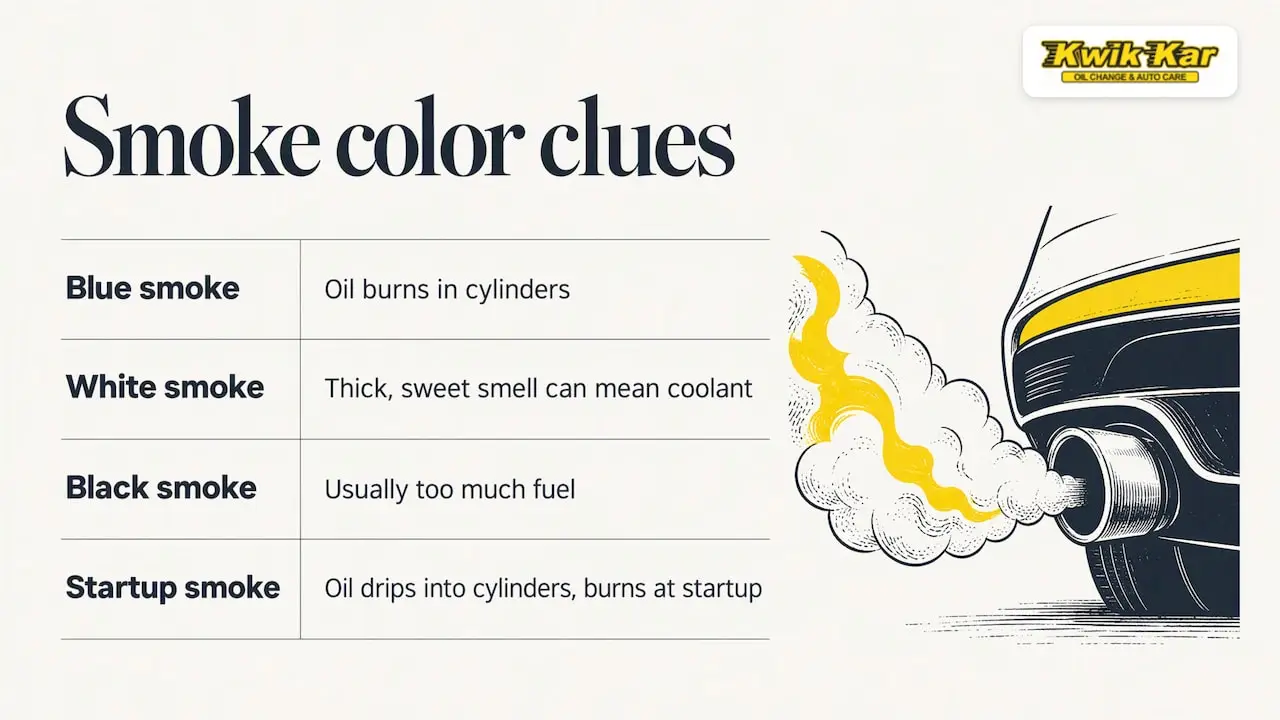
The color matters. Blue means oil. White, thick smoke that smells sweet can mean coolant. Black smoke usually means too much fuel. Many drivers lump them together, so look at the color in daylight against a light background, or ask someone to watch the tailpipe while you start the car.
Timing matters too. When smoke is worst right at startup, the usual explanation is oil that dripped into the cylinders while the engine was off, then burned off in the first few seconds. A Hot Rod shop manual on oil burning lists loose intake valve guides and faulty intake valve seals as causes of a puff of blue smoke when the engine starts after sitting.
Common causes of blue smoke at startup
1. Worn valve stem seals
Valve stem seals are small rubber parts that sit on the valve stems. They let in just enough oil to lubricate the valves and keep the rest out. Over years of heat, they harden and shrink.
When they no longer seal well, oil creeps down the stem while the engine sits. The next start burns it off in a puff. A service guide for a classic Pontiac describes the same “big puff when it first starts” complaint and walks through how to separate seal trouble from other oil burners.
This is the most common reason for a startup-only puff. The smoke often clears within seconds, and the engine may run normally afterward.
2. Worn valve guides
The valve guide is the passage the valve stem slides in. When it wears, the gap grows and oil can pass through even with good seals. The symptom looks much like bad seals, which is why a shop will often look at both before quoting a repair.
3. A clogged or failing PCV system
The positive crankcase ventilation (PCV) system pulls pressure and oil vapor out of the crankcase and sends it back through the intake to be burned. Your textbook-level reference, a chapter on PCV operation and service, explains that a blocked valve or oil separator, or a ruptured internal diaphragm, keeps oil vapors from being recycled properly. They can build up in the intake and raise oil consumption.
The same source notes that a simple rattle test of the valve is not enough to prove it is good, because the spring can weaken over time. Manufacturers set their own replacement intervals, so check your owner’s manual.
PCV trouble is cheaper to fix than most other causes, which is why it deserves a look before anyone talks about an engine rebuild.
4. Worn piston rings or cylinder wear
Piston rings seal the cylinder and scrape oil off the walls. When they wear or stick, oil gets past them. The smoke tends to appear during driving, especially under load, and it is not limited to startup. Oil consumption is usually steady, so you add oil between changes more often.
5. Turbocharger seal leaks
On turbocharged engines, worn turbo seals can send oil into the intake or exhaust. Smoke may show up at startup, during acceleration or after idling. A turbo problem needs hands-on diagnosis, since the turbo can also be damaged by low oil.
6. Overfilled oil
Too much oil can let the crankshaft whip it into foam and push it through the ventilation system. If you recently changed your own oil and the smoke started after, check the dipstick for a level above the full mark.
Match the pattern to the likely cause
Use this table as a starting point. It is a guide to what a mechanic will look at first, not a diagnosis.
| What you see | Likely suspects | How urgent |
|---|---|---|
| One puff after sitting overnight, then clear | Valve stem seals, valve guides | Plan a visit soon, watch oil level |
| Puff after sitting, plus oil level slowly dropping | Seals, guides, early ring wear | Check oil weekly, book an inspection |
| Smoke on startup and again when you lift off the gas going downhill | Valve seals or guides | Book an inspection |
| Steady blue smoke while driving or under load | Piston rings, turbo seals, PCV problem | Get it checked promptly |
| Blue smoke after you restart a hot engine or after long idling | Seals, PCV, turbo | Get it checked, track oil use |
| Blue smoke with an oil pressure light or knocking | Severe oil loss or internal damage | Stop driving, call for a tow |
What about blue smoke after idling?
If you idle for a while and then see a puff when you pull away, oil may be collecting in the intake or pooling in a cylinder while engine vacuum is high. Worn valve seals, a PCV problem or a turbo seal can all do this. Treat it like a startup puff: note how long it lasts, then check your oil level.
Five things you can check in the driveway
You do not need tools for most of this. The goal is to give a mechanic better information, not to replace one.
- Check the oil level. Park on level ground, wait a few minutes after shutting the engine off, pull the dipstick, wipe it, reinsert it and read it. If it is below the add mark, top up with the grade in your owner’s manual. Our guide on checking the dipstick when you notice a burning oil smell walks through it.
- Note when the smoke appears. Only on a cold start? After sitting a few hours? Under hard acceleration? Write it down. The pattern narrows the cause.
- Time the smoke. A puff lasting a few seconds is a different story than smoke that continues for a minute or more.
- Look under the car and around the engine. Oil spots on the driveway or wet areas near the valve cover point to external leaks. Those can smell like burning oil but do not make blue smoke from the tailpipe.
- Track oil use. Mark the dipstick level after a fill, then check again after a week of normal driving. A noticeable drop tells a shop how much oil the engine is burning.
Do not keep driving with the oil light on or the level well below the add mark. Low oil can cause damage far costlier than the original problem.
Blue smoke versus white and black smoke
Here is a quick way to separate the three, so you do not chase the wrong problem.
- Blue or blue-gray: burning engine oil. This article’s topic.
- Thick white with a sweet smell: possible coolant entering the engine. Thin white vapor on a cold morning is usually normal condensation and disappears as the exhaust warms.
- Black: too much fuel or too little air. A dirty filter or fuel system issue is a common place to start. Our pages on engine air filter changes and fuel system cleaning cover those.
If you are not sure what you are seeing, describe it to a technician as exactly as you can. Color, smell, timing and duration all help.
Is it safe to keep driving?
A single small puff on a cold start, with a full dipstick and no warning lights, is usually not an emergency. It is still a sign of wear, and it tends to get worse, not better.
Stop and get help if you see any of these:
- The oil pressure light comes on.
- The oil level drops fast between checks.
- Smoke is constant, heavy or fills the cabin with a burning smell.
- The engine runs rough, misfires or knocks.
- The check engine light flashes.
Oil that burns also reaches the catalytic converter. Over time it can foul it, which is an expensive repair. That is one more reason not to ignore a smoking engine.
Our perspective: start with the cheap checks
We see this symptom often, and the first thing we tell drivers is not to panic. A puff of blue smoke does not mean the engine is finished. Plenty of cars with worn valve seals run for a long time if the oil level is watched and the oil is changed on schedule.
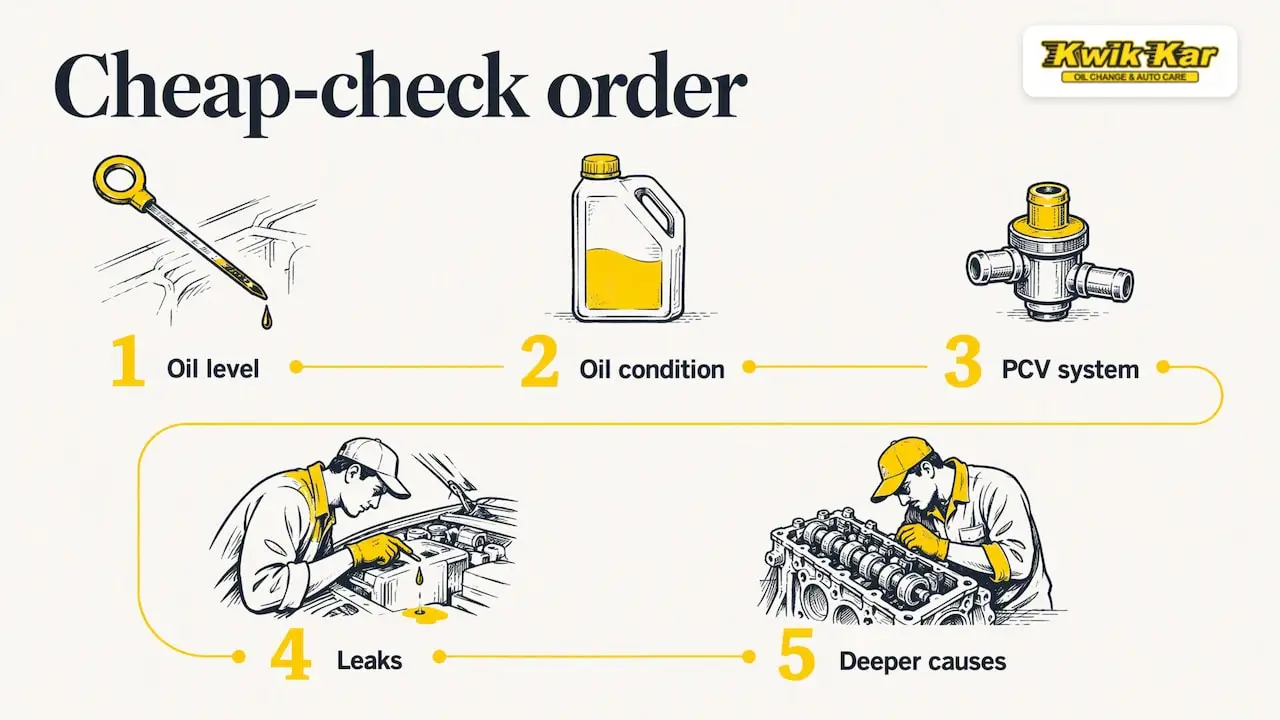
What we do not want is for you to guess. Blue smoke has several possible causes, and they range from a small PCV fix to internal engine wear. We start with what is simplest to confirm: oil level, oil condition, the PCV system, leaks, and then the deeper causes if the symptoms point there.
Communication matters as much as the repair. Our ASE-certified mechanics explain what they find in plain language, and you decide what happens next. If the sensible answer is to monitor oil use and come back, we will say so. If the engine needs real work, you will hear why before anything is done.
One more point: regular oil changes with the right grade of oil protect seals and rings. They do not reverse wear, but they slow it. You can read how often to change oil in our oil change interval guide.
— Kwik Kar
What a shop visit looks like for blue smoke
Expect a conversation first. A good technician will ask when the smoke appears, how long it lasts, how much oil you add, and when the oil was last changed. Then comes a hands-on look.
Typical steps include:
- Checking oil level and condition.
- Inspecting the PCV valve and hoses.
- Looking for external leaks that could be confused with burning oil.
- Scanning for trouble codes if the check engine light is on.
- Evaluating whether seals, guides, rings or a turbo are the likely source, based on what the symptoms show.
Some causes call for more testing, such as a compression or leak-down test, before anyone can say what the repair will be. A responsible shop will tell you that, not guess at a price.
Where we can help
We handle engine repair, oil changes and preventive maintenance, belts and hoses, fuel system service and fluid exchanges, all at our Midlothian shop. If the smoke is joined by a check engine light, we also work on those. See the full list on our services page, or check our specials page for current coupons. We do not publish prices for these services, so call us for details.
Buying a used car? Cold starts tell you a lot
Blue smoke at startup is one of the better reasons to ask a seller not to warm the car up before you arrive. A cold engine shows valve seal and ring problems that a warmed-up one can hide. One dealership blog explains how to look for engine faults during a cold-start test drive, and the idea applies anywhere.
If you are a first-time buyer, a pre-purchase look from an independent shop can tell you whether oil consumption is a concern before you sign.
If the car has been sitting for weeks
Cars that sit for a long time can smoke on the first start, since oil settles and seals dry out. A short puff that fades is common in that case. If you are bringing a vehicle out of storage, this checklist for restarting a stored car covers the basics. If the smoke does not clear after a short drive, have it checked.
Texas inspections and oil-burning engines
Texas changed its rules for passenger vehicles. According to the Texas DMV, House Bill 3297 ended the safety inspection requirement for non-commercial vehicles starting January 1, 2025. Emissions inspections are still required before registration in 17 counties, and Ellis County, where Midlothian is located, is on that list.
This means an ordinary passenger car does not need an annual safety inspection, but it does need an emissions inspection to register in our county. Commercial vehicles are a separate case, with their own inspection requirements. Our Texas emissions and commercial inspections page explains what we offer.
An engine that burns oil can create extra hydrocarbons in the exhaust, so it is smart to sort out smoke before your inspection, not after a failed test.
Frequently asked questions
Why does my car smoke blue when I first start it?
In most cases, oil has seeped past worn valve stem seals or valve guides while the engine sat, and it burns off at startup. A clogged PCV system or worn rings can also be behind it. Check your oil level and have a technician look if it happens regularly.
Can a bad PCV valve cause blue smoke on startup?
Yes. A blocked valve or oil separator, or a torn diaphragm, can let oil vapor build up in the intake and increase oil use. It is one of the cheaper causes to check, so it is a good place to start.
Is smoke on startup normal?
Thin white vapor on a cold day is normal condensation and fades as the exhaust warms. Blue smoke is not normal. It means oil is burning, even if it is only a short puff.
How do you fix blue smoke from an engine?
The fix depends on the cause. It might be a new PCV valve, replaced valve stem seals, or, for worn rings or a turbo leak, more extensive engine work. A diagnosis comes first so you only pay for the repair you need.
Schedule a check before a puff becomes a problem
If your car is puffing blue smoke, bring it in and let us find out why. Call Kwik Kar of Midlothian at (972) 775-5945 to schedule service, and tell us what you have noticed and when. The more detail you give, the faster we can get you back on the road with confidence.
Sources
- Texas DMV: vehicle inspection changes
- Hot Rod: Shop Manual, The Oil Burning Blues
- Fiero Online Service Guide: valve stem seals
- PCV operation, diagnosis and service (Halderman, Pearson)