




Automotive lighting repair covers everything from swapping a burned-out bulb to diagnosing a wiring fault or replacing a cracked headlight assembly. A simple bulb job is usually quick and inexpensive. A modern sealed assembly or an electrical fault can take more time and cost more. The right fix depends on what is actually wrong, and that is why a proper check beats guessing.
This guide explains the common lighting problems, what each repair involves, what published price ranges look like, and what Texas law says about working lights. If you would rather have someone look at it now, call us at (972) 775-5945.
TL;DR
- Most lighting problems start with a bulb, but a fuse, connector, wiring fault or failing assembly can look exactly the same from the driver’s seat.
- Published estimates run roughly $20 to $75 for a bulb, $75 to $250 for diagnosis and wiring work, and $300 to $1,000 or more for a full headlight assembly. Your vehicle sets the real number.
- Cloudy lenses cut light output sharply, and restoration only gets you part of the way back. Aim matters as much as brightness.
- Texas no longer requires safety inspections for ordinary passenger vehicles, but working lights are still required by law every time you drive at night.
Table of Contents
- Signs Your Vehicle Needs Lighting Repair
- What Lighting Covers on Your Vehicle
- Common Causes Behind a Lighting Problem
- Why Headlight Aim Matters
- Halogen, HID and LED: What Changes in the Repair
- What Lighting Repair Typically Costs
- Can You Fix It Yourself?
- Cloudy Headlights: Restore or Replace?
- What Texas Law Says About Vehicle Lights
- What to Expect at the Shop
- A 5-Minute Lighting Check You Can Do at Home
- Our Perspective on Lighting Repair
- Book Your Lighting Check in Midlothian
- Frequently Asked Questions
- Sources
Signs Your Vehicle Needs Lighting Repair
Lights fail in ways that are easy to miss because you rarely see your own taillights. Watch for these.
- A dim or uneven beam. If one side of the road looks darker than the other at night, one headlight may be failing or aimed wrong.
- Flickering. Lights that pulse, cut out over bumps or flicker when you use another accessory often point to a loose connector, a ground problem or a failing component.
- A fast-blinking turn signal. On many vehicles, a signal that flashes faster than normal means a bulb on that side has burned out.
- A warning light on the dash. Some vehicles alert you to a lamp failure. Others tie lighting faults to a broader electrical issue.
- Repeated bulb failures. If the same bulb keeps burning out, a bulb is not the real problem. Moisture, a bad socket or a voltage issue may be.
- Foggy, yellow or hazy lenses. Cloudy plastic scatters light instead of projecting it down the road.
- A tip from another driver or an officer. Someone else usually notices a dead brake light before you do.
A dead brake light is the one to treat as urgent. It is the signal that tells the driver behind you that you are slowing. If you see the brake light warning on your dash too, our guide to the 30-second brake light check walks through what to look at first.
What Lighting Covers on Your Vehicle
When people search for lighting repair they usually mean headlights. A vehicle has far more lamps than that:
- Headlights, low beam and high beam
- Daytime running lights
- Fog lights, if equipped
- Brake lights, including the third brake light mounted high on the rear
- Taillights and license plate lights
- Turn signals and hazard flashers
- Reverse lights
- Interior and dash lighting
They share a power supply, fuses, relays, switches and wiring. A failure in the shared parts can take out several lamps at once, which is why more than one dead light on the same side often points to a connector or circuit rather than separate bulbs.
Common Causes Behind a Lighting Problem
Burned-out bulbs
This is the most common cause and the easiest fix. Halogen bulbs wear out gradually and dim before they fail. Replacing a headlight bulb in pairs is standard practice, since both sides then match in brightness and have similar remaining life. If one side dies, the other is probably close behind.
Blown fuses and bad relays
A fuse protects the circuit. If it blows, something else may have caused it, such as a short or an overloaded connection. Replacing the fuse without finding the cause can mean it blows again.
Corroded sockets and loose connectors
Moisture, road salt and heat can corrode the contacts in a bulb socket. The bulb is fine, but the connection is not. You may see flickering, a dim lamp, or a lamp that only works when you tap the housing.
Wiring faults
Chafed or damaged wires can short or open a circuit. These faults are often intermittent, which makes them hard to find without proper testing. Electrical problems are seldom easy to solve and often require careful, rigorous testing, especially when they come and go.
Failing switches, modules or alternators
A weak charging system can dim lights across the whole vehicle. If your headlights brighten when you rev the engine and dim at idle, have the battery and alternator checked. Our post on the battery light while driving covers what that warning means.
Cloudy or damaged lenses
Older plastic headlight lenses oxidize from sun and weather. Texas summers are hard on them. A cracked housing can also let in moisture, which fogs the inside and shortens bulb life.
Why Headlight Aim Matters
A new bulb is only half the job. Headlights that are aimed too high blind oncoming drivers. Aimed too low, they leave dark gaps on the road ahead of you. Proper lighting service includes checking aim with the right tools so that each lamp conforms to performance standards.
Aim can shift after a bulb or assembly replacement, after suspension work, or after a tire size change. It can also change when you carry a heavy load regularly. If drivers flash their high beams at you on a dark road and you are using low beams, ask for the aim to be checked.
Halogen, HID and LED: What Changes in the Repair
The type of lamp on your vehicle affects both the repair and the bill.
| Lamp type | Typical repair | What to know |
|---|---|---|
| Halogen | Bulb replacement, often a simple swap | Lowest cost and the easiest to service. Bulbs dim over time. |
| HID (xenon) | Bulb, ballast or igniter replacement | Parts cost more, and the high voltage involved is a reason not to improvise. |
| LED | Often a sealed module or full assembly | Frequently not serviceable bulb by bulb. A failure can mean replacing the whole unit. |
Kelley Blue Book notes that replacement costs range from about $10 to $40 for halogen bulbs up to thousands of dollars for sealed LED or laser assemblies, with labor on top.
There is also a quality angle with LEDs. Many newer vehicles use pulse width modulation to dim LED lamps, which can produce flicker. Department of Energy researchers have described how this can create a phantom array effect that makes it harder for other drivers to judge speed and distance. That is one reason to choose quality, manufacturer-approved replacement parts instead of the cheapest lamp you can find online.
What Lighting Repair Typically Costs
Prices vary by vehicle, parts and labor time, so treat these as published ranges and not quotes. One 2026 price guide lists:
| Job | Typical range |
|---|---|
| Bulb replacement | $20 to $75 |
| Wiring repair or diagnostic | $75 to $250 |
| Full headlight assembly replacement | $300 to $1,000 or more per job |
We do not publish set prices for lighting work, because the cost depends on your vehicle and what the diagnosis finds. We can tell you what is needed and what it will cost before the work begins.
Why access adds labor
On many modern vehicles, getting to the headlight means more than opening the hood. Front bumpers or engine bay trim sometimes have to come off before you can reach the assembly. A bulb that costs a few dollars can then involve noticeable labor. That is not padding on a bill. It is the design of the vehicle.
What drives the price up or down
- Vehicle make, model and trim
- Lamp technology (halogen, HID, LED)
- Whether the fault is the bulb, the socket, the wiring or the assembly
- Whether aim adjustment is needed afterward
- Whether one lamp or a pair is being replaced
Can You Fix It Yourself?
Sometimes. On many older vehicles, a halogen bulb swap takes a few minutes with the owner’s manual. Avoid touching the glass of a new halogen bulb with bare fingers, since skin oil can shorten its life. Replace both sides if one has gone.
It becomes a shop job when:
- The bumper or other trim has to come off
- The lamp is HID or a sealed LED unit
- The new bulb fails quickly or the fuse blows again
- Several lights stop at once
- You are unsure the replacement lamp is approved for your vehicle
The same goes for anything involving wiring. A wrong guess with a short circuit can damage a module that costs far more than the bulb.
Cloudy Headlights: Restore or Replace?
Restoration kits are popular because they cost little. They do help. AAA’s testing found that clouded or yellowed headlights produce only about 20 percent of the light of new ones. The same research found that both professional and do-it-yourself restoration bring output back to roughly 70 to 73 percent of new original-equipment performance. Restoration can also change how the light spreads, which may cause glare for oncoming drivers. Replacing the assembly is the only way to return to full original brightness.
A practical way to decide:
- Light haze on an otherwise sound lens: restoration may be a reasonable short-term step, followed by an aim check.
- Deep yellowing, cracks or moisture inside the housing: replacement is the better route.
- Night driving already feels uncomfortable: do not wait. Visibility is the point of the whole system.
What Texas Law Says About Vehicle Lights
Texas requires every motor vehicle to have at least two headlamps, mounted between 24 and 54 inches above the ground. Headlights must also be on at night and whenever conditions make people and vehicles hard to see.
Here is where drivers often get confused about inspections.
- Ordinary passenger vehicles: As of January 1, 2025, safety inspections for noncommercial vehicles are not required. That does not make a dead headlight legal. The equipment rules still apply on the road.
- Emissions testing: Some counties still require an annual emissions inspection. Ellis County, where Midlothian sits, is on the TxDMV list of emissions counties. Emissions testing looks at exhaust output, not your lamps. It is a separate matter from lighting.
- Commercial vehicles: These remain subject to both safety and emissions inspections. If you run a work truck or a fleet vehicle, a failed lamp is something to correct before an inspection, not after.
If you need emissions or commercial inspection help, see our page on Texas emissions and commercial inspections.
What to Expect at the Shop
A good lighting visit follows a clear order.
- You describe the symptom. Which lamp, when it happens, and whether it is constant or intermittent.
- The technician checks the basics. Bulb, fuse, socket and connector come first, since they are the most common causes.
- Testing narrows the cause. If the basics are fine, the circuit is tested for voltage, ground and wiring faults.
- You get a clear explanation. The cause, the options and the cost should be explained before work starts.
- The repair is made and verified. Every lamp is checked, including brake lights, signals and reverse lights, and headlight aim is confirmed where it applies.
Our electrical and lighting repair page describes this kind of work. For a quick bulb job, see our headlight bulb replacement page.
A 5-Minute Lighting Check You Can Do at Home
You do not need tools for this. Park facing a garage door or wall at night.
- Turn on the low beams and compare brightness and position on both sides.
- Switch to high beams and check both.
- Turn on the hazards and confirm all four corners flash.
- Test each turn signal, front and rear.
- Back up to a wall or ask a helper to watch while you press the brake and shift into reverse.
- Look at the lenses for fogging, yellowing, cracks or water inside.
Write down anything that looks off. It makes the diagnosis faster.
Our Perspective on Lighting Repair
We see lighting as a safety system, not a cosmetic one. A light that works lets you see and lets others see you. When a driver comes in with a lamp problem, we start by finding the actual cause, because swapping a bulb that was never the problem wastes time and money.
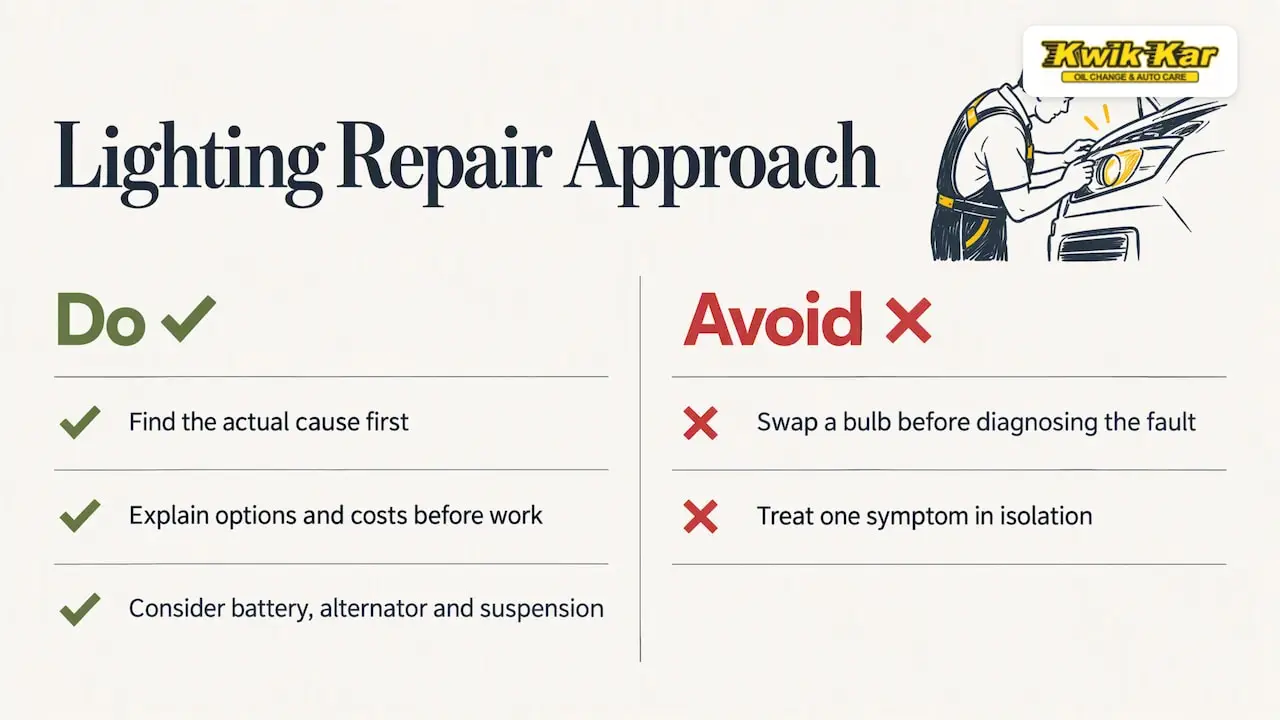
We also think the repair conversation should be plain. You should know what is wrong, what your options are and what each costs before anyone picks up a tool. Our shop works with ASE-certified mechanics, and we focus on honest recommendations and clear communication. If a bulb is all you need, we will say so. If the fault is in the wiring or the charging system, we will explain why.
Lighting also rarely stands alone. A battery or alternator problem can dim the lights. Suspension work can change headlight aim. Because we handle general maintenance and repair in one place, we can look at the whole picture instead of treating one symptom.
— Kwik Kar
Book Your Lighting Check in Midlothian
If a lamp is out, dim or flickering, bring your vehicle to Kwik Kar Lube & Tune. We handle lighting along with the rest of your routine care, so you can combine a lamp fix with an oil change or a brake check in one visit. See everything we offer on our services page, or check current specials before you come in.
Frequently Asked Questions
How much does automotive lighting repair cost?
It depends on the job. Published ranges put bulb replacement at $20 to $75, wiring and diagnostic work at $75 to $250, and full headlight assembly replacement at $300 to $1,000 or more. Your vehicle and the cause of the problem decide where you land, so ask for an estimate after diagnosis.
Why did my new headlight bulb burn out so quickly?
A bulb that fails fast usually points to something other than the bulb. Moisture in the housing, a corroded socket, a loose connector or a voltage problem can all shorten its life. Touching the glass of a halogen bulb during installation can also cause early failure.
Do I need a safety inspection in Texas to check my lights?
Not for an ordinary passenger vehicle. Noncommercial vehicles no longer need a safety inspection as of January 1, 2025. You still need working lights on the road, and commercial vehicles remain subject to safety inspections.
Is headlight restoration as good as new headlights?
No. AAA research found that restoration returns light output to roughly 70 to 73 percent of new performance. Only replacing the assembly restores full brightness. Restoration can still help a lightly hazed lens.
What can I use to clean my car lights?
For surface dirt and bugs, mild car soap and water with a soft cloth is enough. Cleaning will not fix oxidation inside the plastic, which needs restoration or replacement. Avoid harsh solvents, which can damage the lens coating.
To schedule lighting service, call us at (972) 775-5945. Tell us which lamp is giving you trouble, and we will get you on the schedule.
Sources
- How Much Does Automotive Lighting Cost? 2026 Price Guide, Reedleys
- Headlights Burned Out: What’s the Cost to Replace? Kelley Blue Book
- Electrical System Diagnosis Cost Estimate, RepairPal
- Automotive Headlight Change Service, NAPA Auto Parts
- Addressing flicker in lighting, U.S. Department of Energy
- AAA Illuminates the Dangers of Driving with Cloudy Headlights
- Texas Transportation Code § 547.321, Headlamps Required
- TxDMV calendar: inspection changes for noncommercial vehicles
- New to Texas, TxDMV