
Tire cupping is almost always a sign that your tire is bouncing instead of rolling smoothly. The most common causes are worn shocks or struts, an unbalanced wheel, loose or worn suspension parts, and alignment problems. Because the scooped wear stays on the tire even after the cause is fixed, the sooner someone inspects the whole wheel, suspension and steering, the less rubber you lose. Our ASE-certified mechanics at Kwik Kar in Midlothian can inspect all of that for you.
TL;DR
- Cupping (also called scalloping) is a pattern of scooped-out dips spaced around the tread, usually felt as a hum, roar or vibration.
- Worn shocks and struts are the leading suspect, followed by wheel imbalance, worn suspension parts, misalignment, and skipped rotations or poor tire pressure.
- Cupped wear does not reverse. Fixing the cause protects the next set of tires.
- Tread worn to 2/32 inch, bulges, exposed cord or a worsening vibration mean it is time to stop driving on the tire.
- Call us at (972) 775-5945 to have the wheels, suspension and alignment inspected.
Table of Contents
- What Tire Cupping Looks and Feels Like
- The Main Causes of Tire Cupping
- Why It Is Rarely One Cause
- How Cupped Tires Sound
- Is It Safe to Drive on Cupped Tires?
- Can You Fix Cupped Tires?
- How to Keep Cupping from Coming Back
- Our Perspective
- Get the Cause Found and Fixed
- FAQ
- Sources
What Tire Cupping Looks and Feels Like
A cupped tire has high and low spots that alternate around the tread, like someone took an ice cream scoop to it. The dips are usually a few inches apart. They often show up on the edges of the tread first, which is why you may not see them from the driver’s seat.
The easiest check is by touch. With the car parked and the wheels cool, run your hand slowly around the tread. A healthy tire feels smooth. A cupped one feels wavy or bumpy, like a washboard road.
You may notice other signs while driving:
- A rhythmic noise. A hum, growl or roar that rises with speed. It is the sound of the uneven tread slapping the pavement.
- Vibration. Often felt in the steering wheel or seat, getting stronger as you speed up.
- A bouncy or floaty ride. Especially over dips and after bumps.
- Wear that appears on both tires of one axle. This often points to something shared, like worn shocks.
Not every cupped tire is loud. A mildly cupped tire may produce no unusual noise at all, so a quiet ride does not rule it out. If you want to read more about vibration in general, our guide to car shaking while driving covers the other usual suspects.
The Main Causes of Tire Cupping
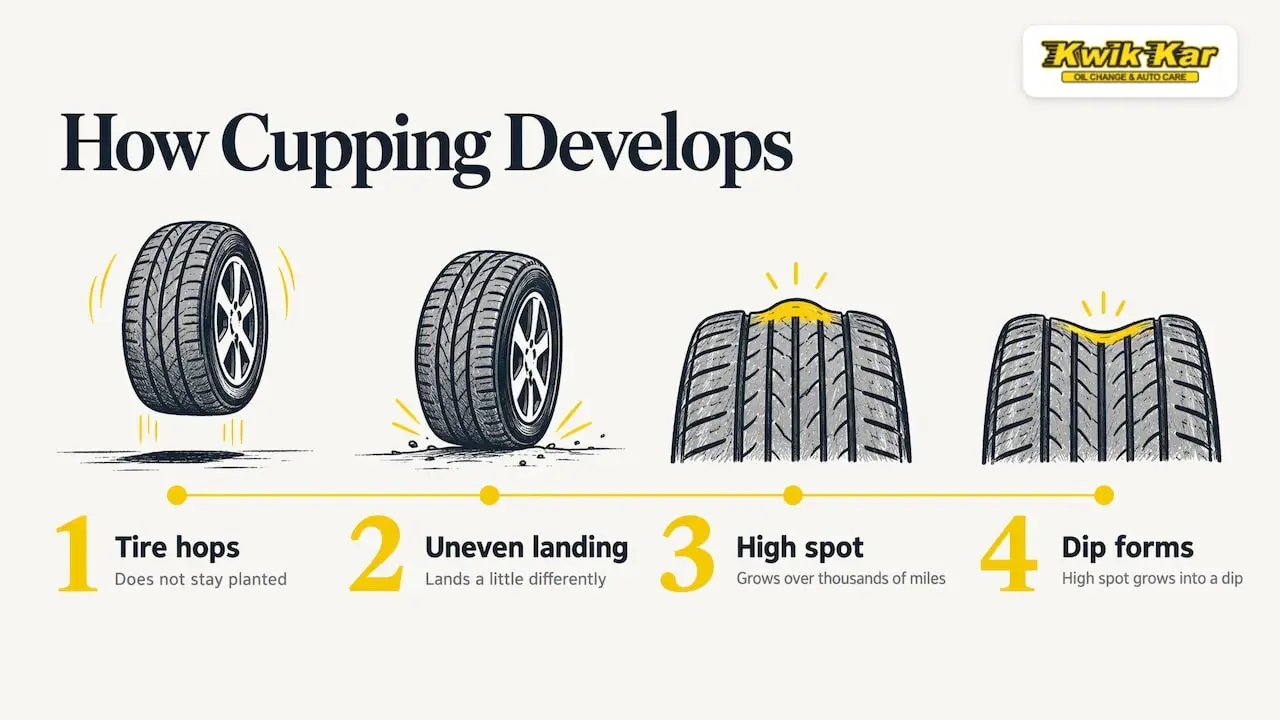
The common thread is a tire that does not stay planted on the road. Each time it hops, it lands a little differently, and over thousands of miles a small high spot grows into a dip. Here is what usually lets that happen.
Worn shocks and struts
Shocks and struts control how much your wheels move up and down. Trade reporting on tire wear diagnostics explains that cupping is usually the result of worn ride control that cannot keep the tire’s bounce in check. As the fluid inside degrades or leaks, the tire can lift off the pavement and wear unevenly.
Signs your dampers may be tired include:
- The car keeps bouncing after a dip or speed bump
- The nose dives when you brake
- Oily residue on the shock or strut body
- Cupping on both tires of the same axle
These are clues, not proof. A bounce-test by pushing down on a fender is only a rough screening, because results vary with the vehicle’s suspension design, weight and tire pressure. A real inspection and road test tell you more.
Wheel and tire imbalance
A wheel with a heavy spot creates a small, repeated bounce with every rotation. The tread then meets the road unevenly, which is a direct route to scalloping. Imbalance can start after a tire is mounted, after a wheel weight falls off, or as the tire wears. Balancing helps stop the problem from developing, but it cannot remove cupping that is already there.
Worn or loose suspension and steering parts
Ball joints, tie rods, control arm bushings and wheel bearings all keep the wheel positioned correctly. When one develops play, the wheel can shake or wobble slightly as it rolls. That movement is enough to start uneven wear, even if your shocks are fine. A bent wheel can do the same thing, and our page on bent rim symptoms explains how to tell.
Poor alignment
When the wheels are not pointed the way the manufacturer intended, the tire scrubs and drags instead of rolling cleanly. Alignment problems more often cause wear on one edge, but they can contribute to cupping, especially alongside worn parts. One important detail: alignment should be measured after worn suspension parts are repaired. Aligning a car with loose components does not hold.
Tire pressure and rotation habits
Underinflated or overinflated tires do not contact the road the way they were designed to. Skipping rotations lets each position wear in its own pattern, and some tread designs are simply more prone to developing dips when they sit too long in one spot. Your recommended pressure is on the sticker inside the driver’s door jamb, not on the tire sidewall. The sidewall number is the tire’s maximum, not your target.
Why It Is Rarely One Cause
A cupped tire is evidence that something is wrong, not a label that says what. Worn shocks, an imbalanced wheel and a loose ball joint can all leave the same marks. Tires that have been bouncing for a while may also be hiding a second problem.
That is why guessing is expensive. Replace only the tires, and the same cause eats the new set. Replace shocks and skip the balance, and the vibration stays. A good inspection works through the list in order: the tire and wheel, the dampers, the steering and suspension joints, and finally alignment.
How Cupped Tires Sound
The noise follows the tire, not the engine. It typically changes with road speed, not with engine RPM or gear. Drivers describe it as a low roar, a rhythmic thumping or a hum that gets louder on smooth highways.
A few ways to tell it apart from other problems:
- A hum that changes when you turn can point toward a wheel bearing instead of tire wear.
- A roar plus a steering pull can mean alignment or suspension trouble along with the tire wear.
- A thump or shake with a visible bulge can mean tire damage. Read our 30 MPH rule for tire sidewall bulges before driving farther.
- A pull when you brake is a separate issue worth checking with our car pulls when braking guide.
Because several faults sound alike, it helps to have a technician listen on a road test and look at the tires, rather than rely on the noise alone.
Is It Safe to Drive on Cupped Tires?
It depends on how far the wear has gone. A lightly cupped tire with good tread depth may still be serviceable for a short time while you schedule an inspection. A deeply cupped tire reduces grip, especially on wet roads, and makes the car feel less steady.
Tread depth is the clearest line. The built-in wear indicators sit at 2/32 inch (1.6 mm). A tire manufacturers’ warranty guide published for MINI owners says a tire worn to that level, or showing exposed cord or fabric, is dangerously worn and should be replaced immediately. It also says vibration, bumps, bulges or irregular wear should be evaluated by a qualified tire service professional.
Stop driving and have the car looked at right away if you notice:
- Exposed cord or steel belts
- A bulge on the sidewall or tread
- Tread down to the wear bars
- Vibration that is getting worse
- A grinding sound or play in the wheel
- Clunking with a pull or wander in the steering
Texas summers add heat to the equation. Hot pavement stresses tires that are already out of round, and dry, cracking rubber is a separate warning sign, covered in our tire dry rot guide. A slow leak can also cause pressure-related wear, so see our page on how to find a slow tire leak.
Can You Fix Cupped Tires?
The honest answer: you fix the cause, not the cups. Once the scooped pattern forms, it does not even itself out, and rotating the tires may move the noise around without erasing the dips. Balancing will not smooth it either.
A sensible repair path looks like this:
- Inspect the tires and measure the damage. Check tread depth in the inner, center and outer grooves at several spots, and feel for the dips.
- Find the cause. Check the shocks or struts, ball joints, tie rods, bushings and wheel bearings. Confirm the wheel and tire assembly is balanced and true.
- Repair what is worn. Replace failing dampers or loose parts before anything else.
- Align the wheels. Done after the repairs so the settings hold.
- Decide on the tires. Mild cupping with plenty of tread may be livable. Heavy cupping, persistent noise or vibration, low tread, or any damage usually means new tires.
- Set the new tires up for success. Correct inflation, a rotation schedule and a balanced assembly.
When you do replace tires, match the size, load index and speed rating shown on the door-jamb placard. All-wheel-drive and four-wheel-drive vehicles often have extra matching requirements between axles, so follow the owner’s manual.
The order matters because it protects your money. New tires on a car with worn shocks are a short-lived repair.
How to Keep Cupping from Coming Back
A few habits go a long way:
- Check pressure monthly, when the tires are cold, using the number on the door-jamb sticker.
- Feel the tread every month or so. Catching a high and low spot early gives you time to fix the cause.
- Rotate on schedule. Follow your owner’s manual. Many drivers rotate around every 5,000 miles, which can also line up with an oil change visit.
- Rebalance after a vibration appears, or after new tires or wheel service.
- Have alignment checked if the car pulls or the tires wear unevenly. Our wheel alignment cost guide explains what to expect from an inspection.
- Don’t ignore ride changes. More bounce, nose dive or clunks over bumps are reasons to check the shocks, struts and steering parts.
If you want a routine to follow, combining a rotation with a general inspection is an easy way to keep an eye on everything at once. Our guide on how often to change oil in Midlothian is a good schedule to hang tire checks on.
Our Perspective
Most people come to us after they hear a noise. By then the tires have often been wearing unevenly for a long time. The tires are the part you can see, but they are usually the messenger, not the problem.
That is why we start with the whole picture: tire condition, wheel and suspension, steering, and alignment. Our mechanics are ASE-certified, and we explain what we find in plain terms so you can decide what to do and in what order. We would rather you leave knowing why the tires wore out than with a bill that treats only the symptom.
Fixing the cause first is what protects a new set of tires. If you are not sure what you are looking at, bring the car in and we will go over it with you.
Kwik Kar
Get the Cause Found and Fixed
Kwik Kar Lube & Tune of Midlothian offers tire sales and service, wheel alignment and steering and suspension repair, all on our services page. That means a cupped tire can be looked at together with the parts most likely to have caused it. Our repairs are warranty-backed.

If you have felt a hum, a bounce or a bumpy tread, call us at (972) 775-5945 and we will get you on the schedule.
FAQ
Is it bad to drive on cupped tires?
It can be. Light cupping with good tread may be fine for a short time, but heavier cupping reduces grip, especially on wet roads, and often brings vibration. Tread worn to 2/32 inch, bulges or exposed cord mean the tire should be replaced right away.
Do bad shocks cause tire cupping?
Yes, worn shocks and struts are one of the most common causes, because they no longer control the tire’s bounce. Cupping on both tires of one axle, a bouncy ride and nose dive when braking are common clues. Since imbalance and worn suspension parts can leave the same pattern, the shocks should be inspected along with the rest of the wheel end.
Will tire cupping fix itself?
No. The scooped pattern does not smooth out with driving, rotation or balancing. What you can do is repair the cause so new or remaining tires do not wear the same way.
Can cupped tires make noise?
Often, yes. The typical sound is a rhythmic hum or roar that rises with speed and can come with steering wheel or seat vibration. Mild cupping may be silent, so feeling the tread by hand is a useful check. If you hear it, call us at (972) 775-5945 and schedule an inspection.
Sources
- Understanding tire wear patterns: A guide to diagnostics, Vehicle Service Pros
- Tire manufacturers’ warranties guide 2024, MINI USA