
A failing starter usually announces itself with a click, a slow crank, a whir or grind, or silence when you turn the key while the dash lights stay on. The tricky part is that a weak battery or a corroded cable can look exactly the same. Our ASE-certified mechanics at Kwik Kar in Midlothian handle battery, alternator and starter service, and this guide shows you how to read the symptoms before you make the call. Call us at (972) 775-5945 if your car is already refusing to start.
TL;DR
- The classic signs are a single click, slow cranking, a whirring or grinding noise, or no crank with the lights still on.
- Intermittent starting, where the car fires up fine ten times and then does nothing, is a common early warning.
- A weak battery, a bad alternator and corroded cables can mimic a bad starter, so timing and a jump-start attempt are useful clues.
- Smoke or a burning smell from under the hood means stop trying to start the car.
- A proper test measures voltage in the cranking circuit before any part is replaced.
Table of Contents
- What the starter does
- The main starter failure symptoms
- Starter solenoid symptoms
- Intermittent starting: why it comes and goes
- Is it the starter, the battery or the alternator?
- How a shop confirms a bad starter
- What a starter replacement costs
- What to do when the car won’t start
- Our perspective
- Get the starting system checked in Midlothian
- FAQ
- Ready to get it looked at?
- Sources
What the starter does
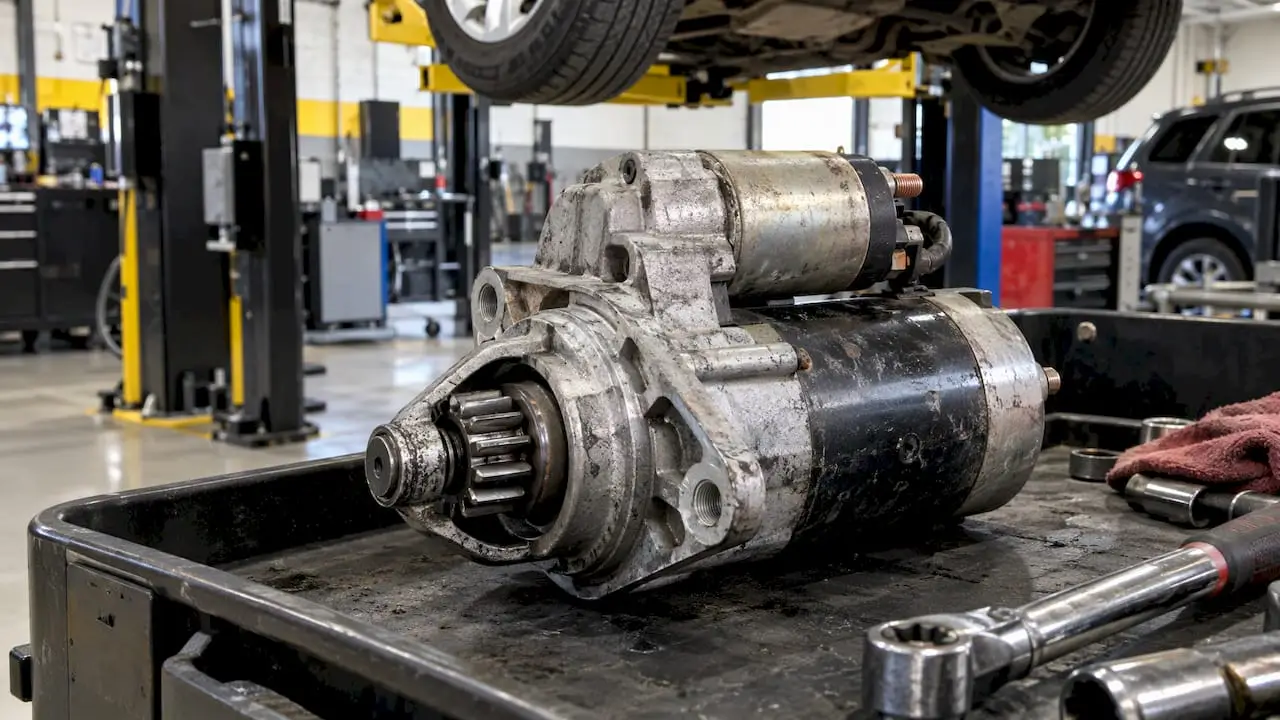
The starter is a small electric motor that spins the engine until it can run on its own. When you turn the key or press the start button, a switch called the solenoid sends battery power to the motor and pushes a small gear, the pinion, into the engine’s flywheel. Once the engine runs, the gear pulls back.
That chain has several links: battery, cables, solenoid, motor and gear. A fault in any one can produce a no-start, which is why symptoms need interpreting.
The main starter failure symptoms
1. A single click and no crank. One solid click with nothing after it can point to a weak battery, a voltage drop in the cables, a bad ground, or a failing starter or solenoid, according to this diagnostic guide on click patterns. A click shows that something moved. It does not prove that enough current reached the motor.
2. Slow, labored cranking. The engine turns over lazily, often worse on cold mornings. A worn starter can draw heavy current and drag, though HSM University’s starting systems lesson notes that thick oil or a hard-to-turn engine can also cause slow cranking.
3. Lights and radio work, but the engine does not crank. AutoZone’s starter guide lists dashboard lights with no cranking as a common sign. The battery has enough power for accessories, but the starter is not turning.
4. Whirring or grinding. A whir with no engine rotation means the motor is spinning without engaging. HELLA’s technical guide ties this to a damaged pinion or freewheel. Grinding often means the gear is not meshing cleanly with the flywheel.
5. The starter keeps running after the engine starts. This can happen when an internal short keeps the starter engaged, as AutoZone’s solenoid symptoms page describes. Release the key and shut the car off, and get it checked before you drive it again.
6. Smoke or a burning smell. Stop immediately. Repeated cranking on a faulty starter can overheat it. Do not keep turning the key.
Starter solenoid symptoms
On many vehicles the solenoid is part of the starter assembly. When it goes bad, you typically get:
- Clicking when you turn the key, with no crank
- No response at all
- Intermittent starting
- The engine not cranking even though the battery is good
Edmunds lists worn contacts, terminal corrosion, loose wiring and engine heat as common causes. Motor Trend explains that when the solenoid clicks but the starter does not crank, the contacts are often worn and cannot pass enough current. That failure tends to show up now and then at first and get worse as arcing wears the contacts further.
Because the solenoid is usually built into the starter, the whole unit is commonly replaced.
Intermittent starting: why it comes and goes
Intermittent starting is the symptom that frustrates drivers most. The car starts normally all week, then clicks on Friday and starts again after a few tries. Common reasons include:
- Worn solenoid contacts. Wear can leave a dead spot where the contacts sometimes do not connect. Heat can make it worse after the engine has been running, so the car may refuse a restart at the gas station.
- Corroded or loose connections. A battery terminal or ground strap that is barely making contact works until vibration or temperature shifts it.
- Voltage drop in the circuit. Delco Remy’s tech tip calls voltage drop a leading cause of click and no-click complaints.
- A worn pinion gear. Delco Remy’s diagnostic manual says a milled pinion can show up as spinning with no crank or an intermittent click with no crank.
A consistently failing starter does the same thing every time. An intermittent problem is harder to catch, so write down when it happens: hot or cold, after short trips, after rain. That note helps a technician a lot.
Is it the starter, the battery or the alternator?
A weak battery cannot hold the solenoid in, so a healthy starter may click or chatter. An alternator that stops charging eventually leaves the battery flat, so the car will not crank the next morning, which looks like a battery failure. A corroded cable or loose ground can imitate all three, as NXT Motors explains.
Timing is a useful clue, according to the same guide:
| What you notice | Likely area |
|---|---|
| Trouble only before the engine starts | Battery, cables or starter |
| Warning lights, dimming lights or stalling while driving | Alternator and charging system |
| Rapid repeated clicking, dim lights | Discharged battery or poor connection |
| No click at all, lights on | Power not reaching the solenoid: switch, relay, fuse or wiring |
| Normal cranking but no start | Fuel, ignition or sensors, not the starter |
The click-pattern rows come from the click diagnosis guide and Delco Remy’s note that a no-click, no-crank condition means power is not reaching the solenoid, so the starter motor is an unlikely cause.
The jump-start test helps too. If a jump gets the car going, the battery or charging side is the likelier culprit. If a jump does not help, AutoZone says the starter is likely at fault and the car should go to a mechanic by tow. Our guide on reasons a car won’t start walks through more of these checks, and if you needed two jumps in a short time, see our piece on parasitic battery drain.
How a shop confirms a bad starter
Guessing leads to replacing parts that were fine. A proper check looks at the whole cranking circuit. NXT Motors gives these targets:
- Battery voltage should reach the solenoid control terminal while the key is in the start position.
- Voltage drop on the positive side should be no more than about 0.5 volts.
- Voltage drop on the ground side should be no more than about 0.3 volts.
If the signal arrives and the drops are within limits, but the starter still clicks, whirs or turns slowly on an engine that turns freely, the starter is the fault. Voltage drop testing needs a meter and an understanding of what the readings mean, so it is a good job to hand to a technician. You can read more about the method in this voltage drop testing guide.
Slow cranking has other causes besides the starter. This slow cranking diagnosis covers cranking, fuel and engine control factors that can look like starter trouble.
What a starter replacement costs
Cost depends mostly on where the starter sits. ConsumerAffairs reports an average around $750 in 2025, with sample vehicles ranging from about $400 to $1,500. A mechanic quoted there says labor can run one to two hours on an accessible starter and eight or more when it is buried under the intake manifold. Your vehicle’s make and model decide where you land, so ask for a written estimate that separates parts and labor.
What to do when the car won’t start
- Check that the shifter is fully in Park or Neutral and the steering wheel is not locked.
- Look at the battery terminals for white or green crust and for loose clamps.
- Note the sound: one click, rapid clicks, a whir, or silence.
- Try a jump-start if you have the equipment and know the safe procedure in your owner’s manual.
- Do not keep cranking for long stretches. Stop if you see smoke or smell burning.
- If it will not start after a jump, have it towed rather than repeating attempts.
Our perspective
Most no-start calls we hear about begin with the same guess: it must be the starter. Sometimes that is right. Often the battery, a cable end or a ground connection is the real problem, and a new starter would not have fixed it.
That is why we start with the symptoms you describe, then check the parts of the starting system in order. We want you to understand what we found and why we recommend a repair before any work begins. Our mechanics are ASE-certified, and we stand behind our repairs with a warranty.
If your car has started to hesitate, click or crank slowly, do not wait for the morning it refuses entirely. Catching it early usually means you choose the time, not the tow truck.
Kwik Kar
Get the starting system checked in Midlothian
Our shop handles battery, alternator and starter service, along with the rest of the work listed on our services page. We can look at the whole starting system, so you know which part needs attention before you pay for it.

Bring the notes you made about the sound and when it happens. They speed up the diagnosis.
FAQ
Can a bad starter work sometimes and fail other times?
Yes. Worn solenoid contacts, a loose connection or heat can make a starter work on one try and fail on the next. The problem usually gets more frequent over time, so intermittent starting is worth having checked early.
What does a bad starter sound like?
Typically a single click, rapid clicking, a whirring noise with no engine rotation, or a grinding sound as the gear meets the flywheel. Rapid clicking often points to a weak battery rather than the starter.
Can a bad starter drain the battery?
A starter that keeps running or draws heavy current can load the battery, but a battery that drains while parked is more often a different electrical issue. Our parasitic drain guide explains how to look into that.
Is it safe to keep trying to start the car?
A few attempts are fine, but long repeated cranking can overheat a starter. If you see smoke or smell burning, stop right away and have the car looked at.
Ready to get it looked at?
If your car clicks, drags or sometimes will not start at all, call Kwik Kar in Midlothian at (972) 775-5945 and schedule a visit. We will find out what is behind it and talk you through the repair before it begins.
Sources
- Checking the starter: causes of failure, troubleshooting (HELLA)
- Signs of a Bad Starter (AutoZone)
- Symptoms of a Bad Starter Solenoid (AutoZone)
- What Is a Starter Solenoid (Edmunds)
- Starter Solenoid Repair (Motor Trend)
- Car Clicks Once but Won’t Start (My Pro Street)
- Tech Tip: Diagnosing Starter Cranking Problems (Delco Remy)
- Diagnostic Procedures Manual (Delco Remy)
- Starting systems, AUTO-220 Lesson 7 (HSM University)
- Battery, alternator or starter (NXT Motors)
- Starter replacement costs (ConsumerAffairs)
- Voltage drop testing
- Slow cranking diagnosis