
If your car pulls to the left or right only when you press the brake pedal, the most likely cause is that one front brake is working harder than the other. A sticking caliper, a worn or collapsed brake hose, uneven pad wear and worn steering or suspension parts are the usual suspects. A pull that shows up under braking should be inspected soon, because it affects how well you can control the car in a hard stop.
This guide explains what each cause feels like, which signs mean you should stop driving, and how a shop finds the real problem instead of guessing. At Kwik Kar in Midlothian, our ASE-certified mechanics look at the whole picture, and we explain what we find as we go. You can reach us at (972) 775-5945.
TL;DR
- A pull that only happens when you brake usually points to unequal braking: the car pulls toward the side with the stronger brake.
- Common causes are a sticking caliper, a bad brake hose, uneven pad wear, mismatched tires or tire pressures, and worn steering or suspension parts.
- Alignment is often blamed first, but a pull under braking is more often a brake problem, and a wrong alignment can cause uneven tire wear.
- If the pull is hard, sudden, or comes with a burning smell or a soft pedal, stop driving and have the car inspected or towed.
- A proper repair ends with a test drive and a check that both sides of the car brake evenly.
Table of Contents
- What “pulling” actually means when you brake
- The most common causes of a car pulling when braking
- Could it just be the road?
- Alignment is not always the answer
- When it is unsafe to keep driving
- How a shop finds the cause
- How the repair is done
- What we do at Kwik Kar in Midlothian
- Get your brakes checked in Midlothian
- FAQ
- Sources
What “pulling” actually means when you brake
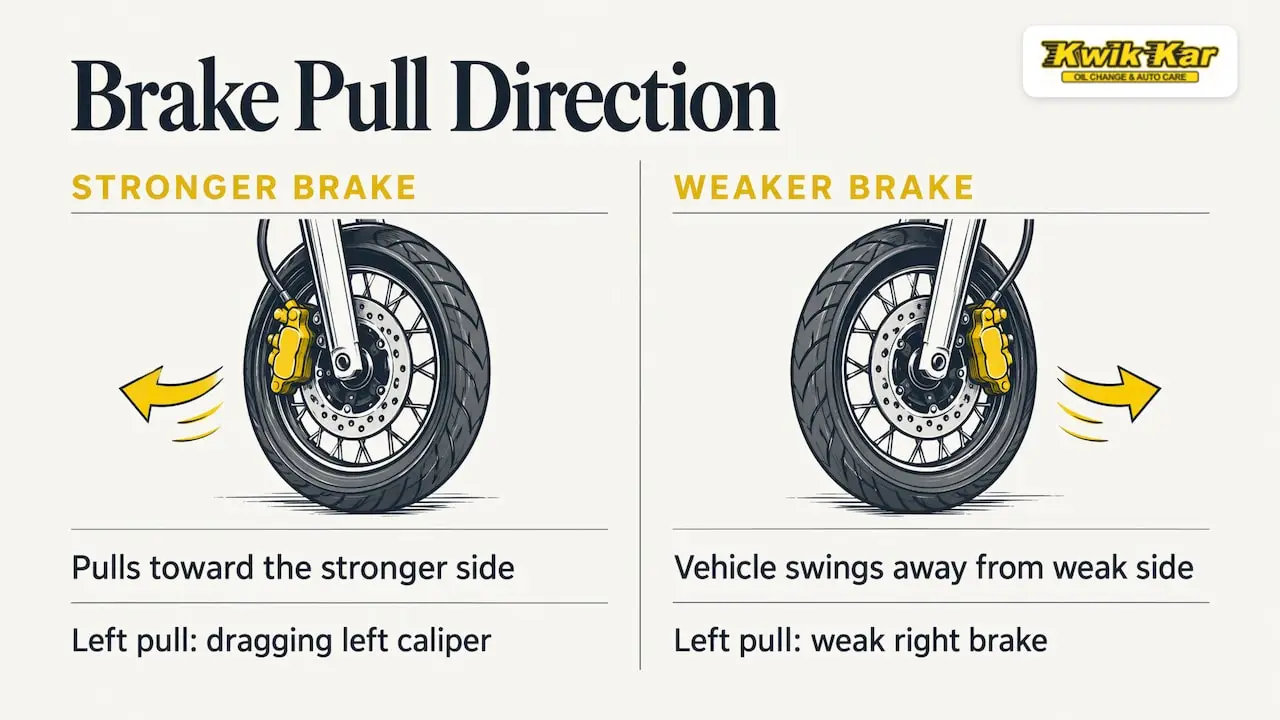
When you brake, both front wheels should slow the car by about the same amount. If one side grabs harder, the car steers toward that side. If one side barely works, the car swings toward the stronger side, which is the opposite direction of the weak brake.
AA1Car’s steering pull guide describes it this way: when the pull happens only while the brakes are applied, the problem may be unequal braking. The vehicle pulls toward the side with the stronger front brake and away from the side with the weaker one.
That is why people searching for a car that pulls left when braking, or one that veers right, often get different answers. The direction alone does not tell you which part has failed. A left pull could be a dragging left caliper or a weak right one. A technician has to measure it.
Pulling only when braking versus pulling all the time
The timing of the pull is the first clue.
- Pulls only when you brake: Think brakes first. Calipers, hoses, pads and brake fluid are the main suspects.
- Pulls all the time, braking or not: Think tires, alignment, or a brake that stays partly applied. Brake & Frontend notes that a stuck caliper can cause a pull even when the brakes are not applied.
- Pulls only on certain roads: This may be road crown, covered below.
Tell your mechanic exactly when it happens. “It pulls right at about 40 mph when I brake firmly, and the wheel stays straight when I coast” saves real diagnostic time.
The most common causes of a car pulling when braking
Here are the problems we see on the list for this symptom, from the most common to the less obvious.
1. A sticking or seized brake caliper
The caliper squeezes the pads against the rotor. If its piston or slide pins stick, the pad may not clamp evenly, or may not release afterward. Then one wheel brakes harder than the other, or keeps dragging.
Apex Technation, a technician training publisher, lists seized slide pins, a seized piston and a collapsed hose as the three most common mechanical causes of a dragging brake. Rust and inactivity make this worse. A car that sits for weeks, especially outdoors, can develop corroded rotors and sticky hardware.
Signs that point to a caliper:
- The car pulls harder the more firmly you brake.
- One wheel is noticeably hotter or dirtier with brake dust than the others after a drive.
- You notice a burning smell after driving.
- Fuel economy drops slightly because a brake drags.
2. A collapsed or damaged brake hose
The rubber hose that carries brake fluid to the caliper can break down on the inside. The fluid gets pushed through, but the hose can act like a one-way valve, so pressure does not release. The brake then drags on one side.
You cannot see this problem from the outside. A hose can look fine and still be blocked inside, which is why a technician checks how the wheel behaves after the brake is released instead of judging by appearance.
3. Uneven pad wear or contaminated pads
Pads that are worn differently side to side grip differently. Oil, grease or brake fluid on the pads or rotor also reduces friction on that side. A fluid leak at one wheel can make the pad slick and cut braking force.
If the outer pad on a wheel is worn more than the inner pad, Brake & Frontend points to the caliper hardware as the most likely cause. Replacing pads without fixing the hardware just repeats the problem.
Our page on brake repair in Midlothian explains what we look at during a brake inspection. If you also hear grinding, read our guide to what to measure when brakes grind.
4. Different tire pressures, sizes or tread
Tires affect braking too. A low tire grips differently and can tug the car as weight shifts forward under braking. Mismatched sizes or very different tread depths from side to side do the same.
That is why the diagnostic routine starts with the tires. Brake & Frontend’s process begins by checking inflation pressure and mismatched tire sizes, and the NHTSA bulletin also tells technicians to check the tires first. If your tires are worn, damaged or cracked, our tire service team can inspect them, and the tire dry rot guide shows what age-related damage looks like.
5. Worn steering and suspension parts
When you brake, weight shifts forward and the suspension and steering parts take extra load. If a control arm bushing, a strut rod bushing, a tie rod end or a wheel bearing is loose, the wheel can shift position as you brake. The result is a pull or a steering wheel that jerks.
AA1Car notes that worn or loose control arm and strut rod bushings can allow alignment changes under braking. If you feel looseness or wandering in the wheel too, read about steering play symptoms and causes, then have the front end inspected. Our steering and suspension repair service covers exactly this.
6. Bent suspension parts or mismatched wheels
A less common cause is an uneven scrub radius. This is the geometry between where the tire touches the road and where the steering axis meets the ground. If it differs between the two front wheels, you get a strong pull under braking. Brake & Frontend explains that this can come from bent front suspension parts, wheels with different offsets, or missing spacers on aftermarket wheels.
A curb hit or pothole impact can bend parts without any visible damage. Our bent rim symptoms article lists what to watch for after an impact.
7. Alignment
Alignment can cause a pull, but it is less often the cause when the pull appears only under braking. We cover this in more detail below, because it is the most common wrong turn in diagnosis.
Could it just be the road?
Sometimes the car is fine. Most roads slope slightly toward the shoulder so water drains. The NHTSA technical service bulletin on vehicle pull explains that this road crown is an environmental effect that cannot be corrected by suspension adjustments or any wheel or tire change. A driver may notice a pull to the left in the left lanes and a pull to the right, or none, in the right lanes on the same stretch of road.
A simple way to sort this out: if the car drifts the same way on a flat, level parking lot, or in both lanes, the cause is in the vehicle. If the tendency changes with the slope of the road, it is most likely the road. A pull that appears only when you press the brake pedal is not road crown, since the road does not change when you brake.
Alignment is not always the answer
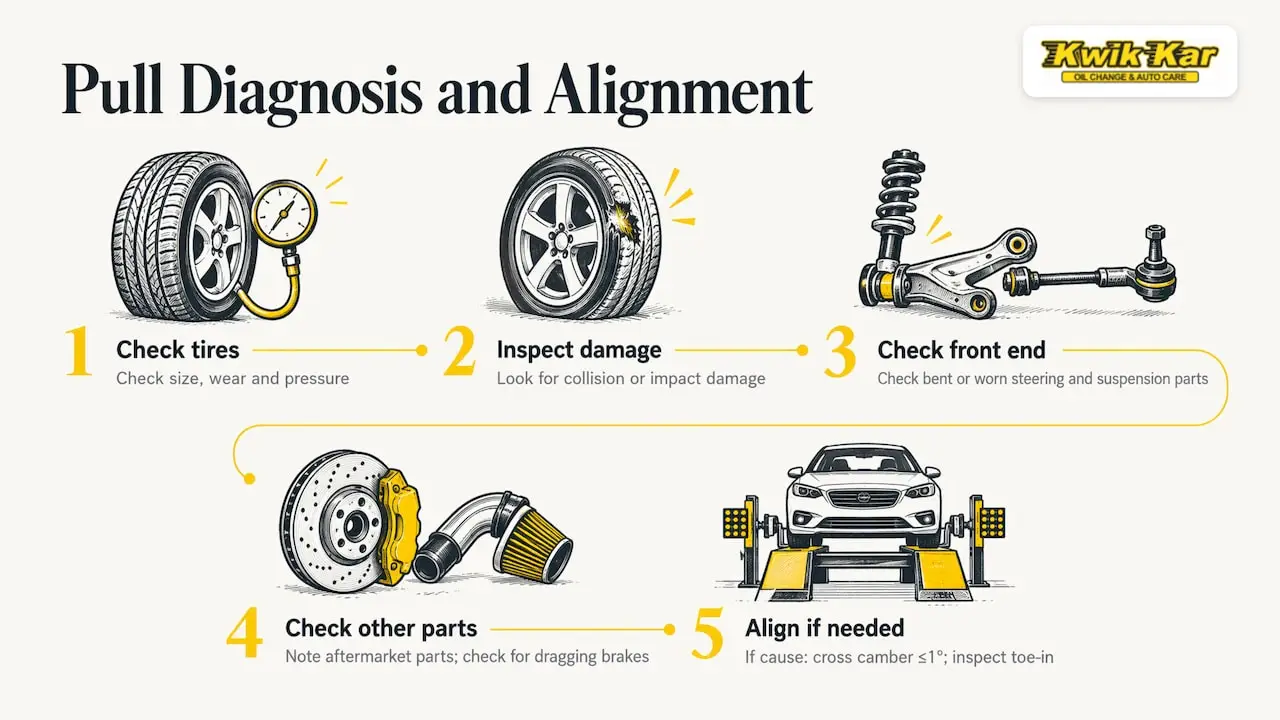
Many drivers book an alignment as soon as a car pulls. That can be a costly detour. The same NHTSA bulletin says pull is frequently misdiagnosed as an alignment concern when the real cause may be tire lateral force, vehicle damage, road crown or worn components. It warns that aligning a car when the tires are the cause can set the alignment outside specifications and lead to uneven tire wear.
The bulletin tells technicians to identify the cause before any repair: check tires for size, wear and pressure, look for collision or impact damage, check for bent or worn suspension and steering parts, note aftermarket parts, and check the brakes for dragging, all before alignment work begins.
When alignment is the cause, the bulletin says to adjust cross camber to eliminate the pull, keep it within 1 degree or less, and then inspect toe-in after the camber change. That is work a shop does on an alignment machine, with the front end already confirmed sound.
We follow this logic at the shop: inspect first, then align if the alignment is truly the problem. Our wheel alignment service page describes the service, and our wheel alignment cost guide explains why inspection comes first.
When it is unsafe to keep driving
A mild pull that has built up slowly is something to book soon. Some signs mean you should not wait.
Stop driving and call for an inspection or a tow if:
- The pull is hard or getting worse quickly. A sudden change can mean a failing brake, tire or steering part.
- The brake pedal feels soft, sinks, or goes to the floor. This can mean a fluid leak or a failing hydraulic part.
- You smell something hot or burning near a wheel. A dragging brake can overheat.
- One wheel is much hotter than the others. Do not touch the rotor or wheel. It can burn you.
- The pull started right after hitting a curb or pothole. Parts may be bent or a tire damaged.
- A warning light is on. An ABS or brake warning with a pull deserves a prompt check. See our guide on driving safely when the ABS light comes on.
If you are not sure how serious it is, call us at (972) 775-5945 and describe what you feel. If the car pulls hard or the pedal feels wrong, do not drive it to us. Arrange a tow.
How a shop finds the cause
A good diagnosis is a sequence, not a guess. Here is how a thorough inspection typically runs, based on the published procedures.
- Listen to the symptom. Which way, at what speed, how hard you brake, and whether it pulls when you coast.
- Check the tires. Pressure, size match and wear come first, per both Brake & Frontend and the NHTSA bulletin.
- Road test. The technician drives the car and notes how severe the pull is. Then they stop firmly. Brake & Frontend says that if the pull is worse in a hard stop, a stuck piston is the most likely problem.
- Compare wheel temperatures. A dragging brake runs hotter. Brake & Frontend describes using a non-contact infrared thermometer, while Vehicle Service Pros says that when ABS shows no faults, a diagnostic thermal imager shows the excess heat from a tight brake more clearly.
- Inspect the brake hardware. If a wheel is hot, the technician checks how freely it turns and tests the caliper. If the wheel turns freely once pressure is relieved, the caliper is fine and the hose becomes the suspect.
- Inspect steering and suspension. Bushings, ball joints, tie rods and wheel bearings are checked for play.
- Check for damage and modifications. Impact damage, bent parts and aftermarket wheels can all change how the car behaves.
The Vehicle Service Pros article adds that a pull where the driver steers against it can come from mechanical steering or suspension trouble, brakes or ABS, or even a calibration issue in driver-assist systems, so it is wise to check for technical bulletins on those parts.
Why timing matters in thermal checks
Thermal checking works best right after a drive. Apex Technation recommends a test drive of 5 to 10 minutes at 25 to 45 mph with at least three to five moderate brake applications from 30 mph or higher, then scanning all four rotors within two minutes of parking. Rotors cool fast, and that window captures the biggest temperature difference between corners. This is shop-level work with the right equipment and a safe place to do it.
How the repair is done
The repair depends on what the inspection finds.
- Caliper problem: The caliper is removed from the knuckle and the mounting hardware is checked for seizing or binding. Depending on condition, hardware or the caliper itself is serviced or replaced.
- Brake hose: A collapsed hose is replaced, and the system is checked for proper pressure release.
- Pads and rotors: Worn or contaminated pads and rotors are replaced as needed, and the cause of any contamination, such as a leak, is dealt with first.
- Brake fluid: Old, contaminated fluid can hurt brake performance. See our article on the brake fluid change interval.
- Steering and suspension: Worn bushings, joints or bearings are replaced.
- Tires and alignment: Tire issues are corrected, and alignment is adjusted last, once the rest is sound.
Then comes the step many drivers never hear about: the check afterward. Apex Technation advises that after any pad, caliper, hose or rotor replacement, the shop should do a test drive followed by an immediate thermal scan of all four corners before the car leaves. If the repaired corner is still hotter than the opposite side, something else may still be wrong, such as a hose that was not identified.
What we do at Kwik Kar in Midlothian
We offer brake services, steering and suspension repair, tire services and alignments under one roof, which matters for this symptom because the cause can sit in any of those systems. Our mechanics are ASE-certified, and we explain what we find and what we recommend as the work moves along. Our repairs are warranty-backed.
If you want a quick overview of other brake warning signs, read 5 signs your brakes may need service. To see everything we handle, visit our services page.
Our view on a braking pull
A car that pulls when you brake is telling you that two sides of the car are no longer doing the same job. The temptation is to fix the part that seems obvious: an alignment, a set of pads, a new tire. We think the better path is to find out why first.
That means starting with the basics, then working through brakes, tires and the front end in order, and checking the result when the work is done. Our ASE-certified mechanics approach it that way, and we tell you what we see so you can decide with full information.
Brakes are the one system you use on every drive, and a small imbalance is easier to correct early than after it wears tires, pads and rotors unevenly. If your car has started to pull, bring it to us before it becomes a bigger repair.
Kwik Kar
Get your brakes checked in Midlothian
If your car pulls when you brake, the fastest way to peace of mind is an inspection that looks at brakes, tires and the front end together. Our team can find which side is working too hard, explain the cause and handle the repair, from calipers and hoses to steering parts and alignment.
See our brake repair page or the full list of services, then call (972) 775-5945 to schedule.
FAQ
Why does my car pull to the left when I brake?
The left front brake may be gripping harder than the right, or the right brake may be weak. A sticking caliper, a collapsed hose, uneven pad wear or a worn suspension part can all do this. The direction alone does not identify the part, so the brakes need to be inspected on both sides.
Can I fix a car that pulls to one side by getting an alignment?
Only if alignment is the cause, and a pull that appears just under braking is more often a brake or suspension issue. A federal NHTSA bulletin warns that aligning a car before the cause is found can set it outside specifications and wear tires unevenly. Have the car inspected first.
Why does my steering wheel turn or jerk when I brake?
That usually means the front wheels are being pushed in different directions as weight shifts forward. Uneven braking, loose bushings, worn tie rods or ball joints, or a bent part can cause it. Because it involves steering, have it looked at promptly.
Is it safe to drive with a car that pulls when braking?
A slight pull is not an emergency, but it should be checked soon. Stop driving if the pull is hard, is getting worse, the pedal feels soft, or you smell something burning near a wheel. In those cases, arrange a tow.
Could road crown cause my car to pull?
Yes, but only while driving, not specifically under braking. The NHTSA bulletin explains that road crown can make a car drift differently depending on the lane. If the pull follows the brake pedal on a flat surface, the cause is in the car.
Sources
- Vehicle Pull, Steering Wheel Off Center, and Alignment (NHTSA technical service bulletin)
- Finding the Cause of Brake Pulls (Brake & Frontend)
- Determine the cause of the pull (Vehicle Service Pros)
- Brake and Chassis Thermal Diagnostics with a Thermal Camera (Apex Technation)
- How To Correct a Steering Pull Problem (AA1Car)