
A failing water pump usually shows itself through coolant leaking at the front of the engine, a temperature gauge that climbs, or a whine or chirp from the belt area. If you see any of these, stop driving soon and have the cooling system checked. A pump that quits can overheat an engine in minutes, and overheating is what turns a manageable repair into an expensive one.
This guide covers the warning signs, what causes pumps to fail, how a shop confirms the problem, what repairs typically cost, and how a bad thermostat can look similar. You can also reach us at (972) 775-5945 if your car is already acting up.
TL;DR
- Leaking coolant, overheating, and whining or grinding noises from the front of the engine are the classic signs of a bad water pump.
- Do not keep driving on a suspect pump. Pull over, shut the engine off, let it cool, and arrange a tow if the gauge is climbing.
- Many pumps last roughly 60,000 to 100,000 miles, and coolant quality affects how long yours lasts.
- Professional replacement is often quoted between $400 and $1,500 or more, because labor drives the price.
- A stuck thermostat can mimic a pump problem, so a proper diagnosis matters before parts are replaced.
Table of Contents
- What the water pump does
- Signs of a bad water pump
- What causes a water pump to fail
- Can you drive with a failing water pump?
- How a shop confirms a bad water pump
- Water pump replacement cost
- Bad thermostat: the look-alike
- How to help your pump last longer
- Our perspective
- Cooling system service at Kwik Kar
- FAQ
- Sources
What the water pump does
Your water pump pushes coolant through the engine, the radiator and the heater core. That flow carries heat away from the engine so it stays in a safe operating range. Most pumps are driven by a belt, and some are driven by the timing belt or chain.
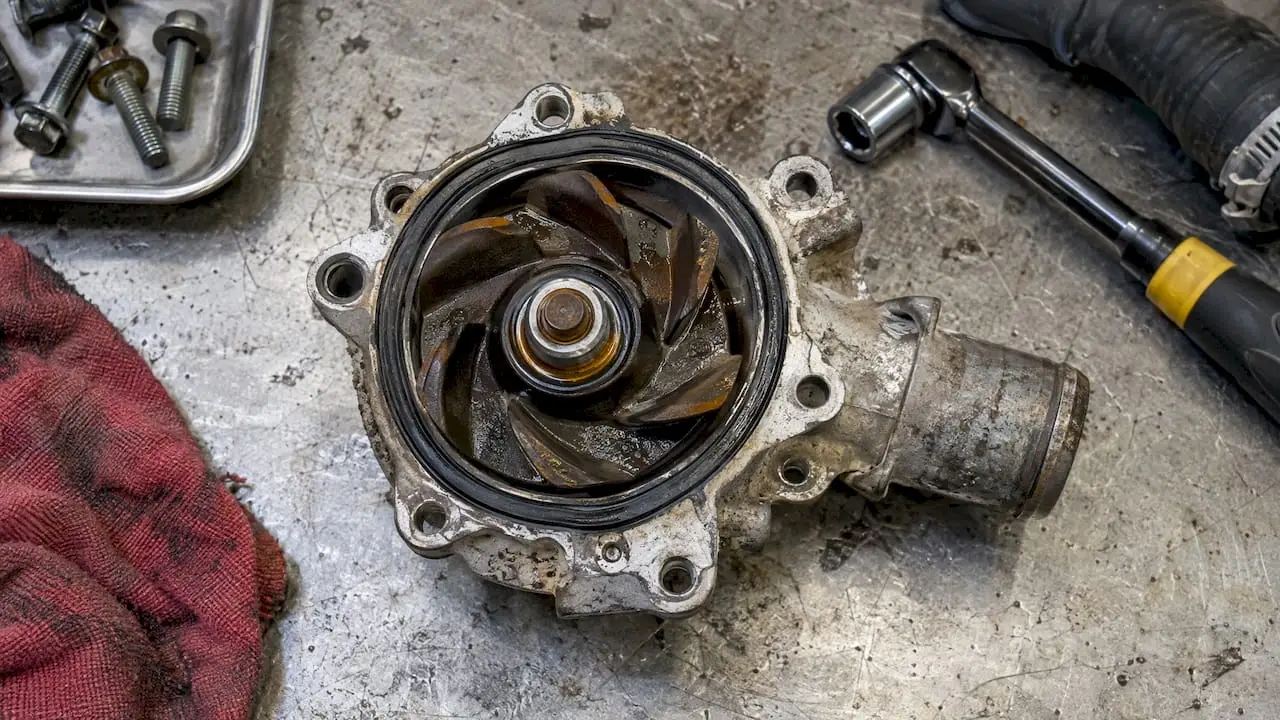
Inside the pump, a shaft rides on a bearing, a seal keeps coolant from escaping, and an impeller with vanes moves the fluid. As miles add up, wear on the bearing, seal and impeller reduces pumping efficiency. A worn seal lets coolant leak past the shaft or out of the pump’s vent hole, and a failed bearing can break the shaft.
Signs of a bad water pump
The symptoms below are the ones most often listed by repair resources. You may notice one or several. AutoZone’s list of bad water pump signs covers the same ground.
- Coolant leaking near the front of the engine. Look for drips under the car or a crusty white or colored residue around the pump. That residue is dried coolant. Leaking shaft seals are among the most common ways a pump fails.
- An engine that runs hot. If the gauge climbs, or a warning message appears, the pump may not be moving enough coolant. Overheating can have other causes too, which we cover in our guide to engine overheating causes.
- Squealing, chirping, growling or grinding. A worn shaft bearing makes noise that often rises and falls with engine speed. Belt problems can sound similar, so see our page on serpentine belt noise to compare.
- A wobbly pulley. With the engine off, a pump pulley should not move when you wiggle it sideways. Play there points to a bad bearing.
- Steam from under the hood. Steam means coolant is escaping onto hot parts or the system is boiling over.
- Corrosion or buildup on the pump. Rust-colored crust around the housing is a sign of seal leakage or poor coolant condition.
- A weak heater. If coolant is not circulating well, cabin heat may be poor. A bad thermostat or a failing blower can cause this too, so a diagnosis helps.
Leak symptoms in detail
Not every trace of residue means the pump is done. A NHTSA service bulletin on water pump leak inspection separates an active leak from an old one. Wet coolant picked up on a paper towel from deposits around the pump indicates an active leak, and the pump should be replaced. Dry residue alone is a temporary leak and does not call for replacement. The same bulletin says a pump with excessive pulley or bearing play, or one that does not turn smoothly, should be replaced.
That distinction is why a quick look in the driveway is only a starting point. A technician can clean the area, run the engine, and see whether fresh coolant returns.
Noise symptoms in detail
Pump noise tends to be a rumble, chirp or growl that comes from the front of the engine and changes with RPM. A bearing that is failing often gets louder over days or weeks. If the noise disappears when the belt is removed for testing, the pump or another belt-driven part is a suspect. A technician can isolate which one without guessing.
What causes a water pump to fail
Pumps wear out, but how long they last depends on how the cooling system is treated. Common causes include:
- Bearing wear. The bearing carries belt load every time the engine runs.
- Seal deterioration. Heat cycles and age eventually let coolant seep past the seal.
- Corrosion and old coolant. GMB, a water pump manufacturer, calls corrosion a silent killer, often tied to poor coolant maintenance or mixing coolant with tap water instead of distilled water.
- Impeller erosion. Vanes wear down or corrode, so the pump moves less coolant.
- Belt and pulley problems. A loose pulley, a worn belt or an over-tight belt puts abnormal load on the bearing.
Lifespan varies, but water pumps typically last 60,000 to 100,000 miles depending on the vehicle and its maintenance history. That is a rough range, not a deadline, and it is a good reason to ask about your cooling system around those mileages.
Can you drive with a failing water pump?
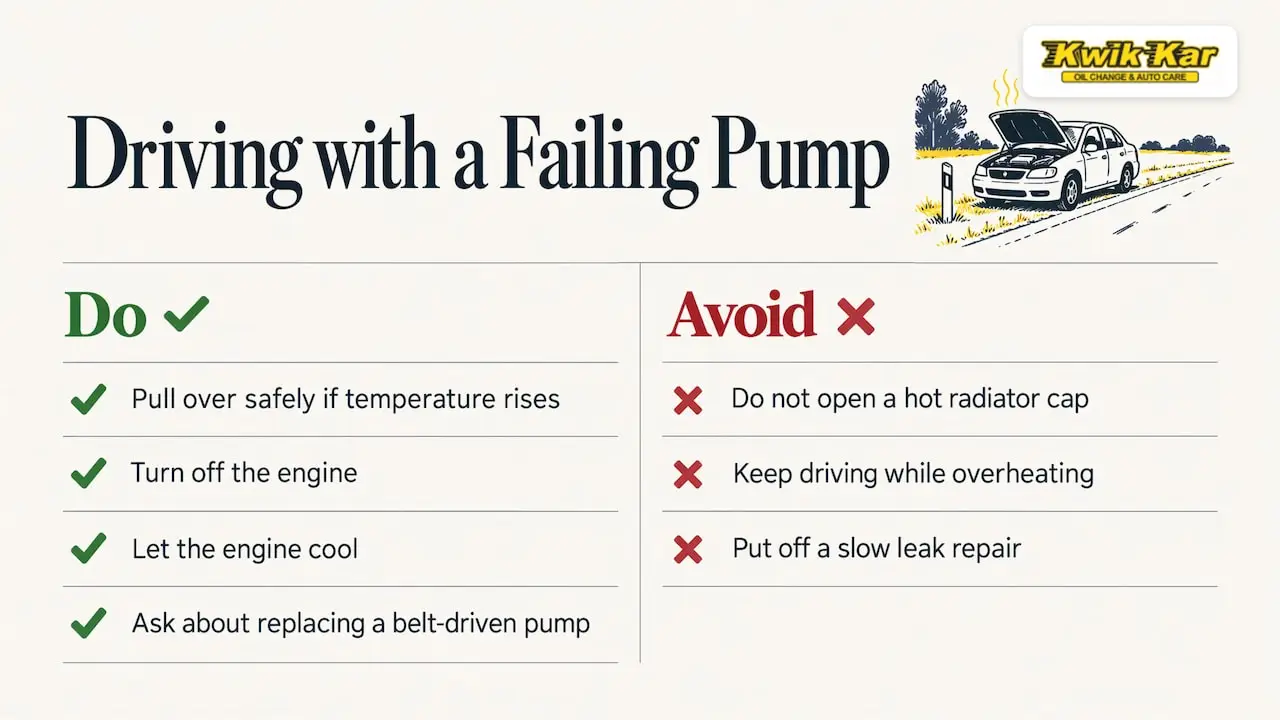
No. If the temperature gauge is rising, pull over safely, turn the engine off and let it cool. Do not open a hot radiator cap. AutoZone advises stopping as soon as possible and shutting the engine off until it cools if overheating comes from a pump issue.
The reason is simple. Repeated overheating can lead to a warped cylinder head, a blown head gasket or a seized engine. Those repairs cost far more than a pump.
A slow leak with no overheating is less urgent, but it is not a repair to put off for long. Cooling system sealers usually cannot stop a shaft seal leak, and steady coolant loss eventually leads to overheating.
One more point for some owners: on engines where the timing belt drives the pump, a seized pump can break the belt. Depending on the engine design, that can cause serious internal damage. If your owner’s manual shows a timing belt, ask us whether the pump should be replaced with it.
What to do if the gauge spikes
- Turn off the A/C and turn the heater to full hot to pull some heat from the engine, if you can do so while moving to a safe spot.
- Pull over and shut the engine off.
- Wait for it to cool fully before touching the radiator cap.
- Call for a tow rather than driving it in.
How a shop confirms a bad water pump
A good diagnosis separates the pump from other causes of the same symptoms. A technician may:
- Inspect the pump, its weep hole and the surrounding area for fresh coolant.
- Check the pulley for play and the bearing for roughness.
- Pressure test the cooling system, which can reveal a leaking shaft seal.
- Check belts, hoses, radiator, cap and thermostat for contributing problems.
- Confirm that the cooling fan is working. See our page on a cooling fan that won’t run.
If you notice bubbling in the coolant reservoir, that is another clue worth mentioning. Our article on coolant reservoir bubbling explains what it can mean.
Water pump replacement cost
Cost depends mostly on how hard the pump is to reach. AutoZone says parts alone usually run $50 to $400, sometimes more than $1,000 for certain vehicles, and professional repair can run $400 to $1,500 or more because of labor. Another 2026 cost guide puts mainstream vehicles at $400 to $1,100, with luxury, European and performance models costing 30 to 60 percent more.
We do not publish set prices for this repair, because the right quote depends on your vehicle. Here is what moves the number:
| Factor | Why it matters |
|---|---|
| Pump location | A pump behind the timing cover takes more labor hours than one on the front of the engine. |
| Timing belt drive | The belt is often replaced at the same time, which adds parts but saves repeating the labor. |
| Vehicle type | Luxury and performance models usually have costlier parts and more labor. |
| Related parts | Belts, hoses, thermostat and coolant are often serviced during the job. |
| Damage found | Overheating may have harmed other components. |
If you drive a luxury model, maintenance budgets for premium cars can help you plan for repairs like this one. For any vehicle, the best way to know your cost is a written estimate based on an inspection.
Why replace related parts together
On many engines the labor to reach the pump overlaps with the labor to replace the timing belt, thermostat or drive belt. Doing them together can avoid paying for the same disassembly twice. Ask your technician which items on your engine share labor, and decide with the estimate in front of you.
Bad thermostat: the look-alike
The thermostat opens and closes to regulate coolant temperature. When it sticks, symptoms overlap with a pump problem, which is why people often search both together.
- Stuck closed: coolant cannot reach the radiator, and the engine overheats, sometimes quickly.
- Stuck open: the engine runs cool, takes too long to warm up, and cabin heat is weak.
- Other signs: a fluctuating temperature gauge and coolant leaks around the thermostat housing.
A bad thermostat can also turn on the Check Engine light. A code such as P0128 usually points to a thermostat stuck open rather than a sensor fault. If your light is on, our check engine light service can read the codes and sort out the cause.
Pump or thermostat?
| Symptom | Points more toward |
|---|---|
| Coolant leak at the front of the engine, whining or chirping noise | Water pump |
| Wobbly pulley | Water pump |
| Overheating with no leak or noise | Thermostat or another cooling issue |
| Slow warm-up, weak heat, gauge stays low | Thermostat stuck open |
| Gauge swings up and down | Thermostat, or trapped air |
This table is a guide, not a diagnosis. Both parts can fail together, and low coolant, a bad fan or a clogged radiator can cause the same signs.
Thermostat replacement cost
The part is cheap and the labor is the variable. AutoZone says thermostats range from under $10 to $175 or more, with professional labor adding roughly $100 to $300. Shop labor rates across the US in 2026 run roughly $110 to $220 an hour, and a thermostat buried behind a timing cover costs far more than an easy-access one.
How to help your pump last longer
You cannot make a pump last forever, but you can avoid the things that shorten its life.
- Keep coolant fresh and at the right level, using the type your manufacturer specifies.
- Mix coolant with distilled water if you top it off, not tap water.
- Replace worn belts and hoses on schedule.
- Fix small leaks early instead of topping off repeatedly.
- Follow the maintenance schedule for your vehicle, including timing belt service where it applies.
- Do not ignore a new noise or a gauge that reads higher than normal.
Our article on habits that extend the life of your car covers more routine care.
Our perspective
We see cooling system trouble most often when a small warning gets put off. A faint chirp, a damp spot on the driveway or a gauge that sits a little higher than usual rarely feels urgent. It is the cheapest time to act.
Our approach is to find out what is actually wrong before recommending parts. A pump, a thermostat, a hose and a fan can all cause the same symptom, and replacing the wrong one costs you money and time. Our ASE-certified mechanics explain what they find, show you the reason for a recommendation, and keep you informed through the repair.
We would rather you come in at the first sign than call a tow truck after an overheat. If you are unsure, bring the car in and we will take a look.
Kwik Kar
Cooling system service at Kwik Kar
We handle radiator and cooling system repair, including inspection of belts, hoses, thermostat and coolant, along with fluid exchanges and maintenance to the manufacturer’s schedule. Our repairs are warranty-backed, and our mechanics are ASE-certified. You can see everything we do on our services page.

If you have a leak, a noise or a temperature gauge that worries you, call us at (972) 775-5945 to schedule an inspection. You can also check our current specials before you come in.
FAQ
What happens to a water pump when it goes bad?
The bearing, seal or impeller wears out. The pump then leaks, makes noise or moves less coolant than the engine needs. If it stops circulating coolant altogether, the engine overheats quickly and can suffer serious damage.
Is it easy to replace a water pump?
It depends on the engine. Some pumps sit on the front of the engine and come off with basic work, while others are behind the timing cover and need hours of disassembly. Because the cooling system must also be refilled and bled of air, many owners leave this job to a shop.
How can you test if a water pump is bad?
Check for fresh coolant around the pump, wiggle the pulley with the engine off to feel for play, and listen for chirping or growling. A shop can also pressure test the cooling system to find a leaking seal. If the gauge is climbing, skip the tests and have the car towed.
How much does it cost to fix a failed water pump?
Professional replacement is commonly quoted from about $400 to $1,500 or more, depending on the vehicle and how much labor is involved. We would need to inspect your car to give an accurate estimate. Call us at (972) 775-5945 and we can set up a time to look at it.
Sources
- Symptoms & Signs of a Bad Water Pump, AutoZone
- How To Replace a Water Pump, AutoZone
- Car Thermostat Replacement Cost, AutoZone
- Water Pump Leak Inspection and Diagnostic Tips, NHTSA
- Tech Tip: Inspect the Cooling System When Replacing the Water Pump, Underhood Service
- 4 Common Causes of Water Pump Failure, GMB
- Water Pump FAQs, GMB
- Coolant Leak Repair Cost in 2026, Empire Auto Protect
- How to Diagnose Coolant Temperature and Thermostat Codes, AutoDTCs
- Porsche maintenance cost budget