
A low coolant reservoir means the cooling system has lost fluid, and the cause is not always visible. If you top it off once and the level stays put, you likely just needed fluid. If it drops again, something is letting coolant out, and the fix is finding that leak, not adding more coolant. At Kwik Kar in Midlothian, our radiator and cooling system work starts with that question: where is the coolant going?
TL;DR
- Check the reservoir only when the engine is cold, on level ground, and compare the level to the LOW and FULL (or MIN and MAX) marks.
- Never open the radiator or reservoir cap on a hot engine. Hot coolant can spray out and cause serious burns.
- One top-off to reach the FULL mark is reasonable. Needing more coolant every few weeks points to a leak, even if you never see a puddle.
- Coolant can leave through small external leaks that evaporate, or internally into the engine. Both need a proper diagnosis.
- If the temperature gauge climbs or a warning light comes on, pull over safely and shut the engine off.
Table of Contents
- What the reservoir level tells you
- How to check the level safely
- Topping off a low reservoir
- Is it normal to add coolant every month?
- Why coolant disappears with no puddle
- Reservoir empty but radiator full
- Warning signs to stop driving
- How a shop finds a hidden coolant leak
- Our perspective
- Get the cooling system checked in Midlothian
- FAQ
- Sources
What the reservoir level tells you
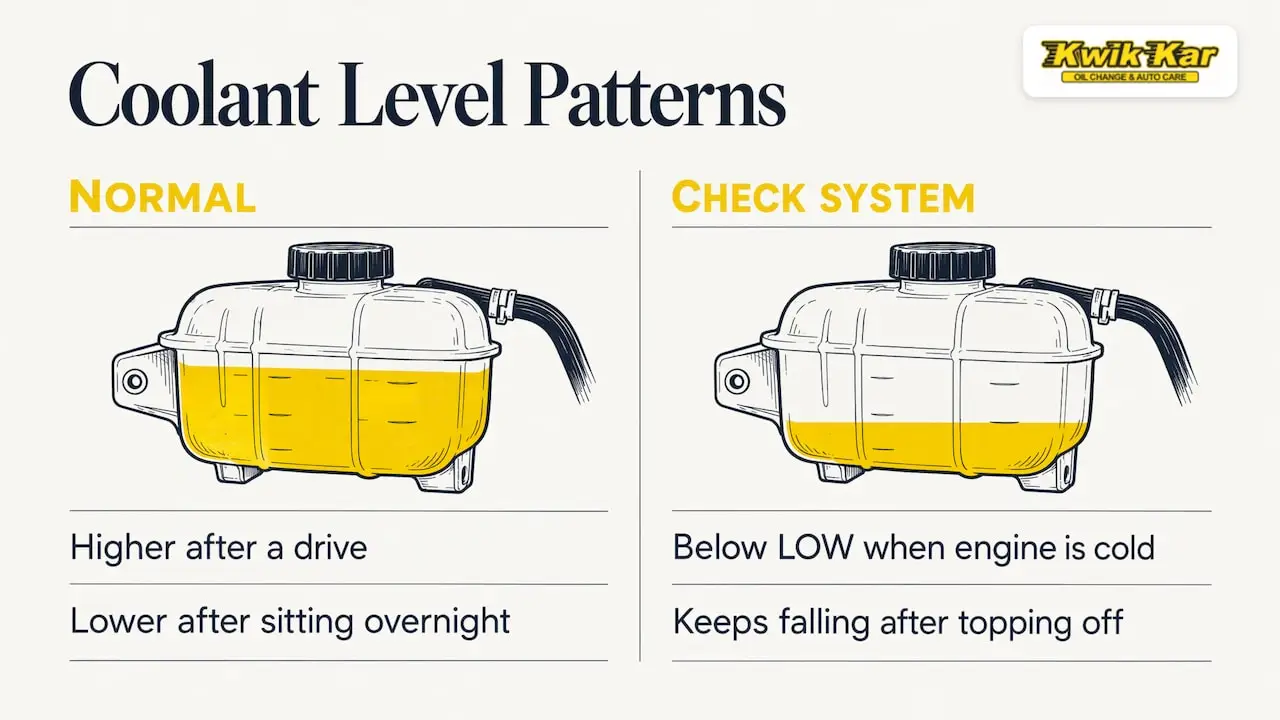
The coolant reservoir (some manuals call it the reserve tank or surge tank) is the translucent plastic bottle near the radiator. It gives the cooling system room to expand. As the engine heats up, coolant expands and flows into the reservoir. As the engine cools, the coolant is drawn back into the radiator.
That is why the level moves. A 2017 service bulletin hosted by NHTSA explains that coolant naturally expands and contracts between the low and full marks as temperature changes, and that overfilling can cause coolant to be pushed out. A level that sits a little higher after a drive and a little lower after the car sits overnight is normal.
What is not normal is a level that sits below the LOW mark when the engine is cold, or one that keeps falling after you top it off.
How to check the level safely
A cooling system runs under pressure. Hot coolant or steam can cause serious burns. Both Mazda’s owner manual and Honda’s owner manual warn against opening the cooling-system cap while the engine or radiator is hot. Honda notes that coolant can spray out and scald you, and says to let the engine and radiator cool first.
Here is the routine:
- Let the engine cool completely. Park on level ground and wait. If you have been driving, give it several hours or check first thing in the morning.
- Find the reservoir. Your owner’s manual shows where it is. Look for the cap with a coolant or thermometer symbol.
- Read the level from the side. The plastic has molded LOW and FULL marks (Honda labels them MIN and MAX). The cold level should sit between them.
- Look at the fluid itself. Coolant is usually brightly colored. Rusty, muddy, oily or sludgy fluid is a sign the system needs attention.
- Check the hoses. Mazda’s manual says to inspect the cooling and heater hoses and connections, and to replace any that are swollen or deteriorated. Wet spots, crusty residue or a hose that feels mushy are all clues.
If you want a broader routine for what else to look at under the hood, this seasonal car maintenance checklist covers the basics a driver can check between service visits.
Topping off a low reservoir
If the cold level is at or near LOW, Mazda’s manual says to add coolant to bring it up to FULL and tighten the cap securely. Two details matter:
- Use the right coolant. Coolants are not interchangeable. Mazda’s manual, for example, calls for FL-22 when the marking appears on or near the cooling-system cap. Your owner’s manual and the cap will tell you what your vehicle needs. Honda describes its coolant as a mix of water and ethylene-glycol antifreeze, so a vehicle-specified mixture matters more than whatever is on the shelf.
- Do not overfill. The marked range already allows for temperature changes. The NHTSA-hosted bulletin tells technicians to make sure the system was not unnecessarily overfilled before they chase a coolant loss, because overfilling can push fluid out and look like a leak.
Think of a top-off as a short-term step to get you safely to a diagnosis, not as the repair. Our team can also handle a radiator and cooling system service if the fluid itself is old or contaminated.
Is it normal to add coolant every month?
No. Honda’s manual says frequent additions call for a cooling-system check, and Mazda’s says an empty reservoir or a frequent need for coolant is a reason to have the system looked at by a dealer. A sealed cooling system should not consume fluid on a regular schedule.
Here is a simple way to judge it:
- Level drops once after a repair, then holds. Air pockets may have worked their way out. Recheck cold after a few days.
- Level drops again within days or a couple of weeks. There is a leak or an internal loss. Get it diagnosed.
- Level is empty and you top it off repeatedly. Stop relying on top-offs. Running low on coolant is how engines overheat.
If your engine is already running hot, read our guide on engine overheating causes and what to do on the road.
Why coolant disappears with no puddle
This is the question behind most searches for a reservoir that keeps dropping. No puddle does not mean no leak. Here are the usual explanations.
Small external leaks that evaporate
A weeping hose clamp, a seeping radiator seam or a worn water pump seal may release coolant only when the system is hot and pressurized. The drips land on hot metal and evaporate before they reach the ground. You may notice a sweet smell after a drive, white or crusty residue around a connection, or a damp spot on a hose. A failing pump is a common source, and our page on water pump failure signs and costs lists what to look for.
A cap that no longer holds pressure
The cap is part of the pressure system. If it cannot hold pressure, coolant can be forced out of the overflow, or the system can lose fluid when hot. The NHTSA-hosted bulletin includes pressure-testing the cap in its diagnostic flow for exactly this reason.
Internal loss into the engine
When coolant is not outside the engine, it may be inside. A failing head gasket is one possible cause, where coolant enters the combustion chamber or mixes with the engine oil. Warning signs include white exhaust smoke, a misfire, or oil that looks milky or contaminated. If you notice these, stop driving the vehicle and have it checked. Our guides on engine misfire symptoms and blue smoke on startup help you tell related symptoms apart.
Heater core leaks
The heater core is a small radiator behind the dash. A leak there can drain coolant into the cabin. Clues include a sweet smell inside the car, a damp passenger-side floor mat, or a film on the inside of the windshield when the heat is on.
Overfilling
This one is easy to miss. If the reservoir was filled past FULL, the extra fluid can be expelled as the engine heats up, and the level then looks like it dropped. That is why the cold reading, between the marks, is the one to trust.
Reservoir empty but radiator full
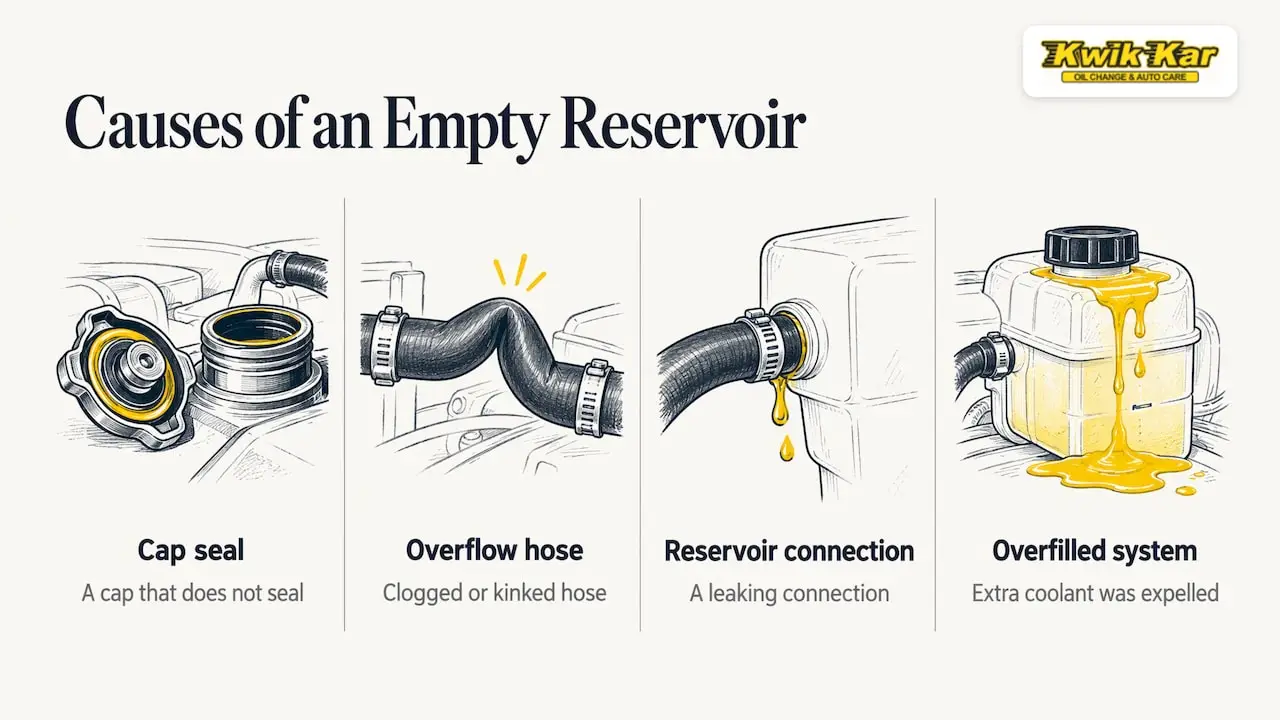
Some drivers find an empty reservoir and a radiator that is full to the top. That usually means the system is not drawing coolant back as it cools, which can come from a cap that does not seal, a clogged or kinked overflow hose, or a leak in the reservoir connection. Another possibility is that the system was overfilled and the extra was expelled. Either way, the reservoir and radiator should be checked together, with the engine cold.
If you notice bubbling in the reservoir, our page on coolant reservoir bubbling explains what that can mean.
Warning signs to stop driving
A low reservoir is not an emergency by itself. These signs together with it are:
- The temperature gauge climbs toward hot, or a coolant or temperature warning light comes on.
- Steam comes from under the hood.
- The heater blows cold air when it should be warm.
- You smell sweet, syrupy fluid.
- You see white smoke from the tailpipe.
If any of these happen, pull over where it is safe and switch the engine off. Mazda’s manual also advises making sure the cooling fan is not running before working near it. Do not open the cap. Let the engine cool, and arrange a tow or a shop visit rather than driving on. Overheating can damage the engine in ways that cost far more than the original leak.
If the fan is the concern, here are five safe checks for a cooling fan that won’t run.
How a shop finds a hidden coolant leak
When there is no puddle, diagnosis is a process of elimination. The NHTSA-hosted bulletin lays out a sensible order:
- Inspect external components, including original and aftermarket parts, for signs of leakage.
- Pressure-test the cap and the cooling system. Pressure makes slow leaks show themselves.
- If the loss is still not found, check for coolant contamination in the oil, fuel or exhaust-gas-recirculation (EGR) system, which is the part that sends some exhaust back into the engine.
The order matters. Checking the simple, inexpensive things first keeps you from paying for a major repair you did not need. It also explains why topping off alone leaves you guessing: you never learn which of these steps would have found the cause.
A written checklist helps you spot problems before they become expensive, and a vehicle inspection checklist is a good model for noting what you see on each part of the car.
Our perspective
We see the same pattern with low coolant: the driver tops off, the level looks fine for a week, and then the reservoir is low again. The top-off treated the symptom. The cause is still there.
That is why we focus on the cooling system as a whole, not just the bottle. Our ASE-certified mechanics look at the hoses, cap, radiator and water pump together, and we explain what we find in plain terms before any repair begins. Clear communication is part of how we work.
Our radiator services and fluid exchange are there for the cases where the coolant is old or contaminated, and our maintenance and repair work covers the leak or failed part behind a falling level. Our repairs are warranty-backed, so you know the work is stood behind.
A cooling system that is fixed once and checked properly usually costs less than a season of top-offs followed by an overheated engine.
Kwik Kar
Get the cooling system checked in Midlothian
If your reservoir keeps dropping, or it is empty and you are not sure why, we can look at the whole system for you. Our radiator and cooling system service covers the radiator and the parts around it, and you can see everything else we do on our services page.

Bring the vehicle in and tell us what you have noticed: when the level dropped, how often you have added coolant, and any smells or warning lights. That history helps. You can reach us at (972) 775-5945.
If the check engine light is also on, our check engine light diagnostics can help sort out whether it is related.
FAQ
How much coolant should be in the reservoir when cold?
The level should sit between the LOW and FULL marks (or MIN and MAX) on the reservoir when the engine is cold. If it is at or near LOW, add the vehicle-specified coolant up to FULL and tighten the cap. Do not fill past the FULL mark, because the system needs room to expand.
Why does my coolant level keep dropping with no leak?
There is nearly always a leak, even if you cannot see it. Small drips can evaporate from hot parts, a worn cap can lose pressure, and coolant can also leak internally into the engine. A pressure test of the system is the usual way to find it.
Do I fill coolant to MIN or MAX?
Fill to the FULL or MAX mark when the engine is cold. The range between the marks already allows for normal expansion when the engine heats up. Filling above it can cause coolant to be pushed out.
Can I keep driving with a low coolant reservoir?
If the engine is not overheating and the level is only slightly low, you can top it off with the correct coolant and drive to have it checked soon. If the temperature gauge rises, steam appears, or a warning light comes on, stop safely and switch the engine off. Never open the cap while it is hot.
When should I schedule service?
Schedule it whenever you need to add coolant more than once, or when the reservoir is empty. Call Kwik Kar in Midlothian at (972) 775-5945 and we will look at the cooling system with you, explain what we find, and get you back on the road with confidence.
Sources
- Engine Compartment Inspection, 2024 Mazda CX-90 owner’s manual
- Engine Cooling System, Honda owner’s manual
- Service bulletin 1 08 01-17, NHTSA, 2017
- Car owner maintenance checklist
- Vehicle inspection checklist