




If the brake light on your dash is red and the pedal feels soft or sinks toward the floor, stop when it’s safe and arrange a tow. If it’s just the parking-brake indicator, releasing the brake fully will usually clear it. Start by checking your parking brake and gauges; if the pedal still feels normal and the light is amber or tied to ABS, you can often drive cautiously to a shop.
TL;DR:
- The brake warning light can indicate low brake fluid, hydraulic system issues, or ABS sensor faults, each requiring different urgency levels.
- If the brake pedal feels soft or sinks, or if the red warning light remains on after releasing the parking brake, immediate inspection and towing are advised.
- Checking the parking brake and brake fluid level are safe, quick diagnostics that can clarify whether the issue is minor or serious.
- Driving cautiously with amber ABS warning lights and normal pedal feel is typically safe until you reach a repair shop; red lights with pedal issues demand stopping immediately.
- Routine maintenance, such as fluid exchanges and pad inspections, significantly reduces the chances of brake warning lights appearing unexpectedly.
Table of Contents
- Common causes of the brake warning light
- What to do immediately if the brake light turns on while driving
- Quick owner diagnostic checks you can safely do
- When to stop driving and arrange towing or emergency service
- Prevention and maintenance to avoid brake-warning lights
- How we diagnose and repair brake-warning issues
- Understanding brake warning light symbols and variations across different vehicle makes and models
- How to interpret ABS light in relation to the brake light
- Potential electronic sensor faults causing brake light activation
- Consequences of ignoring the brake warning light on dash
- When to seek professional diagnostics vs DIY inspection
- Our take on brake warning lights
- Get your brakes checked at Kwik Kar of Midlothian
- FAQ
- Sources
Common causes of the brake warning light
Most of the time, the brake light on your dash points to one of a handful of culprits, and figuring out which one helps you decide how urgent the problem is.
- Parking brake engaged: Mechanical and electric parking brakes both trigger the light. Some vehicles have automatic parking-hold features that behave in ways that surprise owners who aren’t expecting them.
- Low brake fluid: A leak or simple pad wear over time can lower the fluid level in the reservoir enough to trip the sensor.
- Hydraulic system faults: Master cylinder problems or a failed power-assist circuit can cause the light to come on along with a noticeably different pedal feel.
- ABS or ESC-related issues: A dedicated ABS light means something different from a general brake-system warning, and we cover that distinction in more detail below.
- Contaminated or boiled brake fluid: Moisture absorbed into brake fluid over time lowers its boiling point and can make it compressible under heat, a less common but genuinely dangerous cause of warning lights and pedal softness, according to SAE research on fluid sensing.
Each of these has a different urgency level, which is exactly why the next two sections matter so much.
What to do immediately if the brake light turns on while driving
The moment that light appears, your job is to gather information calmly, not to panic.
- Check the pedal first. Does it feel normal, or soft and sinking?
- Look at your gauges. Note whether other warning lights are on alongside the brake light.
- Signal and pull over to a safe spot as soon as you reasonably can.
- Confirm your parking brake is fully released. Electric parking brakes sometimes behave differently than owners expect, so check the switch or pedal position carefully.
- Listen and feel for trouble. If the pedal feels soft or sinks, you hear grinding, or the car pulls to one side, stop driving and arrange a tow.
- If only the ABS light is on and the brakes otherwise feel normal, you can usually drive cautiously to a shop, avoiding hard braking along the way.
Pro Tip: Note the exact moment the light appeared and anything that happened right before it, like recent brake work or a fluid top-up. That detail speeds up diagnosis once you’re at the shop.
Quick owner diagnostic checks you can safely do
Before you call anyone, a few simple checks can tell you a lot, as long as you do them somewhere safe.
- Confirm the parking brake is released. Check the lever, pedal, or electronic switch, and look for any text or icon on the dash confirming its status.
- Visually inspect the brake fluid reservoir. Pop the hood when it’s safe and check the level against the markings; glance underneath the car for any puddles.
- Do a short, low-speed brake test. In a parking lot or quiet street, test pedal firmness and listen for grinding or squealing, but only if the pedal already feels reasonably normal.
- Use an OBD-II reader if you have one. Record any codes that come up so you can pass them along to your technician.
- Avoid pushing your luck. Skip high-speed driving, hard braking, or long trips if the light is red or the pedal feels off in any way.
When to stop driving and arrange towing or emergency service
Some signs mean you should stop driving right away rather than trying to limp to a shop.
- Red brake light plus a soft or sinking pedal: stop immediately and arrange a tow.
- Visible fluid leaks, a reservoir level that keeps dropping, grinding noises, or the car pulling hard to one side: don’t keep driving.
- ABS light alone with normal-feeling brakes: limit your speed and drive a short distance to a repair shop rather than continuing a long trip.
According to AAA’s guide to dashboard warning lights, a red brake warning light signals a serious issue that should never be ignored, and if it stays on after you’ve released the parking brake, or it’s paired with a soft pedal, you should stop when safe and get the vehicle towed to a professional shop. When you call for a tow or talk to a service advisor, describe exactly what you noticed: pedal feel, any noises, which light is on, and when it started. That context helps the technician prepare before your car even arrives.
Prevention and maintenance to avoid brake-warning lights
A lot of brake warning lights are preventable with a little routine fleet maintenance and attention.
- Exchange brake fluid on a regular schedule. Moisture works its way into brake fluid over time, lowering its boiling point and increasing the risk of a soft or failing pedal under heavy use.
- Inspect pads and rotors routinely. As pads wear down, the fluid level in the reservoir drops gradually, which can eventually trigger the warning light on its own.
- Follow your owner’s manual for service intervals, and get familiar with the difference between red and amber indicators so you know how urgently to respond.
- Schedule a professional inspection whenever you’re unsure. A shop visit typically includes checking fluid condition, looking for leaks, and testing pedal feel.
Moisture in brake fluid lowers its boiling point and can make the fluid compressible under heat, a failure mode documented in SAE research on continuous brake fluid sensing. That’s one more reason fluid exchanges deserve a spot on your maintenance calendar, not just pad replacements. For a closer look at other symptoms worth watching, our guide on signs your brakes may need service walks through what squealing, pulling, and pedal softness usually mean.
How we diagnose and repair brake-warning issues
When you bring a brake warning light to us, we start with a consistent checklist: fluid level and quality, signs of leaks, pedal feel, ABS sensor function, and a look at the master cylinder and brake lines. That order lets us rule out the simple explanations before chasing anything more involved.
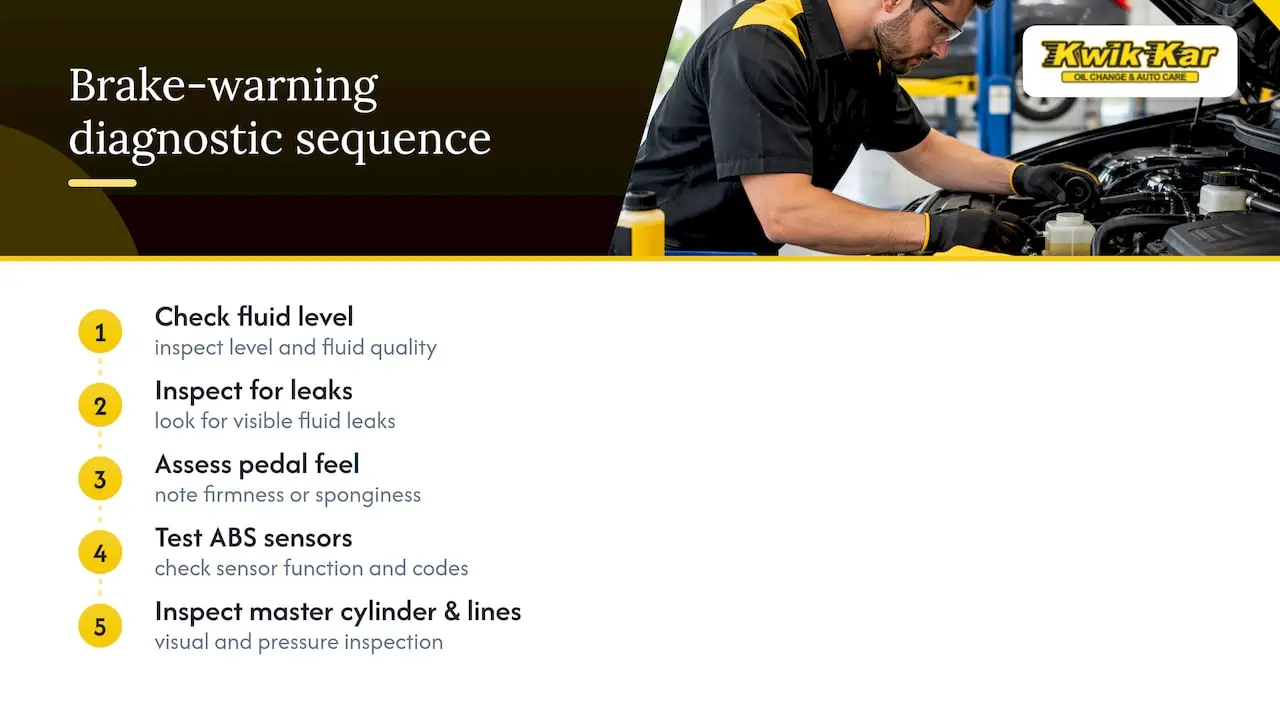
Depending on what we find, the repair might be as straightforward as a fluid exchange or a leak repair, or it might involve pad and rotor replacement or sensor and module work. Either way, we walk you through what we found and give you a clear estimate before any repair begins.
Before you come in, it helps us if you can tell us when the light first appeared, how the pedal has felt, any recent brake work, and any dashboard codes you’ve noted. You can schedule a brake inspection through our services page or reach out through our home page to get started.
Understanding brake warning light symbols and variations across different vehicle makes and models
Not every brake warning light looks the same, and the differences matter more than most drivers realize. A circular icon with “BRAKE” or an exclamation point inside parentheses is common across many vehicles, but the exact symbol, color, and even its position on the cluster can vary by manufacturer.
Generally, a red brake icon signals a more serious issue, often tied to fluid level, pressure, or a system fault, while an amber or yellow version frequently points to something less urgent, like a parking brake reminder or a minor sensor fault. Some vehicles separate these into two distinct icons entirely, one for the parking brake and one for the general brake system, while others combine them into a single light with different illumination patterns.
Electric parking brakes add another layer of variation. Depending on the manufacturer, releasing the brake might require holding a switch, pressing the brake pedal first, or following a specific sequence described in the owner’s manual, as documented in Honda’s electric parking brake guidance. Automatic parking-hold features, which some vehicles use to keep the car stationary at a stop without you holding the pedal, can also light up the brake indicator in ways that catch owners off guard.
Because of this variation, your owner’s manual is genuinely the fastest way to confirm what a specific light means on your specific vehicle. Keeping it in the glovebox, rather than assuming every brake light behaves the same way, pays off the first time something unusual lights up.
How to interpret ABS light in relation to the brake light
The ABS light and the brake light aren’t the same warning, and mixing them up can lead to the wrong response. The ABS light on its own usually means the anti-lock braking system has a fault or has disabled itself, while your regular hydraulic brakes typically still work.
According to AAA’s warning light explainer, when the ABS light alone is illuminated, conventional braking usually remains functional, but the anti-skid protection that ABS provides during hard or emergency stops is lost. That’s a meaningful trade-off: you can likely drive to a repair shop, but you’re doing so without the safety margin ABS normally gives you on wet roads or during sudden stops.
The situation changes when both the ABS light and the brake light come on together. That combination often points to a more significant issue, sometimes involving the hydraulic system itself rather than just the ABS module, and it deserves the same caution as a standalone red brake light: pull over safely and have the vehicle inspected before continuing to drive it any distance.
Knowing your vehicle’s specific indicator logic before an emergency happens makes a real difference in how calmly and accurately you respond, which is part of why AAA recommends getting familiar with your dashboard lights ahead of time rather than during a stressful moment on the road.
Potential electronic sensor faults causing brake light activation
Not every brake warning light traces back to fluid or mechanical wear. Modern vehicles rely on a network of sensors to monitor brake fluid level, pad wear, and ABS wheel speed, and any one of them can trigger a warning even when the underlying brake hardware is fine.
A fluid level sensor sitting in the reservoir can fail or send an inaccurate reading, lighting up the dash even when fluid levels are adequate. Wheel speed sensors, which feed data to the ABS system, can develop wiring faults, corrosion, or physical damage from road debris, and a single malfunctioning sensor is often enough to trip the ABS light or a combined brake warning.
Brake pad wear sensors, common on many vehicles, are designed to alert you before pads wear down completely, but a damaged sensor wire can trigger a false warning or fail to trigger a real one. Loose or corroded electrical connectors throughout the brake system can also cause intermittent warning lights that come and go, which makes them particularly frustrating to diagnose without a proper scan tool.
This is one of the clearest reasons a basic OBD-II code reading matters before you assume the worst. A stored code pointing to a specific sensor circuit can save diagnostic time and sometimes means the fix is simpler and less expensive than a hydraulic or hardware repair would be.
Consequences of ignoring the brake warning light on dash
Treating a brake warning light as background noise is one of the riskier habits a vehicle owner can fall into. A red brake light in particular is meant to function like a traffic signal: according to AAA guidance on breakdowns, red dashboard lights typically indicate severe issues, and stopping promptly when one appears reduces both safety risk and repair costs.
Ignoring a low fluid warning can allow a small leak to become a bigger one, eventually leading to a spongy or failing pedal at the worst possible moment, like during a sudden stop. Letting contaminated brake fluid go unaddressed compounds the risk, since moisture-laden fluid with a lowered boiling point can become compressible under the heat of repeated hard braking, undermining your stopping power exactly when you need it most.
Driving for extended periods with the ABS light on, even if your regular brakes feel fine, means you’re operating without the anti-skid protection ABS normally provides, which matters most in exactly the situations you can’t plan for: wet pavement, sudden obstacles, emergency stops.
Beyond the safety angle, delaying attention to a brake warning light often turns a straightforward fluid exchange or sensor fix into a more involved repair, simply because the underlying issue had time to get worse.
When to seek professional diagnostics vs DIY inspection
Some brake warning lights call for nothing more than a glance and a confirmation; others call for a technician with a scan tool and a lift. Knowing the difference saves you time and keeps you safe.
A DIY check makes sense when the light appeared right after you parked on a hill, when you suspect the parking brake simply didn’t release fully, or when you just want to confirm the fluid reservoir looks normal before deciding on next steps. These are low-risk checks you can do safely in a driveway or parking lot.
Professional diagnostics become the right call once you’re dealing with a red brake light that won’t clear, a pedal that feels different than usual, any grinding or unusual noise, or a combination of the ABS and brake lights together. A shop has access to diagnostic tools that can read stored codes across the brake and ABS systems, pressure-test hydraulic lines, and inspect components that aren’t visible or safely accessible from the driver’s seat.
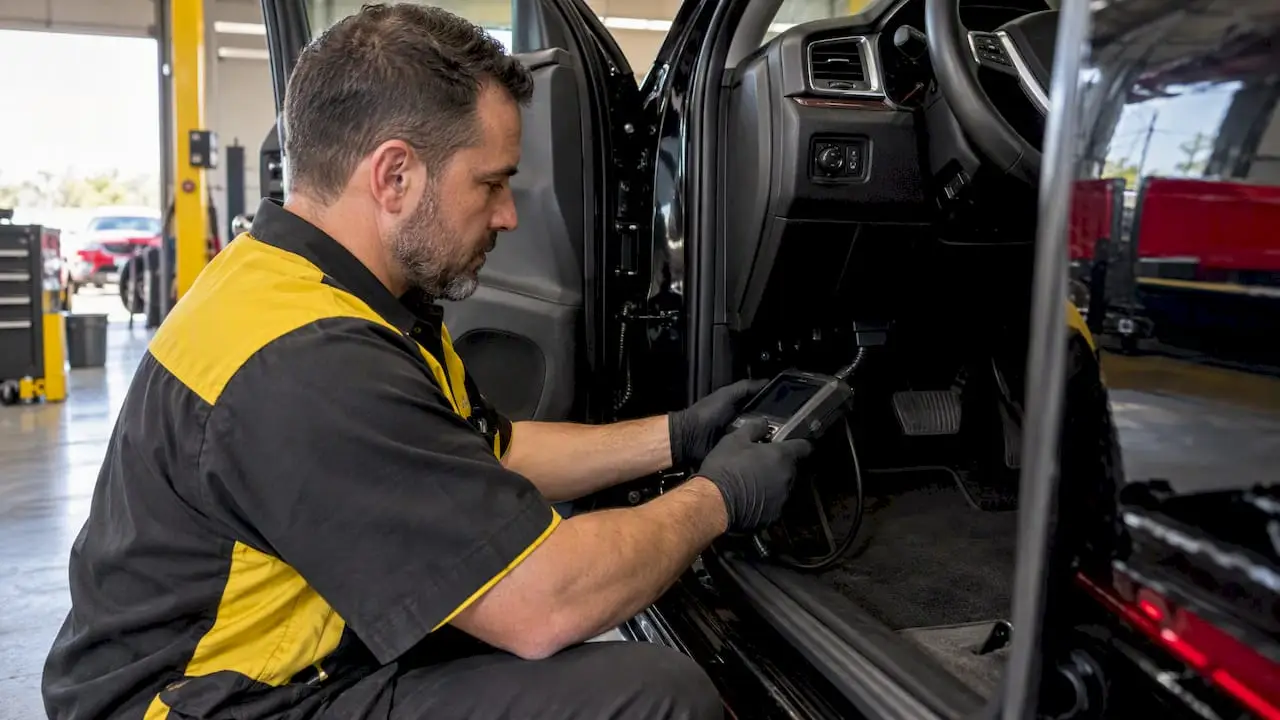
If you’re ever uncertain which category your situation falls into, treating it as a professional matter is the safer default. A quick inspection costs far less than the risk of continuing to drive on a brake system that might be failing.
Our take on brake warning lights
The biggest mistake we see isn’t ignoring the brake light outright, it’s treating every illumination as either a false alarm or a full emergency with nothing in between. Most brake warning lights fall somewhere in the middle: real enough to need attention soon, not always urgent enough to require roadside towing.
Conventional advice often oversimplifies this into “stop immediately” or “it’s probably nothing,” and neither extreme serves you well. The pedal feel test matters more than the color of the light in a lot of real-world cases, and we think drivers underrate how much information a thirty-second check in a parking lot can provide before they ever call a shop.
What we’d prioritize first is simple: check the parking brake, check the pedal, and note what else is happening on the dash. That sequence, done calmly, tells you almost everything you need to know about how urgent your situation actually is, and it gives whoever inspects the car a real head start.
— Kwik Kar
Get your brakes checked at Kwik Kar of Midlothian
We built our brake inspection process around exactly the kind of uncertainty this article walks through. When you’re not sure whether a warning light means a quick fix or something more serious, we check fluid level and quality, pedal feel, ABS sensors, and the master cylinder and lines before we tell you anything, so you get a clear picture instead of a guess.

We walk you through what we find and give you a straightforward estimate before any work begins, whether that turns out to be a fluid exchange, a leak repair, or something more involved. If you’re local to Midlothian and that red or amber light has you wondering what’s next, schedule a brake inspection through our services page or check our current specials before you come in.
FAQ
What would cause the brake light on the dash to come on?
The brake light often comes on because the parking brake is engaged, but it can also signal low brake fluid, a hydraulic system fault, or an ABS or sensor issue. Checking your parking brake and fluid reservoir first usually narrows down which one you’re dealing with.
Can you drive with the brake light on?
If the light is amber, tied only to ABS, and your pedal feels normal, you can typically drive cautiously to a repair shop. If the light is red or your pedal feels soft or sinks, AAA recommends stopping when safe and arranging a tow rather than continuing to drive.
Can you drive with the brake light out?
A brake light that’s out, meaning a bulb or indicator isn’t illuminating when it should, is a separate issue from a warning light staying on, and it’s worth having checked since it affects your visibility to other drivers. It’s best addressed promptly rather than driven on indefinitely.
How do I fix my brake warning light?
The fix depends entirely on the cause: releasing a fully engaged parking brake clears some lights immediately, while low fluid, a leak, or a sensor fault requires inspection and repair. A certified shop can check fluid level and quality, pedal feel, and ABS sensors to identify the exact cause before recommending a repair.
Sources
- How to read dashboard lights | AAA
- A warning light road map | AAA
- Advanced continuous sensing technology for hydraulic brake fluid | SAE 2022