


Most manufacturers recommend a brake fluid flush every 2 to 3 years or about 30,000 miles, whichever comes first. Your owner’s manual is the starting point, but a quick moisture test or visual check can tell you whether to move that date up. Towing, mountain driving, track use, or a failed moisture test all call for shortening the interval.
TL;DR:
- Brake fluid should be replaced every 2 to 3 years or about 30,000 miles, with shorter intervals recommended for towing, mountain driving, or track use.
- Testing moisture content with a strip or electronic device confirms if the fluid remains within safe water percentage levels, typically under 2 to 3 percent.
- A visual check of fluid color and level can indicate whether a full system flush is needed, especially when fluid turns amber or brown, or contains particles.
- Mixing different brake fluid types or guessing specifications is risky; always verify the fluid grade on the reservoir cap or manual before topping off.
- Most professional flushes include replacing the fluid in every line, including ABS modules, and require proper bleeding sequences to avoid trapping air and degrading brake performance.
Table of Contents
- What manufacturers recommend and how to read your manual
- Why brake fluid breaks down over time
- How to check and test your brake fluid
- DIY testing versus a professional flush
- Your brake fluid schedule and checklist
- How we approach brake fluid intervals in the shop
- Get your brake fluid checked at Kwik Kar Midlothian
- FAQ
- Sources
- Primary sources and manuals to check
What manufacturers recommend and how to read your manual
Every automaker builds a brake fluid interval into its scheduled maintenance chart, and the numbers cluster around the same range. Some manuals specify a calendar interval, others tie it to mileage, and a few list both and tell you to use whichever happens first. Ford’s own service guidance tells owners that brake fluid absorbs water over time, which degrades its effectiveness, and directs them to the scheduled maintenance section of the owner’s manual for the exact interval.
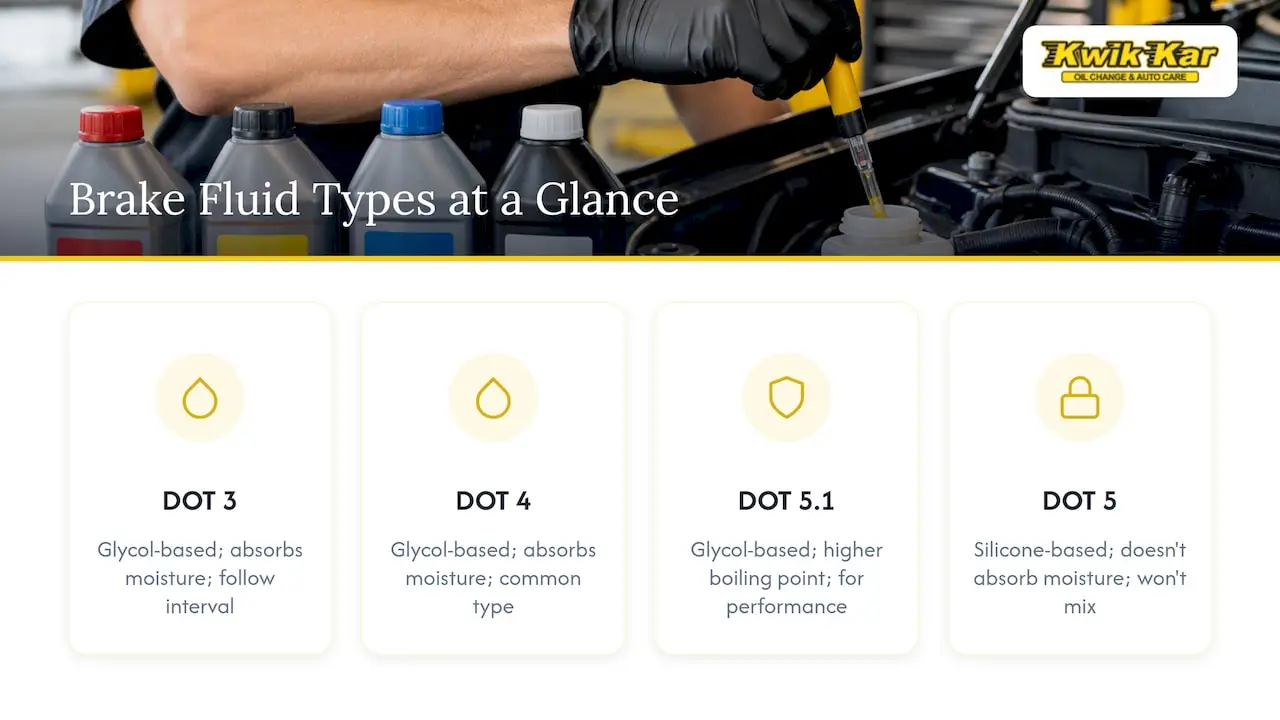
Your vehicle’s fluid type matters too. DOT 3 and DOT 4 are the most common glycol-based fluids and both absorb moisture from the air, which is why they need periodic replacement. DOT 5.1 is also glycol-based but formulated for a higher boiling point, often used in performance or heavy-duty applications. DOT 5 is silicone-based, doesn’t mix with the others, and is rare outside specialty vehicles. Mixing fluid types or guessing at the spec is a mistake, so always check the cap on your reservoir or your manual before topping off.
If you can’t find the brake fluid interval listed by name, look under “scheduled maintenance” or “fluid services” in your manual’s maintenance chapter. It’s usually grouped near coolant and transmission fluid intervals rather than listed on its own.
Why brake fluid breaks down over time
Brake fluid is hygroscopic, meaning it pulls moisture from the air even inside a sealed system. That water doesn’t stay separate. It blends into the fluid and lowers its boiling point, which raises the risk of vapor lock, a condition where fluid boils under heavy braking and turns to compressible vapor instead of solid pressure. That’s the moment a firm pedal can suddenly feel soft or sink to the floor.
SAE research on brake fluid performance found that a major portion of water pickup in a brake system is transmitted through the rubber hoses themselves, not just through reservoir caps or seals. The same research documented how water content reduces vapor lock temperature and changes the fluid’s viscosity at low temperatures, both of which affect how your brakes respond.
Heat cycling speeds up this process. Repeated hard stops from towing, mountain descents, or track driving push fluid temperatures higher more often, which depletes the corrosion inhibitors and other additives faster than normal daily driving does. That’s the practical reason demanding use shortens the interval.
How to check and test your brake fluid
A two-minute inspection tells you most of what you need to know before committing to a full flush.
- Open the reservoir cap and check the fluid level against the min and max lines.
- Look at the color: fresh fluid is pale yellow to clear, aging fluid turns amber, and fluid that looks brown or black with visible particles needs attention soon.
- Use a moisture test strip, available at most auto parts stores, dipped briefly into the reservoir fluid.
- Compare the strip color to the chart on the package, which usually marks action thresholds at specific moisture percentages.
Moisture content under roughly 2% to 3% water is generally considered acceptable, while fluid testing above that range signals it’s time to flush.
Many shops skip test strips in favor of an electronic refractometer, which gives a more precise moisture reading in seconds. If a technician shows you a refractometer result during a routine visit, ask what percentage they consider the cutoff for your vehicle, since thresholds can vary slightly by fluid type.
DIY testing versus a professional flush
Checking color and running a moisture strip is something most owners can do at home in a few minutes. Acting on a flush is a different matter.
A proper flush doesn’t just top off the reservoir. It pushes fresh fluid through the entire system, including each wheel’s caliper or wheel cylinder, until the old fluid is fully purged and the system is bled of air. Skipping a wheel or rushing the bleed process leaves trapped air or old fluid behind, which undermines the whole point of the service.
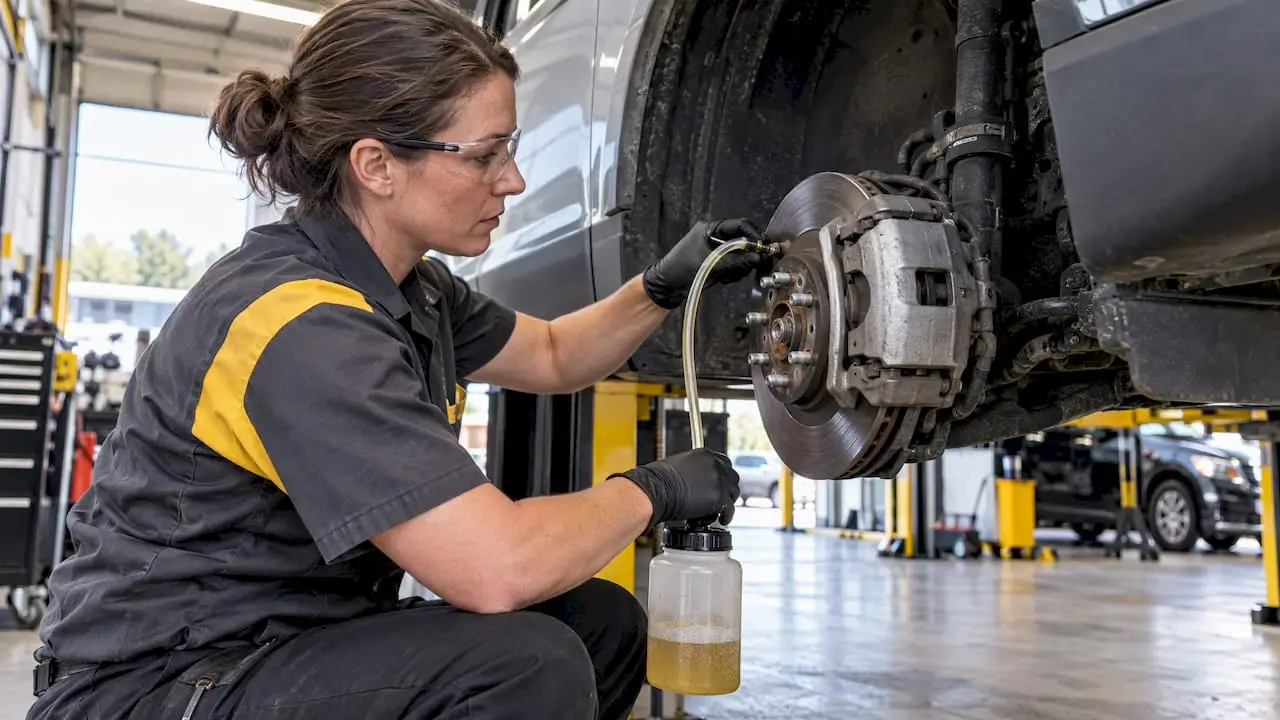
Modern vehicles complicate DIY attempts further. Anti-lock braking systems and electronic stability control often require a specific bleed sequence or a scan tool to cycle the ABS module correctly. Getting that wrong can trap air in the modulator, so if your vehicle has one of these systems, a professional flush is the safer route.
Your brake fluid schedule and checklist
For most daily-driven vehicles, the baseline is 2 years or 30,000 miles, whichever comes first, confirmed against your owner’s manual. Shorten that window if you tow regularly, drive mountain grades often, or track your car.
A simple checklist keeps this from slipping through the cracks:
- Write the manufacturer-recommended date or mileage on your service reminder.
- Bring a moisture test strip to your next oil change and test the reservoir.
- Note the fluid color each time you check it.
- Record the moisture percentage if you test it, so you can track the trend over time.
Pairing this check with an oil change appointment or your state inspection is the easiest way to remember it without adding a separate trip.
How we approach brake fluid intervals in the shop
We treat the owner’s manual interval as the starting point, not the final word. During routine service, we run a moisture test on the reservoir fluid rather than relying on mileage alone, because two vehicles with identical mileage can show very different water content depending on climate and driving habits.
What we typically see lines up with what the color chart suggests: fluid that still looks pale usually tests low for moisture, while fluid that has shifted to amber or brown often tests higher and points toward a flush. One habit we recommend to every customer is writing the next check date directly on the service reminder sticker, so it rides along with your next oil change instead of getting forgotten.
— Kwik Kar
Get your brake fluid checked at Kwik Kar Midlothian
If it’s been a while since anyone looked at your brake fluid, we make it simple to find out where you stand. We start with a visual reservoir check, follow up with a moisture test strip or refractometer reading, and walk you through what the results mean before any work begins.

When a flush is needed, we replace the fluid throughout the system to the vehicle’s specified DOT grade and bleed each line properly, including ABS-equipped systems that need a specific sequence.
- Visual inspection of fluid level and color.
- Moisture testing to measure water content objectively.
- Full system flush and bleed when results call for it.
| What you get | Why it matters |
|---|---|
| Moisture test reading | Confirms whether your fluid still meets safe limits |
| OEM-spec fluid replacement | Keeps your braking system within manufacturer tolerances |
| Full system bleed | Removes trapped air and old fluid from every line |
Our brake services page has more detail on what’s included, and you can also check our specials page for any current offers. Give us a call or stop by to get your brake fluid tested, usually while you’re already in for an oil change.
FAQ
How often does brake fluid really need to be changed?
Most manufacturers recommend a brake fluid flush every 2 to 3 years or about 30,000 miles, whichever comes first. A moisture test can confirm whether your specific fluid needs attention sooner or can safely wait.
Is it necessary to change brake fluid every 2 years?
For many vehicles, 2 years lines up with common manufacturer guidance, though your owner’s manual is the definitive source for your specific model. If a moisture test shows low water content, some owners extend slightly, but condition-based testing should guide that decision rather than skipping the check altogether.
What happens if I don’t change brake fluid?
Brake fluid absorbs water over time, which lowers its boiling point and raises the risk of vapor lock, a condition where fluid boils under hard braking and the pedal can feel soft or sink. Ford’s maintenance guidance notes that absorbed water degrades fluid effectiveness, which is why the interval exists in the first place.
Can brake fluid last 5 years?
Fluid that tests low for moisture and still looks pale yellow may technically still function at 5 years, but that falls outside most manufacturer recommendations and increases risk. A visual check paired with a moisture test strip is the only reliable way to know, rather than guessing based on time alone.
Sources
- Operating performance of motor‑vehicle braking systems affected by fluid water content (SAE technical paper)
- Brake fluid is the maintenance item everyone forgets — Auto Wire
- Dark brake fluid: When to change & what it means — Car Care Total
- Maintenance – Brake Fluid Check (Ford service content)