




For most new cars, the right move is to follow the owner’s manual or the dashboard oil-life monitor rather than schedule an early change on your own. Modern factory-fill oil is built to handle normal break-in wear, so an early drain usually is not necessary unless the manufacturer specifically calls for it or the car is a performance model built for track use, in which case a change around 500 miles is common. When that first service does happen, the shop should also replace the filter and reset the oil-life monitor during a proper oil change.
TL;DR:
- Most new cars do not require an early oil change unless specified by the manufacturer or if the vehicle is built for track use, often around 500 miles.
- Factory-fill oils are usually synthetic and designed to last through the break-in period, with oil-life monitors adjusting change intervals based on actual driving conditions.
- High-performance, track-prepped models, and owners who push their cars hard early on should verify the 500-mile recommendation and confirm with their dealer before high-RPM or extended driving sessions.
- Always follow the owner’s manual or official manufacturer guidance for the first service window, and if unavailable, use the dashboard reminder or a yearly check as a fallback.
- A proper first oil change should include oil and filter replacement, a visual inspection, fluid top-offs, tire pressure check, and oil monitor reset.
Table of Contents
- Recommended Timing and Mileage Windows for the First Oil Change
- Exceptions and Special Cases That Require an Earlier First Change
- How Oil-Life Monitors Work and What You Should Do About Them
- What a First Oil Change at a Shop Should Include
- Signs or Driving Conditions That Mean You Should Change Oil Sooner
- Owner’s Manual and Warranty Coverage Basics
- Kwik Kar’s Approach to Your Car’s First Oil Change
- Get Your First Oil Change Done Right at Kwik Kar Midlothian
- Where to Verify Model-Specific Guidance
- Sources
- FAQ
Recommended Timing and Mileage Windows for the First Oil Change
There is no single mileage number that fits every car. The right window depends on the type of oil your engine came with, whether your vehicle uses an oil-life monitor, and how you drive it. The owner’s manual is the authoritative source for your specific model, and it usually separates “normal” driving schedules from “severe” ones.
A few things shape that first-service window:
- Factory-fill oil in most new cars is synthetic or a synthetic blend, engineered to hold up through the break-in period.
- Oil-life monitors calculate your actual driving conditions rather than relying on a fixed mileage number.
- Low-mileage drivers should still change oil at least once a year, even if the monitor has not triggered a reminder, since oil degrades with time as well as mileage.
If you cannot find your manual, check the manufacturer’s official website for a downloadable PDF or call your dealership’s service department and give them your Vehicle Identification Number. When no other guidance is available, a reasonable starting point is your dashboard reminder or a yearly check, whichever comes first. Guessing at a mileage figure without checking your specific model is the most common mistake new owners make.
Exceptions and Special Cases That Require an Earlier First Change
A handful of vehicles genuinely do need an earlier first oil change, and it usually comes down to how hard the engine works in its first few hundred miles.
- High-performance and track-prepped models sometimes carry a manufacturer requirement for an early service.
- Cars driven on track days or in competitive events put extra heat and load stress on the oil almost immediately.
- Owners of performance trims should check the supplemental performance manual, not just the standard owner’s manual.
Some performance vehicles, including certain high-performance trims, come with manufacturer guidance recommending a first oil change at about 500 miles, with broader break-in restrictions extending to around 1,500 miles. Track or aggressive driving raises oil temperature and increases contamination faster than typical commuting, which is why those schedules exist. If your car falls into this category, confirm the exact interval with your dealer before your first track outing or extended high-RPM session.
How Oil-Life Monitors Work and What You Should Do About Them
Oil-life monitors have largely replaced the old guesswork of choosing between “normal” and “severe” maintenance schedules. Instead of a fixed mileage, the system tracks how you actually drive.
- The monitor factors in trip length, engine temperature, RPM patterns, and idle time to estimate remaining oil life.
- AAA explains that these systems adjust service intervals based on real driving conditions, which is why two identical cars can show different percentages at the same mileage.
- The monitor must be reset after every oil change, or it will keep counting down from the old baseline instead of the new service date.
Confirm the reset happened before you leave the shop.
Pro Tip: If you tow, idle for long stretches, or mostly drive short trips around town, consider scheduling service a bit sooner than the monitor suggests rather than waiting for it to hit zero.
What a First Oil Change at a Shop Should Include
Knowing what belongs in a proper first service helps you ask the right questions at the counter.
- Oil and filter replacement using the grade and specification listed in your owner’s manual.
- A quick visual inspection of belts, hoses, and visible fluid levels.
- Fluid top-offs where needed, such as washer fluid or coolant.
- Tire pressure check across all four tires, including the spare if accessible.
- Oil-life monitor reset, confirmed on your receipt or service ticket.
Before you leave, ask the technician to confirm the oil grade matched your manual, that the filter was actually replaced, and that the monitor was reset. Pricing varies by region and vehicle, so check a shop’s services page or specials page for current, verified pricing rather than relying on a number from somewhere else.
Signs or Driving Conditions That Mean You Should Change Oil Sooner
Sometimes your car will tell you it needs oil service before the monitor does. Watch for these physical signs:
- Rapid oil level loss between checks, which can point to a leak or excessive consumption.
- Metallic particles on the dipstick or unusual engine noise like ticking or knocking.
- Milky or emulsified oil, which can indicate coolant mixing into the oil system.
Certain driving conditions also justify moving up your service date, including frequent towing, short stop-and-go trips that never let the engine fully warm up, dusty or unpaved roads, and heavy idling in traffic or while working.
Pro Tip: If you notice any of these signs, check your oil level and color, snap a photo for reference, and get it looked at by a trusted technician before your next scheduled interval.
Owner’s Manual and Warranty Coverage Basics
Your owner’s manual is not a suggestion. It is the document that defines your specific maintenance schedule, including the difference between “normal” and “severe” driving conditions, and manufacturers write break-in guidance directly into it. Following that schedule protects your warranty coverage, since skipped or mismatched services can become a dispute point if something goes wrong later.
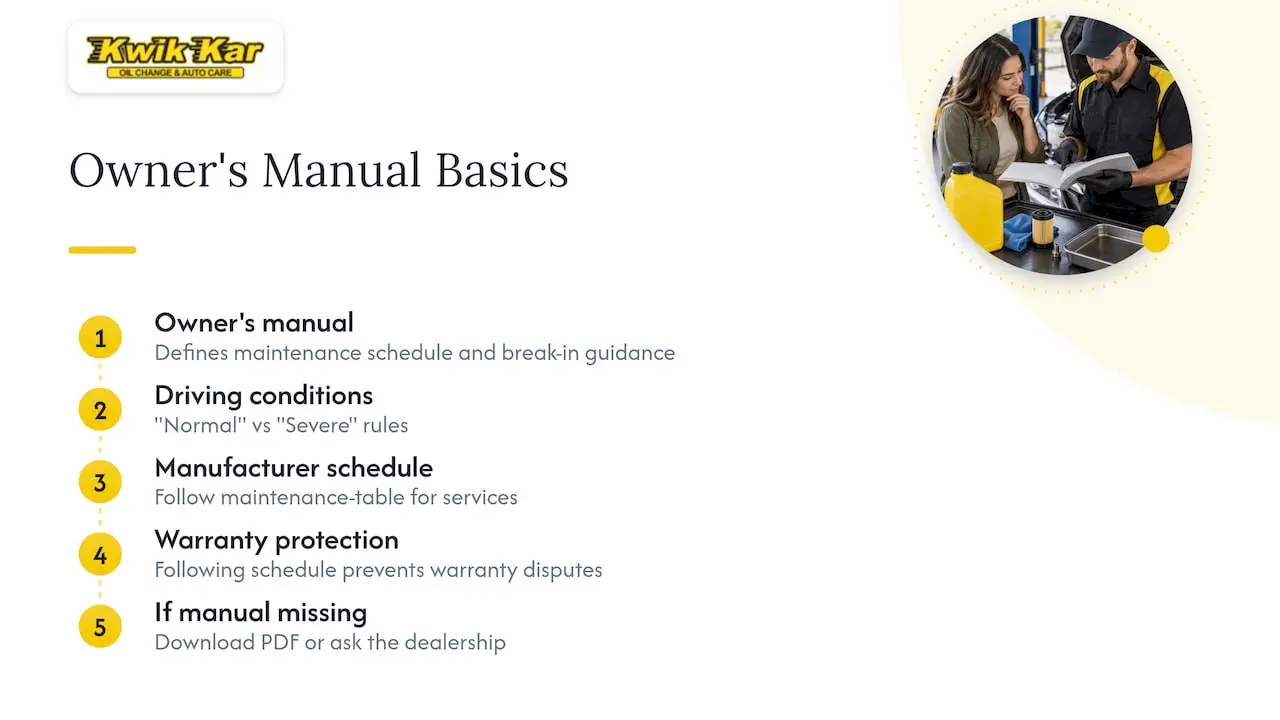
If you misplaced your manual, check your manufacturer’s official website for a PDF download or ask your dealership’s service department. Look specifically for the maintenance schedule tables and any break-in section near the front of the book.
Kwik Kar’s Approach to Your Car’s First Oil Change
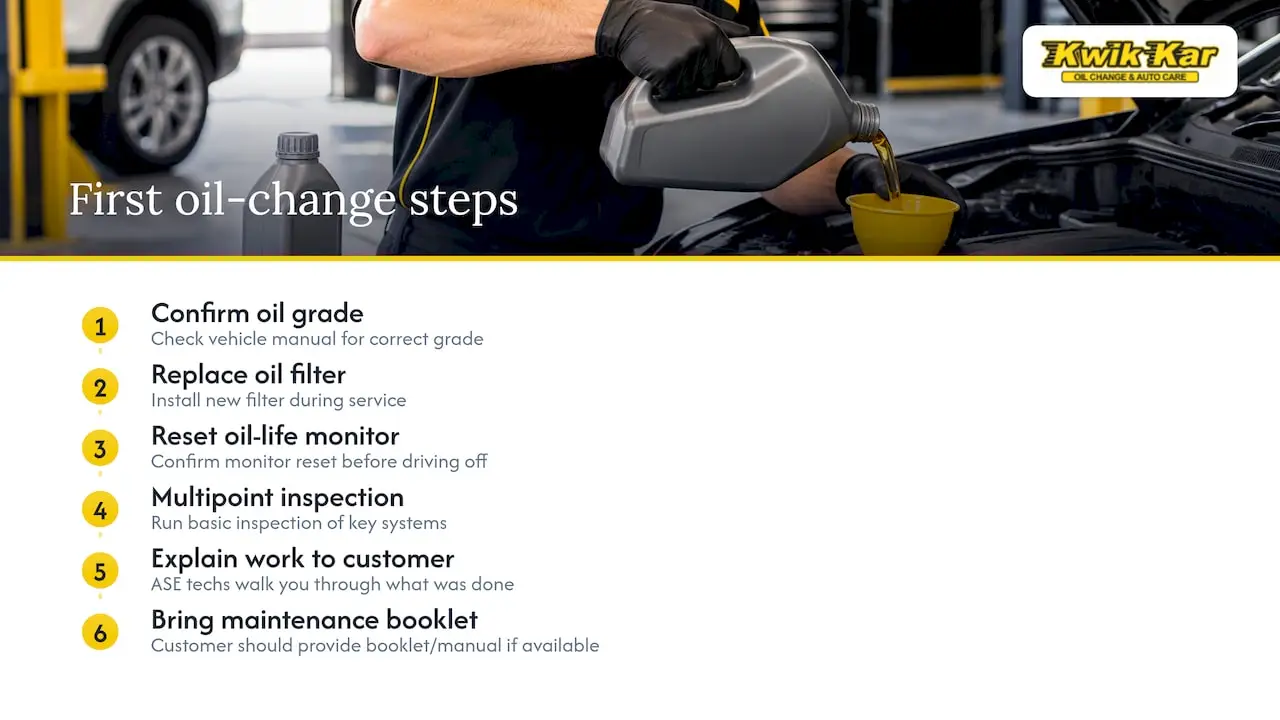
When a new car comes in for its first service, we start with the manual: confirming the correct oil grade, replacing the filter, resetting the oil-life monitor, and running a basic multipoint inspection. Our ASE-certified mechanics walk you through what was done and why, so nothing about the process feels like a mystery. Bring your maintenance booklet or manual if you have it, and ask for confirmation that the monitor was reset before you drive off.
Get Your First Oil Change Done Right at Kwik Kar Midlothian
Following your manual is the right call, and having a shop that actually follows it with you makes the whole process easier. Kwik Kar Lube & Tune Of Midlothian handles Full Service Oil Changes alongside filter replacement, fluid checks, and tire pressure verification, all performed by ASE-certified mechanics who explain each step in plain language.

- Bring your owner’s manual or maintenance booklet if you have one.
- Ask about current offers on our specials page before you book.
- Request written confirmation that your oil-life monitor was reset.
We keep communication clear from check-in to checkout, so you know exactly what your car needed and what it did not. Schedule your appointment online or give us a call to get your new car’s first service handled correctly.
Where to Verify Model-Specific Guidance
- Your vehicle’s owner’s manual or manufacturer PDF for break-in and warranty rules.
- AAA’s maintenance schedule guidance for general interval context.
Sources
FAQ
How long do you run break-in oil in a new engine?
Most modern vehicles do not use a separate “break-in oil” that gets swapped out early. The factory-fill oil is typically designed to last through the full break-in period and into the first regular service interval listed in your owner’s manual.
Should I get my first oil change at 500 miles or 1,000 miles?
For most everyday vehicles, neither number applies. Only specific high-performance or track-prepped models carry manufacturer guidance calling for a first oil change around 500 miles; everyone else should follow their owner’s manual or oil-life monitor instead.
Should I get an oil change right after buying a new car?
Not usually. Dealerships typically deliver new cars with fresh factory-fill oil, so an immediate change is not necessary unless your manual specifically requires it for your trim or driving style.
How long can a brand new car go without an oil change?
That depends on your model’s oil-life monitor and driving conditions, since the monitor adjusts based on how you actually drive rather than a flat mileage number. Even light-mileage drivers should not go longer than about a year between changes, since oil breaks down over time as well as distance.
— Kwik Kar