



Check your owner’s manual first. Most vehicles fall into a general 30,000 to 60,000 mile guidance window for differential fluid, but some models call for inspection only, not a fixed replacement. Towing, mountain driving, or extreme heat can cut that interval in half. Leaks, whining gears, grinding, metal flecks in the fluid, or having to top it up repeatedly mean you need service now, regardless of mileage.
TL;DR:
- Differential fluid should be checked or replaced based on the vehicle’s manual, with intervals often ranging from 30,000 to 60,000 miles, but severe driving can shorten this window to around 7,500 miles.
- Signs like gear noise, whining, grinding, leaks, or metallic fluid indicate urgent service is needed, regardless of mileage.
- Severe-use conditions such as towing, mountain driving, or off-road activity demand more frequent inspections or early fluid changes to prevent accelerated wear.
- Performing a DIY drain and refill is feasible for those comfortable working under vehicles; professional service typically involves a similar process with added checks on seals and vents.
- Using manufacturer-specified fluid type and additives is crucial to maintaining differential health and avoiding costly gear failure.
Table of Contents
- What Does Differential Fluid Actually Do?
- How Often to Change Differential Fluid?
- When Should You Service the Differential Earlier?
- How Do You Change Differential Fluid Yourself?
- What Does a Professional Differential Service Include?
- How Can You Keep Your Differential Healthy Longer?
- Kwik Kar’s Take: Manual First, Inspection Second, Shop When Needed
- Our Editorial Take: Why “One Mileage Number” Advice Falls Short
- Get Your Differential Checked the Right Way
- Sources
- FAQ
What Does Differential Fluid Actually Do?
Differential fluid is not interchangeable with engine oil, and it is not optional once your vehicle logs real mileage. It lubricates the gears inside the differential housing, carries heat away from spinning components, and protects the bearings and seals that keep the whole assembly sealed and quiet. Technical training materials describe it as the oil that keeps differential components meshing smoothly and, in limited-slip designs, allows the clutch packs to engage the way the manufacturer intended.
When that fluid breaks down or the wrong type goes in, problems show up fast:
- Gear noise, whining, or a low hum that changes with speed
- Rougher shifting sensation felt through the axle on turns
- Chatter or grabbing from a limited-slip differential that needs a specific friction additive
- Faster wear on bearings and seals, which leads to leaks
Some differentials use sealed housings designed around scheduled inspection rather than routine fluid swaps. That is a manufacturer decision, not a shortcut, so it still deserves a look on schedule.
How Often to Change Differential Fluid?
Your owner’s manual is the final word here, not a general rule of thumb. Manufacturer schedules for differential fluid vary by model, drivetrain, and even trim level, so two vehicles from the same brand can carry different requirements.
Subaru’s own maintenance documentation illustrates the point well. Many models call for inspecting front and rear differential gear oil at set intervals, while the BRZ’s rear differential has a hard replacement interval of 4 years or 60,000 miles. That is not a universal number. It is one automaker’s spec for one drivetrain.
Quick reference: common guidance patterns
- Many owner’s manuals: 30,000 to 60,000 miles for fluid replacement or inspection
- Some sealed or performance differentials: inspect only, replace based on condition
- Limited-slip and towing-rated axles: often shorter intervals with specific fluid additives
“Inspect” and “replace” mean different things in practice. An inspect interval means a technician checks fluid color, level, and contamination, then decides whether it needs changing. A replace interval is fixed, and skipping it voids the manufacturer’s intended service window even if the fluid looks fine.
When Should You Service the Differential Earlier?
Severe-use conditions shrink these intervals more than most drivers expect. If your driving regularly includes any of the following, plan on checking the differential sooner than the standard schedule:
- Towing a trailer or hauling heavy loads
- Frequent low-speed driving through mountainous or hilly terrain
- Stop-and-go traffic in extreme heat or cold
- Off-road use, deep water crossings, or dusty conditions
Honda’s Maintenance Minder system gives a concrete example of how much severe use changes the math. Under mountainous, low-speed driving or frequent towing, certain differential and transmission fluid service can be required at 7,500 miles, then every 15,000 miles going forward. That is a dramatically tighter window than a typical 30,000-mile baseline.
If any of this describes your driving, keep a simple log of severe-use trips. It gives you (and any shop you visit) a real basis for moving up the inspection date instead of guessing.
How Do You Change Differential Fluid Yourself?
A drain-and-fill on a rear differential is a reasonable DIY project if you are comfortable working under a vehicle and following torque specs exactly. Here is the safe sequence:
- Secure the vehicle. Park on level ground, chock the wheels, and raise the axle with a jack before setting it on jack stands rated for the weight. Never work under a vehicle supported only by a jack.
- Gear up. Put on gloves and eye protection. Differential fluid has a strong sulfur smell and old fluid can carry metal grit.
- Locate the fill and drain plugs. Most housings have a fill plug near the top and, on some models, a separate drain plug at the bottom. Mobil’s own procedural guide walks through this drain and refill sequence step by step.
- Drain the old fluid into a catch pan and inspect it. Metal shavings, a burnt smell, or a milky look point to internal wear or water contamination, not a routine service.
- Clean the drain plug and mating surface, then replace the crush washer or gasket if your vehicle uses one, following OEM guidance rather than reusing a worn part on assumption.
- Torque the drain plug to spec. Factory instructions matter here; Ford’s own cover kit documentation lists exact torque values and fill volumes for its axle applications, and overfilling or under torquing is a common mistake.
- Refill through the fill plug until fluid reaches the bottom of the fill hole, not a dipstick mark. Overfilling can cause seal leaks and pressure buildup.
- Reinstall the fill plug and torque it to spec.
Dispose of used gear oil at a recycling center or shop collection point rather than pouring it out. If you find metal chunks, a burnt smell that will not fade, or fluid that looks like it has been contaminated with water, stop and get the axle inspected by a professional before driving it hard again.
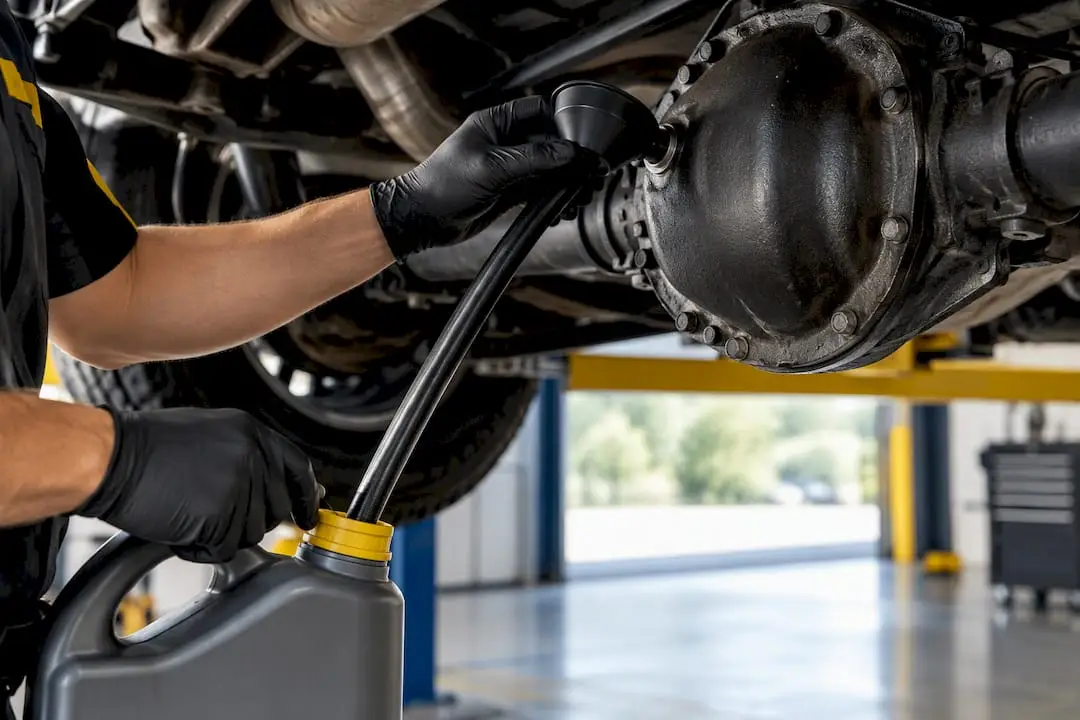
Pro Tip: Keep a small funnel with a long, flexible hose dedicated to gear oil. The fill hole on most differentials sits at an awkward angle, and a rigid funnel almost guarantees a mess.
What Does a Professional Differential Service Include?
A shop-performed differential fluid exchange follows the same basic logic as the DIY version, with a few things a lift and experience make easier. The technician drains the old fluid, refills with lubricant that meets or exceeds your manufacturer’s spec, and checks the housing seals and vent for early signs of leaking while everything is already exposed.
Service time is usually short. A straightforward fluid exchange without complications typically wraps up in well under an hour, though the exact time depends on your vehicle and whether the shop finds something else worth addressing while it’s apart.
Before you approve the work, ask a few direct questions:
- Which fluid grade and viscosity are you using, and does it match my manual’s spec?
- Does my differential need a limited-slip friction additive?
- Are the axle seals and vent in good shape, or showing early wear?
- Is there any warranty on the service itself?
That American Automobile Association also points out that differential and manual-transmission fluid can be genuinely hard to check yourself, and recommends qualified-technician service when you are not confident inspecting it. If your differential needs frequent top-ups, that is not normal. It means fluid is escaping somewhere, and the leak needs to be found, not just refilled.
How Can You Keep Your Differential Healthy Longer?
Preventive habits cost you almost nothing and save real repair bills down the line.
- Glance under the vehicle for drips near the differential housing every time you’re in for an oil change
- Note any new whining, grinding, or clunking on turns, and don’t wait it out
- Track towing trips, off-road outings, or heavy hauling in a simple log
- Use only the fluid grade and limited-slip additive your manufacturer specifies
- Keep a written service record so you or any shop knows exactly what went in and when
Pro Tip: Write the fluid type and mileage on a small sticker inside the trunk or glovebox after every differential service. It saves you from guessing during your next inspection.
Kwik Kar’s Take: Manual First, Inspection Second, Shop When Needed
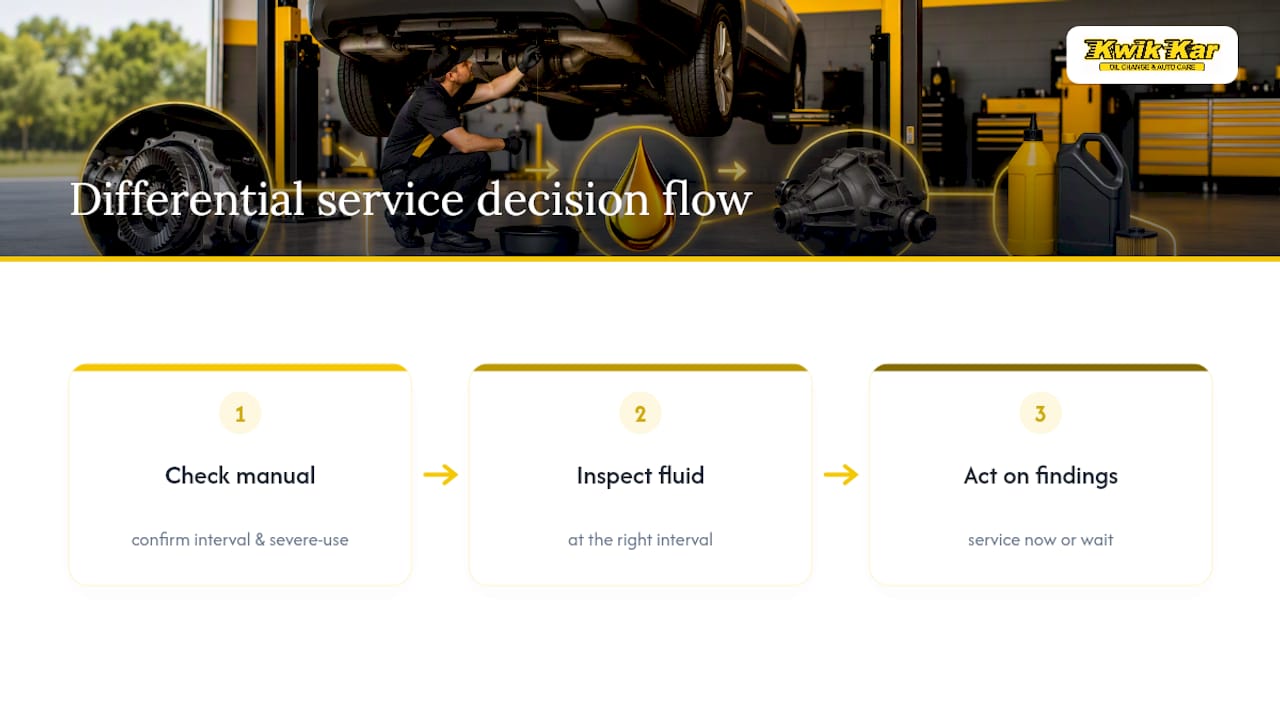
The decision flow really is that simple: check the manual, inspect at the right interval, and act on what you find rather than a guess. Most differential problems we see start the same way. Someone skipped an inspection because the fluid “looked fine last time,” or towed regularly without ever adjusting the schedule for it.
Qualified mechanics can check your differential fluid condition during a routine visit and walk you through exactly what they find, in plain language, before any work happens. If a fluid exchange is due or your driving fits the severe-use category, our team can handle that as part of a broader maintenance and repair visit. Transparent communication means you get a straight answer about whether your differential needs service now or can wait until your next scheduled check.
If you’re not sure where your vehicle falls on this schedule, bring your owner’s manual in and let a professional look at both.
Our Editorial Take: Why “One Mileage Number” Advice Falls Short
Most articles on this topic default to a single mileage figure, and that habit does readers a disservice. Differential intervals depend on drivetrain design, limited-slip hardware, and how the vehicle is actually driven, not a round number that sounds authoritative.
The manufacturer schedule should always outrank a generic range you found online, and the “inspect versus replace” distinction deserves more attention than it usually gets. An inspect-only schedule is not the manufacturer being vague. It’s an acknowledgment that fluid condition, not calendar time alone, should drive the decision in some drivetrains.
What we think gets underrated is the severe-use adjustment. Drivers who tow occasionally or drive mountain roads regularly rarely realize their interval should look nothing like the baseline in the manual’s general chart. If you take one thing from this article, let it be this: read the severe-use section of your manual specifically, not just the standard maintenance table, and log the trips that qualify.
— Kwik Kar
Get Your Differential Checked the Right Way
There is a straightforward alternative to guessing your way through a maintenance manual or hoping a quick top-up solves a leak. Qualified mechanics can inspect your differential fluid condition against your manufacturer’s actual schedule, not a generic mileage chart, and explain exactly what they find before any work begins.

Whether you need a routine inspection during your next oil change or a full differential fluid exchange after noticing gear noise or a slow leak, our team walks you through the fluid spec, cost, and timeline before starting. Check our current specials for available savings on fluid services, then visit our services page or stop by Kwik Kar of Midlothian to schedule a differential inspection today.
Sources
- What is the maintenance schedule for my 2019 Subaru? · Customer Self-Service
- Quick Tips for Checking Vehicle Fluids | AAA Club Alliance
- Maintenance Minder (Honda Ridgeline example)
- Six steps to changing rear differential fluid | Mobil™
- Ranger Differential Cover Kit instructions (Ford Performance)
FAQ
How Do I Know if My Differential Fluid Needs Changing?
Watch for gear whine, grinding on turns, fluid leaks under the axle housing, or having to top up the fluid repeatedly. Any of these signs, or fluid that looks metallic or burnt when checked, means the differential needs attention regardless of your mileage.
What Happens if I Never Change My Differential Fluid?
Degraded fluid loses its ability to lubricate and cool the gears, which accelerates wear on bearings, seals, and the gear teeth themselves. Left unaddressed, this can progress to gear failure, a repair that costs far more than routine fluid service would have.
Can I Use Any Gear Oil in My Differential?
No. Your differential needs the specific viscosity and grade your manufacturer lists, and limited-slip differentials often require a friction modifier additive on top of that. Using the wrong fluid can cause clutch chatter in limited-slip units or fail to protect the gears properly.
How Long Does a Differential Fluid Service Take at a Shop?
A straightforward differential fluid exchange without complications usually takes well under an hour. Kwik Kar of Midlothian can typically handle this as part of a broader maintenance and repair visit, and pricing details are available when you contact the shop directly.
Is Differential Fluid the Same as Transmission Fluid?
No, they serve different systems and usually require different specifications, even though some manufacturer service schedules group them together for convenience. Always check your specific vehicle’s fluid chart rather than assuming one fluid works for both.