




Bubbling in the coolant reservoir means air, steam or exhaust gas is moving through your cooling system. A little movement right after you shut the engine off is often normal. Steady bubbling while the engine runs, or bubbling with a rising temperature gauge, is not, and you should stop driving until you know why.
This guide explains the common causes, how to tell a minor problem from a serious one, and what to do next. It also covers how to stay safe around a hot cooling system.
TL;DR
- Bubbles come from trapped air, a weak radiator cap, boiling coolant, or combustion gas leaking into the coolant.
- A few bubbles after shutdown can be normal. Steady bubbling while driving needs attention.
- If the temperature gauge climbs, coolant overflows, or steam appears, pull over and shut the engine off.
- Never open the cap on a hot system. Pressurized coolant can scald you.
- Bubbles that persist after a proper bleed, along with coolant loss or white exhaust smoke, point toward a head gasket check.
Table of Contents
- What the bubbles are telling you
- Normal bubbling versus a warning sign
- Common causes of a bubbling coolant reservoir
- Does bubbling mean a blown head gasket?
- Can you drive with bubbling coolant?
- Safe checks you can do yourself
- How long do bubbles last after service?
- Our perspective on bubbling coolant
- Get your cooling system checked in Midlothian
- When the heat is also a problem
- What to tell the technician
- FAQ
- Ready to find out what the bubbles mean?
- Sources
What the bubbles are telling you
Your cooling system is sealed and pressurized. The pressure raises the temperature at which coolant boils, so the engine can run hot without the fluid turning to vapor. The reservoir (also called the overflow or expansion tank) is where extra coolant goes as it heats up and expands, and where it returns as the engine cools.
Because the reservoir is connected to the rest of the system, anything moving through the system can show up there as bubbles. According to Haynes Manuals, bubbling usually indicates that air or gas is moving through the cooling system, or that the coolant has reached a temperature where vapor begins to form. The same source notes that a small amount of movement after the engine is switched off can occur as heat spreads through stationary coolant, while steady bubbling during operation deserves closer attention.
So the first question is simple. When do you see the bubbles, and what else is happening at the same time?
Normal bubbling versus a warning sign
Use this quick comparison before you decide how worried to be.
| What you see | Likely meaning | What to do |
|---|---|---|
| A few bubbles or a faint gurgle just after shutdown | Heat spreading through stationary coolant | Watch the level and gauge over the next few drives |
| Bubbles soon after a coolant top-off, flush or repair | Trapped air working its way out | Let the engine cool and recheck the level; the system may need bleeding |
| Steady bubbles while driving, gauge normal | Air, a weak cap, or low coolant | Have the cap and system pressure checked |
| Bubbles with a rising temperature gauge or steam | Overheating | Pull over safely and shut the engine off |
| Constant bubbles, coolant loss with no visible leak, white exhaust smoke | Possible combustion gas in the coolant | Stop driving and get a professional diagnosis |
One symptom alone rarely settles the question. Patterns do.
Common causes of a bubbling coolant reservoir
1. Trapped air in the cooling system
Air is the most common and least serious cause. It gets in when the system is opened: a coolant change, a new hose, a radiator or thermostat replacement, a water pump job. It can also creep in through a slow leak that lets the level drop.
Air does not carry heat the way liquid coolant does. Trapped pockets can cause gurgling sounds, weak heat from the vents, and a temperature gauge that swings up and down. In a bad case, an air pocket near the thermostat or the cylinder head can cause real overheating.
If bubbling started right after service, air is the first suspect. The fix is to bleed the system, which means letting the trapped air escape and topping the coolant back up. Many vehicles have a specific bleed procedure, sometimes with a bleed valve and sometimes with the front of the vehicle raised. Your owner’s manual or a technician can tell you the right method for your engine.
2. A weak or worn pressure cap
The cap does more than close the opening. It holds the system at a set pressure and releases it when it goes above that. Haynes explains that when pressure drops because of a worn radiator cap, debris or a weakened spring, coolant can vaporize sooner than expected, and that shows up as bubbling in the reservoir.
This is one of the cheapest things to check and one of the easiest to overlook. A cap that no longer seals properly can mimic much bigger problems. A shop can test both the cap and the system pressure with the right gauge, which is a better approach than guessing.
3. Low coolant level
When the level is low, air has room to enter the system and hot spots form more easily. A low level also tells you coolant went somewhere. Check for puddles under the vehicle, damp hoses, crusty residue around fittings, or a sweet smell after driving.
Topping off treats the symptom. Finding where the coolant went is the actual repair. If you keep adding coolant every week or two, have the system inspected. Our radiator and cooling system service covers inspecting hoses, the radiator and related parts for leaks.
4. Overheating and poor circulation
When coolant gets hot enough, it boils, and the steam appears as bubbles in the reservoir. Several things can cause that:
- A thermostat stuck closed, which traps hot coolant in the engine
- A clogged or restricted radiator
- A failing water pump
- A cooling fan that is not turning on
- Low coolant or a weak cap, as above
If your gauge is climbing along with the bubbling, read our guide to engine overheating causes. If the fan seems to be the issue, our cooling fan checklist walks through safe things to look at before a shop visit.
5. Combustion gas leaking into the coolant
This is the cause most people fear, and the one that deserves respect. The head gasket seals the joint between the engine block and the cylinder head. If it fails, or if the head or block is cracked or warped, high-pressure combustion gas can push into the coolant passages. That gas rises into the system and shows up as bubbles in the reservoir.
This cause is less common than air or a bad cap, but it is serious because continued driving can badly damage the engine. The next section explains how to tell the difference.
Does bubbling mean a blown head gasket?
Not by itself. Bubbling is one of several possible signs, and many other cooling system faults look similar. A head gasket problem becomes more likely when several of these show up together:
- Repeated coolant loss with no visible leak. The level keeps dropping, but the ground under the vehicle stays dry.
- Persistent overheating. Especially under load, such as highway driving or climbing a grade.
- Thick white exhaust smoke. Coolant burning in the cylinders looks like steam from the tailpipe, and it often smells sweet.
- Milky, tan residue under the oil filler cap. This can mean coolant is mixing with the engine oil.
- Bubbles that continue after the system has been properly bled.
- Rough running or misfires after warm-up.
If you have one of these and not the others, a simpler cause is more likely. A weak cap, a leaking hose, a sticking thermostat or air in the system can each produce a single symptom.
How a shop confirms combustion gas
A technician can use a combustion leak tester, often called a block test. As MotorTrend describes it, the tool draws vapor from the top of the radiator through a blue test fluid. If combustion gas is present, the fluid turns from blue to yellow. The same article notes that its authors prefer a four-gas analyzer for a more accurate reading of hydrocarbons in the cooling system.
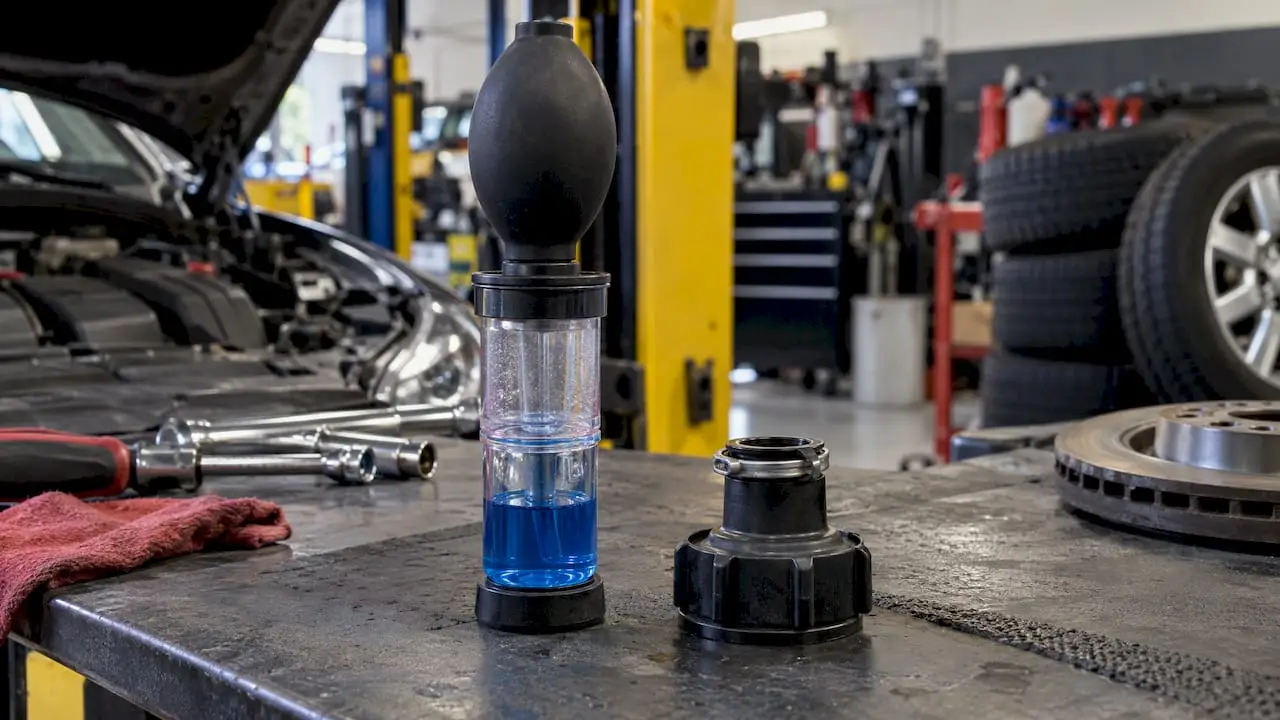
This matters because a diagnosis should come before a repair. Head gasket work is a big job, and you do not want to replace parts based on bubbles alone. Pressure testing the system, checking the cap, and testing for combustion gas lets a technician narrow the cause first.
Can you drive with bubbling coolant?
It depends on what else is happening.
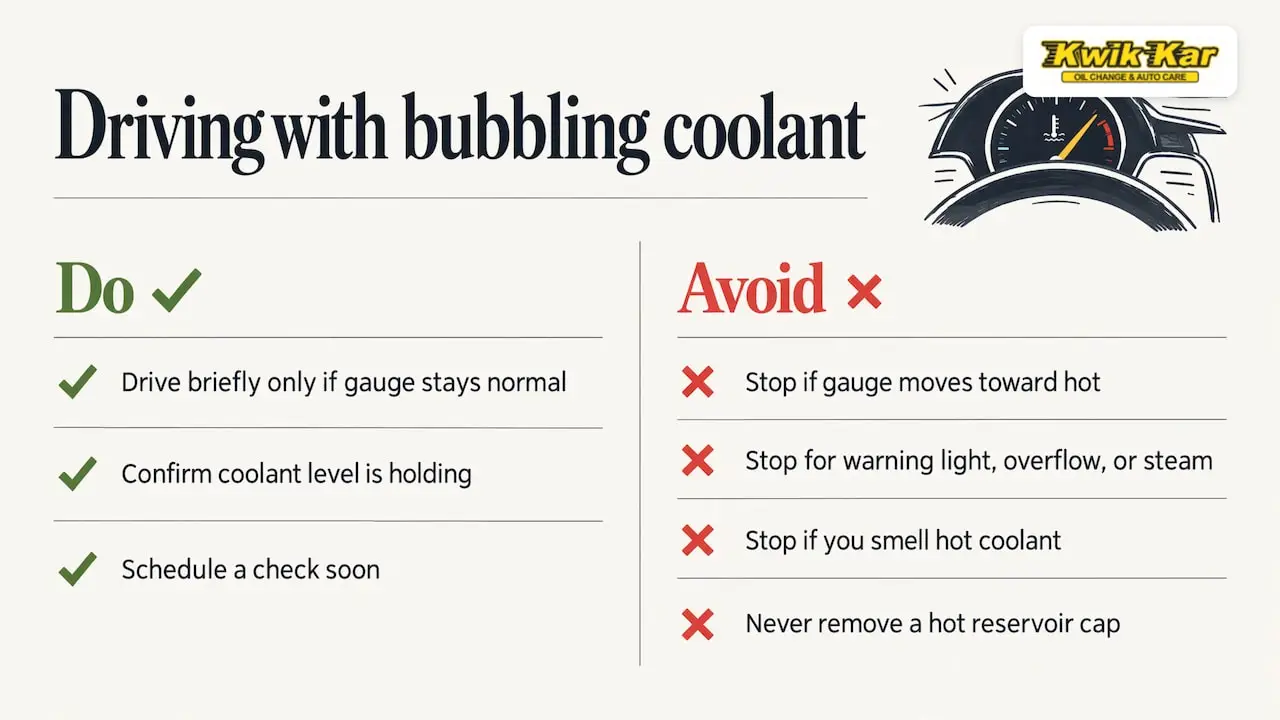
Okay to drive a short distance, with attention: the bubbles are minor, appeared right after service or a top-off, the temperature gauge stays in its normal range, and the coolant level is holding. Keep an eye on the gauge and schedule a check soon.
Stop driving: the gauge moves toward hot, a warning light comes on, coolant is overflowing, you see steam, or you smell hot coolant. Overheating can destroy an engine quickly, and the repair bill grows with every extra mile.
If the engine overheats, follow the steps that vehicle manufacturers give owners. Kia’s owner’s manual says to pull off the road and stop as soon as it is safe, shift to Park and apply the parking brake, and turn off the air conditioning. If coolant is leaking under the vehicle or steam is coming from under the hood, it says to stop the engine and not open the hood until the leaking has stopped or the steam has disappeared.
A Nissan owner’s manual is just as direct: do not keep driving if the engine overheats, because of the fire risk. It also warns never to remove the reservoir cap on a hot engine, since pressurized hot water can spurt out and cause burns or scalding.
Safe checks you can do yourself
You can learn a lot without opening anything. Do these with the engine off and completely cool.
- Check the level. Read the markings on the side of the reservoir. Compare the level cold, not hot.
- Look at the coolant. It should be a clean, uniform color. Rust-brown, oily, or sludgy fluid needs attention.
- Look for leaks. Check the ground under the vehicle, the hoses, and around the radiator.
- Inspect the cap. Look for a cracked or worn rubber seal. Only handle it when the system is cold.
- Check the oil cap and dipstick. A milky look is worth mentioning to a technician.
- Note the pattern. When do the bubbles start? After a drive, at idle, when the A/C is on? What was the gauge doing?
That last step helps more than most people expect. A short note on when and how it happens gives a technician a head start.
Waiting before you open anything
A hot cooling system holds pressure. Do not open the radiator or reservoir cap while the engine is warm. Plan on waiting well over half an hour after shutdown, and longer after a hard drive, and follow your owner’s manual. When you do open it, turn the cap slowly so any remaining pressure can release, and keep your face and hands clear. Wear gloves and eye protection.
What not to do
- Do not pour cold water into a hot, overheated engine.
- Do not keep driving to see if it clears up.
- Do not mix coolant types without checking what your vehicle requires.
- Do not buy major parts before the cause is confirmed.
How long do bubbles last after service?
If air was introduced during a coolant change or repair, the bubbles often clear after the system burps itself over a few heat cycles, meaning a few warm-ups and cool-downs. The level may drop slightly as air works out, so recheck it when the engine is cold and top it off to the correct mark.
If the bubbling continues beyond a few drives, if the heater blows cold air, or if the gauge fluctuates, air may still be trapped. That is a reason to have the system bled properly, not to keep topping off. A thorough bleed typically follows a vehicle-specific procedure, and it is a routine part of cooling system work.
Our perspective on bubbling coolant
We see the same pattern often. A driver notices bubbles, looks online, and within five minutes has decided the engine is finished. In most cases that is not what is happening, and in the cases where it is, waiting makes it worse. The answer is in the middle: take it seriously, and get it diagnosed.
Our approach starts with the simplest, cheapest explanations. Is the coolant level right? Is the cap sealing? Are the hoses sound? Is there air in the system after recent work? Those checks come before talk of major repairs.
When the evidence points deeper, we explain what we found and what it means, in plain terms, so you can make the decision with the facts in front of you. Our technicians are ASE-certified, and we aim to keep communication clear from the first look to the final repair.
If your temperature gauge is climbing or you see steam, do not wait for an appointment. Pull over, shut the engine off, and call.
Kwik Kar
Get your cooling system checked in Midlothian
Coolant problems rarely fix themselves, and they tend to get more expensive the longer they run. Our radiator and cooling system service is built around finding the cause first: inspecting coolant condition and level, hoses, the radiator, and related parts so you know what is actually wrong.

If the bubbling is part of a bigger picture, like rough running or an overdue maintenance schedule, our tune-up service and the rest of our full list of services may help. You can also check our specials page for current coupons.
When the heat is also a problem
Cooling trouble sometimes appears in the cabin first. If your heater blows lukewarm air along with the bubbling, air pockets or low coolant may be the reason, because the heater core relies on the same coolant flow. If your A/C seems weak at the same time, the cooling fan may be involved, since it serves both the radiator and the A/C condenser on many vehicles. Our guide on what to tell your mechanic about A/C problems can help you describe symptoms clearly.
Texas summers add stress to every part of the system. A cooling system that is only just coping in April can fail in July traffic, so addressing bubbling early is the safer path.
What to tell the technician
A good description shortens diagnosis. Before you call or drop off the vehicle, jot down:
- When the bubbles appear: cold start, after driving, at idle, or only on the highway
- Whether the temperature gauge moves, and how far
- Any recent work on the cooling system or engine
- How often you have to add coolant
- Any white smoke, sweet smell, or milky oil
- Whether the heater and A/C work normally
These details let the technician decide whether to start with a cap and pressure test, a bleed, or a combustion gas test.
FAQ
Can I drive if my coolant is bubbling?
Only if the bubbles are minor, the temperature gauge stays normal, and the level is holding. If the gauge rises, coolant overflows, or you see steam, pull over safely and shut the engine off. Driving an overheating engine can cause expensive damage.
Does bubbling coolant mean a blown head gasket?
Not necessarily. Trapped air, a worn cap, low coolant, or boiling from poor circulation are all more common. A head gasket becomes more likely when bubbling comes with ongoing coolant loss, overheating, white exhaust smoke, or milky oil, and a technician can confirm it with testing.
Why is my coolant bubbling after a coolant change?
Air usually enters the system whenever it is opened for service. The air can take a few heat cycles to work out, and the system may need to be bled. If bubbling continues or the heater blows cold, have it rechecked.
Is it normal for coolant to bubble when the engine is off?
A small amount of movement just after shutdown can happen as heat spreads through still coolant. Steady or growing bubbling, a rising gauge, or a dropping coolant level is not normal and should be checked.
Is it safe to open the reservoir cap to look?
Not while the engine is hot. The system stays pressurized after shutdown, and hot coolant can spray out and scald you. Let the engine cool fully and open the cap slowly.
Ready to find out what the bubbles mean?
If your coolant reservoir is bubbling and you are not sure why, let us take a look before a small issue turns into an engine repair. Call Kwik Kar Lube & Tune of Midlothian at (972) 775-5945 to schedule a cooling system inspection, or visit our website to see what we offer.
Sources
- Why Your Coolant Reservoir Is Bubbling: Key Causes Explained, Haynes Manuals
- If the engine overheats, Kia owner’s manual
- If your vehicle overheats, Nissan owner’s manual
- Blown Head Gasket Diagnostic, MotorTrend