




If your air conditioner runs constantly but blows warm air, and you notice ice forming on the indoor coil or hear a hissing sound near the lines, those combined signs may indicate a refrigerant leak. Turn the system off, ventilate the area, and call a licensed HVAC technician. Adding refrigerant on your own only masks the problem and won’t fix the underlying leak.
TL;DR:
- Refrigerant leaks often cause ice buildup, refrigerant escaping sounds, and increased energy bills, but these signs usually appear together for a reliable diagnosis.
- Indoor refrigerant leaks can lead to health issues like dizziness, headaches, and nausea, especially in poorly ventilated spaces, requiring swift medical attention.
- Common leak points include coils, fittings, Schrader valves, and outdoor line sets, with slow leaks potentially remaining undetected for months.
- Detecting a leak involves multiple methods such as visual oil residue, electronic detectors, UV dye, soap bubbles, and nitrogen pressure tests for accuracy.
- Promptly turning off the system, ventilating the area, and hiring licensed technicians are critical steps to safely address refrigerant leaks and prevent damage.
Table of Contents
- AC Refrigerant Leak Symptoms You Can Check Yourself
- Is a Refrigerant Leak Dangerous to Your Health?
- Where Refrigerant Leaks Usually Start
- How Technicians Detect and Confirm a Refrigerant Leak
- What to Do Right Now If You Suspect a Leak
- Preventing Refrigerant Leaks Before They Start
- What Honest AC Diagnostics Should Look Like
- Where to Learn More
- Sources
- FAQ
AC Refrigerant Leak Symptoms You Can Check Yourself
A single odd noise or a slightly cooler-than-usual room doesn’t always mean trouble. But when several signs show up together, your confidence in a refrigerant leak diagnosis should go up. Here’s what to look and listen for.
- Warm or weak airflow from the vents. Your system runs, the fan works, but the air coming out feels lukewarm instead of cold. This happens because refrigerant carries the heat out of your home, and a low charge means there isn’t enough of it left to do the job.
- Ice or frost on the evaporator coil or copper lines. A dropping refrigerant charge lowers the pressure inside the coil enough that moisture in the air freezes right onto the metal. If you can safely check the indoor unit or the line set running to the outdoor condenser, frost or a slick coating of ice is a strong red flag.
- Hissing, bubbling, or gurgling sounds near the lines. Refrigerant escaping through a small crack or a loose fitting often makes a faint hiss. A bubbling or gurgling noise can mean the leak is larger or the refrigerant is mixing with oil as it escapes.
- Higher energy bills and longer run times. As refrigerant drops, your system has to work harder and run longer to reach the same temperature. That extra runtime can increase your electricity bill even before you notice the house feels warmer.
- Rising indoor humidity or uneven cooling. A properly charged system pulls moisture out of the air as a byproduct of cooling. When refrigerant is low, humidity creeps up, some rooms feel muggy while others feel fine, and you might notice more condensation on your windows.
Common symptoms include warm air from vents, ice buildup on the evaporator coil, hissing sounds, rising indoor humidity, and higher energy bills as the system runs longer to compensate for the lost refrigerant charge.
Pro Tip: One symptom alone rarely proves a leak. A dirty filter or a duct problem can also cause warm air or higher bills, so weigh the whole picture before assuming the worst. Many of these symptoms overlap with other HVAC issues, which is exactly why technicians look for two or three signs pointing the same direction before they commit to a diagnosis.
Is a Refrigerant Leak Dangerous to Your Health?
Refrigerant gas isn’t something you want to breathe in large amounts, and in tight or poorly ventilated spaces it can act as an asphyxiant by pushing oxygen out of the air. The EPA notes that refrigerants can be flammable or toxic depending on the type and concentration, which is why professional handling and prompt repair matter.
Watch for these symptoms if you suspect a leak indoors:
- Dizziness or lightheadedness
- Headache
- Nausea or vomiting
- Coughing or throat irritation
- Fainting or an irregular heartbeat in severe cases
These reactions come from inhaling refrigerant gas, and prolonged exposure in a confined, poorly ventilated space is the riskiest scenario. Most household leaks release refrigerant slowly, and small residential exposures are often not life-threatening, but symptoms still deserve a fast response.
If anyone in your home feels dizzy, nauseous, or short of breath, get them into fresh air immediately. Call 911 or your local poison control center if symptoms don’t improve quickly. While you wait for a technician, ventilate the space by opening windows and running fans, and avoid open flames or sparks near the unit.
Where Refrigerant Leaks Usually Start
Refrigerant runs through a sealed loop, but a handful of spots wear out faster than the rest of the system. Evaporator and condenser coils are the most common leak points because their thin copper tubing takes constant exposure to moisture, temperature swings, and vibration.
Beyond the coils, technicians typically check:
- Fittings and brazed joints, where two pieces of copper tubing are sealed together and can weaken over years of expansion and contraction
- Schrader valves, the small access ports used for charging and testing, which can wear out or get damaged during service
- Line sets exposed to the outdoors, where UV exposure, corrosion, and accidental impact (a trimmer, a falling branch, a curious pet) take their toll
A slow pinhole leak can seep for months before you notice anything, while a sudden failure, like a punctured line, drops your cooling capacity almost overnight. The difference matters for repair: a pinhole in an accessible spot might get patched, but corrosion damage across a coil usually means replacing that coil or line set entirely.
How Technicians Detect and Confirm a Refrigerant Leak
Diagnosing a leak takes more than a guess, and a good technician layers several methods to be sure before recommending a repair.
- Visual inspection for oily residue at fittings and coils, since refrigerant often carries traces of compressor oil that leave a stain right at the leak point.
- Electronic leak detectors, which sense refrigerant vapor in the air. They work fast but can occasionally throw a false positive near other chemical vapors, so techs usually confirm with a second method.
- Dye and UV inspection, where a fluorescent dye circulates through the system and shows up under UV light at the leak site. This is especially useful for slow leaks hidden inside an air handler, since it avoids tearing the unit apart.
- Soap bubble tests, a low-tech but reliable check where soapy water applied to a suspected joint bubbles up if gas is escaping.
- Nitrogen pressure testing, which pressurizes the sealed system with nitrogen to reveal a pressure drop, useful when a leak is too slow for electronic detectors to catch.
Technicians combine visual checks, electronic detectors, dye tests, soap tests, and nitrogen pressure testing because no single method catches every leak size or location.
Pro Tip: If a technician offers to simply “top off” your refrigerant without locating the leak first, ask why. Recharging a leaking system is a short-term patch that can strain the compressor and leave you paying for refrigerant again in a few months.
What to Do Right Now If You Suspect a Leak
- Shut off the AC if you smell chemical odors, hear active hissing, or anyone feels sick. Running a leaking system can worsen the leak and stress the compressor.
- Ventilate the space by opening windows and doors and running fans, especially if the affected equipment is indoors or in a closet near living areas.
- Skip the DIY fixes. Refrigerant requires specialized equipment and licensing to handle safely, so this isn’t a project for a weekend toolbox.
- Call a licensed HVAC technician to inspect, confirm the leak location, and repair it properly.
- Seek medical help immediately if anyone shows symptoms like dizziness, nausea, or trouble breathing. Contact poison control or 911 if symptoms are severe or don’t improve after moving to fresh air.
Preventing Refrigerant Leaks Before They Start
You can’t eliminate every leak risk, but routine care catches small problems before they become expensive ones.
- Schedule annual or biannual tune-ups that include pressure checks and a visual inspection of the coils. Catching a slow leak early avoids the compressor stress that comes from months of low refrigerant charge.
- Keep the outdoor unit clear of overgrown shrubs, mulch buildup, and stray debris that can corrode or physically damage the coil and line set.
- Watch your utility bill. An unexplained jump in electricity use, paired with rooms that feel more humid than usual, is often the first sign something’s off long before you hear a hiss.
- Hire certified technicians for any brazing or line repair, and ask for documentation of pressure readings and the exact leak location. That paperwork protects you if the same coil needs attention again.
Pro Tip: Ask your technician to show you the before-and-after pressure readings after a repair. A real fix should hold steady on a follow-up nitrogen test, not just “feel colder” for a week.
What Honest AC Diagnostics Should Look Like
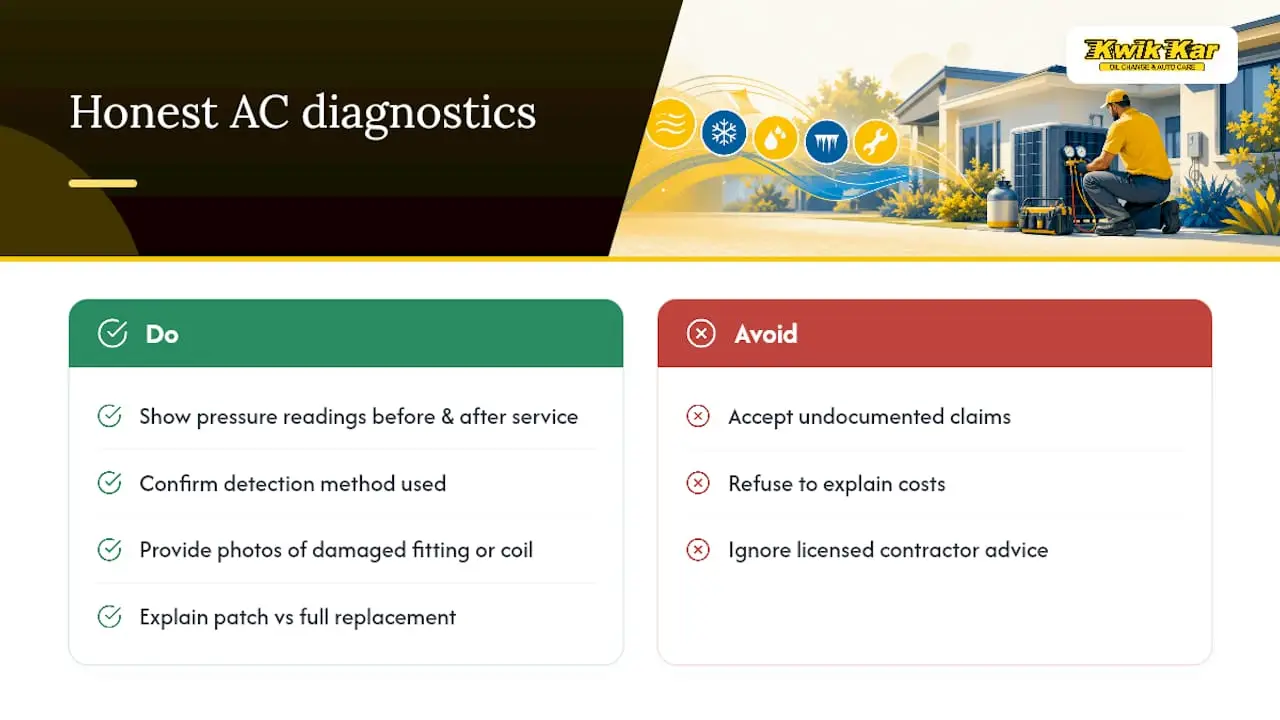
A technician who’s done the job right will walk you through what they found: the pressure readings before and after service, which detection method confirmed the leak, and photo evidence of the damaged fitting or coil. You should feel comfortable asking where the leak is, whether a patch or full replacement makes more sense, and what’s driving the cost difference between the two.
To be clear about scope: Kwik Kar of Midlothian works on vehicle air conditioning systems, not home HVAC equipment. Our certified mechanics handle diagnostics and A/C services for cars and trucks. For a leak in your home system, a licensed HVAC contractor is the right call. But if your vehicle’s AC is blowing warm or acting up, that’s exactly the kind of transparent, documented service we aim to provide.
Where to Learn More
For deeper reading, the EPA’s refrigerant safety guidance covers regulatory context, while Poison Control’s refrigerant fact sheet explains exposure risks and when to seek help.
This article is general information, not a substitute for advice from a qualified doctor. Consult a qualified healthcare professional about your own circumstances before acting on anything here.
Sources
- AC refrigerant leak signs — Summers PHC
- Refrigerant poisoning — Healthline
- Refrigerant safety — US EPA
- AC refrigerant leaks: Leak detection and repair — Trane
- Keeping it chill: Is refrigerant dangerous? — Poison Control
FAQ
Can an AC Refrigerant Leak Make You Sick?
Yes, refrigerant exposure can cause dizziness, headaches, nausea, and coughing, and it can act as an asphyxiant in tight spaces by displacing oxygen. Small household exposures are often not life-threatening, but you should still ventilate the area and seek medical attention if symptoms don’t clear up quickly.
Can You Stay in a House With a Freon Leak?
It depends on the severity and how well-ventilated the space is. If you smell strong chemical odors or anyone feels dizzy or nauseous, leave the affected area, ventilate with open windows and fans, and contact a technician rather than waiting it out.
How Expensive Is It to Fix a Refrigerant Leak?
Cost depends on where the leak is and how much repair it needs, ranging from a simple fitting repair to a full coil or line replacement. A technician can only give you an accurate number after confirming the exact leak location with proper diagnostic testing.
Where Is the Most Common Place for an AC Refrigerant Leak?
The evaporator and condenser coils are the most frequent leak points because their thin copper tubing takes the most exposure to moisture, vibration, and temperature changes. Fittings, brazed joints, and Schrader valves are the next most common spots.
How Do Technicians Detect a Refrigerant Leak?
Technicians use visual inspection, electronic leak detectors, dye and UV testing, soap bubble checks, and nitrogen pressure testing to confirm exactly where a leak is coming from before recommending a repair.
If your vehicle’s air conditioning is blowing warm, making odd noises, or just isn’t keeping up with the Texas heat, bring it by Kwik Kar of Midlothian. Our certified mechanics will check it out and walk you through exactly what’s going on, no guesswork, no pressure. Contact us or stop by today to get it sorted before summer really turns up the heat.