




If your AC clutch not engaging is the problem, the most likely culprits are low refrigerant tripping the low-pressure cutout, a blown fuse, or a bad relay, with wiring and ground faults close behind. A worn clutch coil or seized compressor happens too, but far less often. Before you buy parts, check the fuse, look at the relay, and confirm refrigerant pressure and voltage at the clutch connector.
TL;DR:
- A low-pressure switch trip due to refrigerant loss is a common reason for clutch failure, so pressure checks are essential before part replacement.
- Electrical issues like blown fuses, failed relays, or wiring faults are the most frequent causes of clutch non-engagement, often requiring simple tests to diagnose.
- Mechanical failures such as a seized compressor or worn clutch components are less common but tend to be costly and require physical inspection.
- Running diagnostic steps in order—pressure measurement, electrical testing, and mechanical checks—prevents unnecessary repairs and focuses on cost-effective solutions.
- Certified professionals use manifold gauges and scan tools to accurately diagnose clutch problems, especially when DIY methods yield ambiguous results.
Table of Contents
- Why Won’t the AC Clutch Engage? What It Actually Does
- What Causes an AC Clutch Not to Engage?
- Step-by-Step Diagnostic Workflow for a No-Engage AC Clutch
- How Do You Test the Electrical Side of an AC Clutch Circuit?
- Can You Check the AC Clutch and Compressor by Hand?
- AC Clutch Repair Costs: When to Fix, Replace, or Call a Shop
- Staying Safe While You Diagnose an AC Clutch Problem
- Our Take on Diagnosing a No-Engage AC Clutch
- Get a Verified AC Clutch Diagnosis at Kwik Kar of Midlothian
- Sources
- FAQ
Why Won’t the AC Clutch Engage? What It Actually Does
The AC compressor clutch is a magnetic switch. When the clutch coil gets energized, it pulls the pressure plate against the spinning pulley, locking the compressor shaft to the engine’s belt so it can actually pump refrigerant. No power to that coil, and the pulley just spins freely while the compressor sits idle.
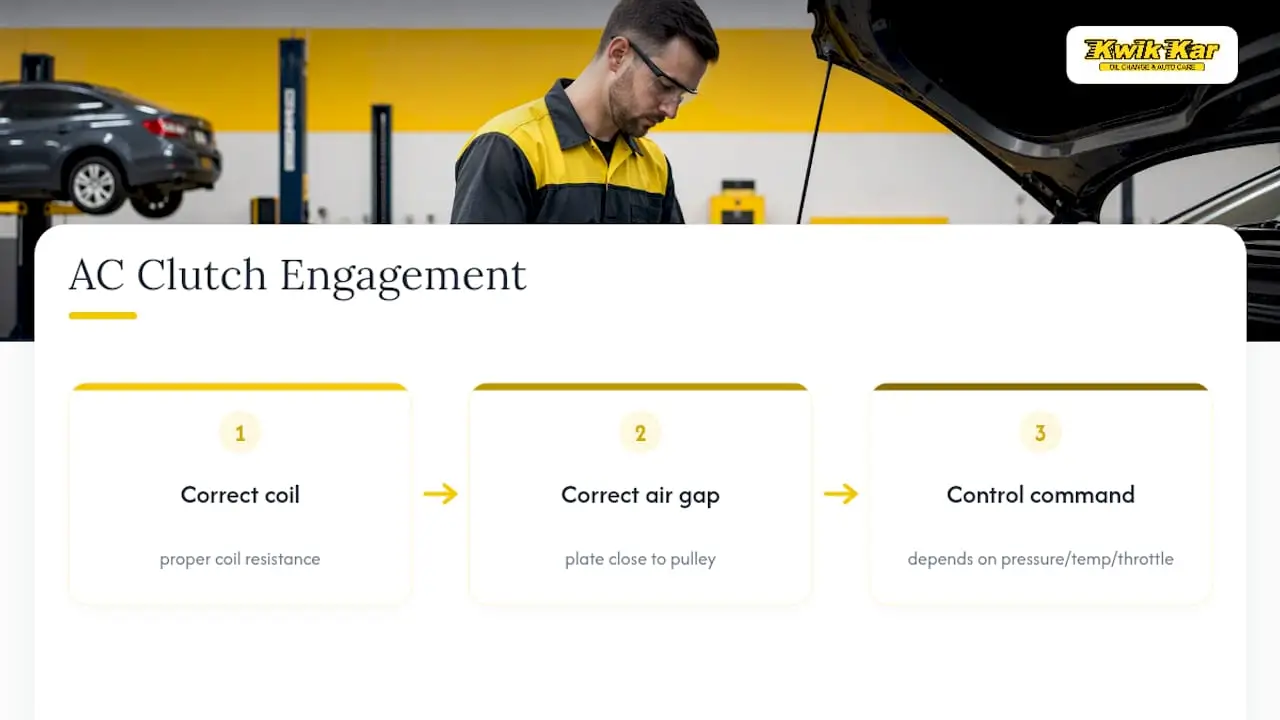
Three things have to line up for that clutch to engage: correct coil resistance, the right air gap between the plate and pulley, and a signal from the body control module or engine control module telling the coil to fire. That signal depends on inputs like refrigerant pressure and sometimes engine temperature or throttle position. This is why a mechanically perfect clutch can sit dead silent. If the ECM decides conditions aren’t right, it simply won’t send power, no matter how healthy the coil is underneath.
What Causes an AC Clutch Not to Engage?
Causes split cleanly into three categories, and working through them in order saves you from replacing parts you didn’t need.
Electrical issues are the most common starting point:
- A blown fuse in the AC circuit, which can prevent power from reaching the clutch
- A failed relay that may not send power to the clutch coil
- Open or corroded wiring between the relay and the clutch connector
- A bad ground connection at the compressor or body
- The BCM or ECM withholding the engage signal due to a sensor reading it doesn’t like
Refrigerant problems come in second, and they’re deceptively simple to miss:
- A low refrigerant charge that can trigger the low-pressure cutout switch to prevent clutch engagement
- A pressure switch that may fail to send the correct signal even if refrigerant levels appear normal
Confirming static and running pressures with manifold gauges before you add any refrigerant is the right move here. Topping off a system that isn’t actually low won’t fix anything and can create new problems.
Mechanical failures are the least common cause but the most expensive to fix:
- An open or shorted clutch coil that simply can’t build a magnetic field anymore
- Excessive air gap between the pressure plate and pulley, often from wear
- Worn clutch bearings or a wobbling pulley
- A seized compressor that can’t turn even with full electrical power
Step-by-Step Diagnostic Workflow for a No-Engage AC Clutch
Work through these steps in order. Skipping ahead to “replace the clutch” without ruling out cheaper causes first is how DIY repairs turn into wasted money.
- Confirm the symptom. Start the engine, turn the AC on max, and feel the vents. Warm air with the compressor pulley spinning freely (not locked to the belt) confirms a no-engage condition rather than a cooling or airflow problem elsewhere.
- Check the fuse and relay. Pull the AC compressor fuse and inspect it visually, or better, test it with a multimeter for continuity. Then check the relay. Swapping in an identical relay from another circuit can confirm a bad one, but do this carefully.
- Read system pressures. Connect manifold gauges to the high and low side service ports. Low static pressure with the system off strongly suggests a low charge; abnormal running pressures point toward a restriction or a bad pressure switch.
- Check voltage at the clutch connector. With the AC commanded on, use a multimeter to confirm you’re getting close to battery voltage at the clutch connector. No voltage there means the problem is upstream in the wiring, relay, or module logic.
- Measure coil resistance and current draw. Disconnect the clutch and measure resistance across the coil terminals. An open circuit reading means a dead coil; unusually low resistance can point to a partial short. A current (amp) check at the connector helps separate a coil problem from a module or wiring problem, since an ordered fuse to relay to voltage to coil resistance to amp draw sequence is exactly how technicians isolate electrical faults from clutch or compressor faults.
- Run a scan tool. A bidirectional scan tool can often command the compressor clutch directly. If it engages on command but not through normal operation, look at the sensor inputs the module is using to decide whether to fire the clutch. Pull any related trouble codes while you’re in there.
Pro Tip: Never bypass a low-pressure switch with a jumper wire to force the clutch on if you suspect the system is genuinely low on refrigerant. Running a compressor with insufficient lubrication from low charge can destroy it in seconds, turning a cheap fix into an expensive one.
How Do You Test the Electrical Side of an AC Clutch Circuit?
Electrical testing is where most no-engage clutch problems get solved, and it’s also where sloppy technique causes damage. A few specifics matter here.
- Fuses: A visual check catches an obviously blown fuse, but a hairline crack in the element can look fine and still fail under load. Test with a multimeter set to continuity, and check whether that fuse shares a circuit with another accessory that’s also acting strange.
- Relays: Swapping relays is a legitimate diagnostic trick, but mismatched relays carry a real risk of kickback voltage that can damage sensitive control modules. Test a suspect relay with a multimeter instead when possible, checking for continuity across the switched terminals when the coil side is energized with 12 volts.
- Voltage drop: Measure voltage at the clutch connector, then compare it to voltage right at the relay output. A significant drop between those two points means corroded connectors or damaged wiring somewhere in between.
- Coil resistance: A healthy clutch coil typically reads in the low single-digit ohm range, though the exact number varies by vehicle and compressor model. An open or near-infinite reading confirms a failed coil.
Pro Tip: If pressures and voltage all check out but the clutch still won’t fire, don’t assume the coil is bad yet. Run a bidirectional scan-tool test first, since many modern vehicles inhibit the clutch signal entirely when a sensor input looks questionable to the module.
Can You Check the AC Clutch and Compressor by Hand?
Yes, and it’s one of the fastest ways to rule out a seized compressor without spending a dime on tools you don’t already own.
- Seizure check: With the engine off, try turning the clutch pulley by hand. It should spin freely with minor resistance. If it’s locked solid or grinds, pressures won’t rise properly when the engine runs and the clutch attempts to engage, which confirms a seized or internally failed compressor rather than an electrical fault.
- Air gap: Use a feeler gauge to measure the space between the pressure plate and pulley face at several points around the circumference. Most manufacturers specify a range measured in thousandths of an inch. Shims can sometimes correct an oversized gap.
- Bearing and pulley wear: Listen for grinding or squealing from the pulley bearing with the engine running and the clutch disengaged. Wobble you can see or feel by hand usually means the bearing is failing and the clutch assembly needs replacement.
- Internal damage: Metal shavings in the refrigerant lines or a compressor that won’t turn even under gentle force usually means the compressor itself is done, not just the clutch.
AC Clutch Repair Costs: When to Fix, Replace, or Call a Shop
Clutch replacement is a cheaper repair than replacing the whole compressor, since clutch-only jobs run less than a full compressor swap in most cases, while internal damage or metal debris in the lines usually forces a full compressor replacement. Labor cost swings on how accessible the compressor is on your specific engine, since some require removing other components just to reach it.
A simple recharge is only a real fix if there’s no underlying leak. If your system runs low again in a few weeks, you’re chasing a leak, not solving a shortage. Refrigerant recovery and handling also come with legal requirements. EPA rules require certified equipment and, in most cases, certified technicians to recover and recharge automotive refrigerant, which limits how far a DIY repair can go once you’re past the diagnostic stage.
Use this simple decision checklist: power present at the clutch but it still won’t engage points to the clutch itself; no power at all points to wiring or the control module; and a pulley that won’t turn by hand points straight to compressor replacement.
Staying Safe While You Diagnose an AC Clutch Problem
Never vent refrigerant to the atmosphere. Use certified recovery equipment or let a shop handle it, both for legal reasons and because refrigerant exposure to skin or eyes causes real injury. Keep direct 12-volt bench tests brief. Wear eye protection and gloves anytime you’re working near refrigerant lines. If your diagnosis points to internal contamination or compressor failure, stop there and bring it to a professional rather than pushing further on your own.
Our Take on Diagnosing a No-Engage AC Clutch
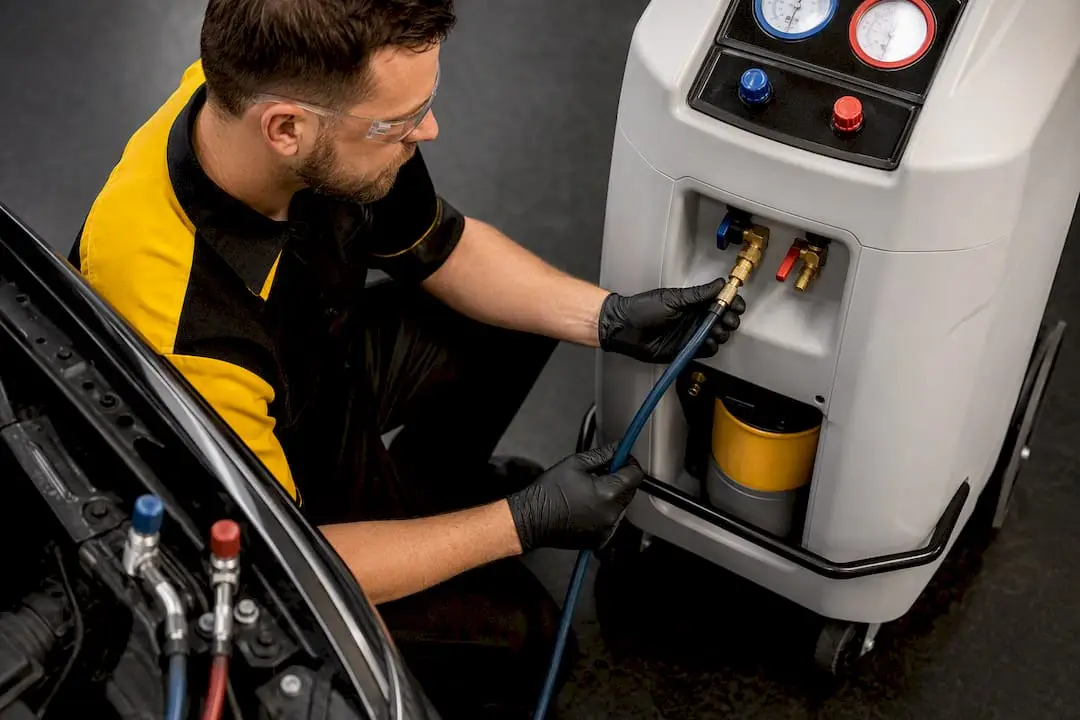
We follow the same logic laid out in this guide: quick checks first, then pressure readings, then electrical testing, and only then a hands-on mechanical inspection. That order matters because it stops good clutches from getting replaced for what’s actually a $15 relay or a corroded ground wire. Technicians use manifold gauges and scan tools to pin down the actual cause before recommending clutch or compressor replacement, and customers are walked through what is found and the cost before any work starts.
**
Get a Verified AC Clutch Diagnosis at Kwik Kar of Midlothian
Chasing a no-engage clutch with a multimeter in your driveway works right up until you need certified refrigerant recovery equipment or a scan tool that talks to your specific control module. That’s where Kwik Kar of Midlothian picks up where your toolbox leaves off. Our AC diagnostic and repair services cover pressure checks, electrical testing, and scan-tool diagnosis using the same step-by-step approach outlined above, so you get an actual answer instead of a guess.

We’ll give you a clear, verified quote before any work begins, whether that means a relay, a clutch, or a full compressor. Check our current specials before you book, then call or stop by Kwik Kar of Midlothian in Midlothian, Texas, to get your AC blowing cold again.
Sources
- Troubleshooting a “No A/C Compressor Engagement” Fault – Shop Press
- AC Compressor Clutch Not Engaging: 6 Causes and How to Fix Them – R & Y A/C Compressors®
- Carparts
- AC compressor clutch replacement cost guide – PartCatalog blog
FAQ
How Do You Force an AC Clutch to Engage?
A scan tool with bidirectional control can command most clutches on directly, which technicians use to test the coil and mechanical engagement in isolation. Jumping 12 volts straight to the clutch connector is possible but should only be a brief test, never a workaround for a system that’s actually low on refrigerant.
What Stops an AC Clutch From Engaging?
The most common blockers are a blown fuse, a failed relay, low refrigerant tripping the low-pressure cutout, or wiring and ground faults between the relay and the clutch. Less often, the clutch coil itself has failed or the control module is withholding the signal because of a questionable sensor reading.
How Do You Tell if the Compressor Is Bad or Just the Clutch?
With the engine off, try turning the compressor pulley by hand. If it turns freely but pressures still won’t respond correctly when the engine runs, the compressor may be internally failed and won’t build pressure even with a good clutch signal. If the pulley is locked solid, you’re looking at a seized compressor, not a clutch problem.
How Much Does It Cost to Fix an AC Clutch?
Costs vary by vehicle, but clutch-only replacement is generally less expensive than a full compressor swap, while internal damage or contamination in the lines usually pushes the repair toward full compressor replacement instead. Kwik Kar of Midlothian provides a verified, itemized quote after diagnosis so you know the exact cost before any work begins.
Can Low Refrigerant Really Stop the Clutch From Engaging?
Yes. Most systems use a low-pressure switch specifically to prevent the clutch from engaging when the charge is too low, protecting the compressor from running without adequate lubrication. Confirming pressures with manifold gauges before adding refrigerant is the right way to verify this cause instead of guessing.