




If your car has a timing belt, plan on replacing it at your manufacturer’s interval and budget accordingly for most vehicles. Skip it, and an interference engine can suffer serious internal damage if the belt snaps. Check your owner’s manual for your exact interval, and have a shop inspect the belt if you’re unsure where you stand.
TL;DR:
- Most timing belts should be replaced between 60,000 and 100,000 miles, with some models requiring shorter intervals around 30,000 to 60,000 miles.
- Rubber degrades over time regardless of mileage, so replacement is recommended approximately every four years, especially for vehicles that sit unused.
- Visible cracks, glazing, or oil contamination on the belt, along with ticking noises or rough idle, indicate a possible impending failure requiring immediate inspection.
- Replacing a timing belt involves extensive labor, including removing multiple engine components, and should include replacing tensioners, idlers, and seals to prevent future issues.
- The cost generally ranges from $400 to $1,000, with more complex jobs or additional parts like the water pump increasing the price; DIY work is risky on interference engines.
Table of Contents
- How Often Does a Timing Belt Need Replacement?
- What Are the Warning Signs of a Failing Timing Belt?
- What Does a Timing Belt Replacement Actually Involve?
- How Much Does Timing Belt Replacement Cost?
- Should You DIY a Timing Belt or Hire a Professional?
- How Can You Save Money on Timing Belt Service?
- How Should You Prepare for a Timing Belt Appointment?
- A Shop-First Take on Timing Belt Work
- Get Your Timing Belt Checked at Kwik Kar of Midlothian
- Sources
- FAQ
How Often Does a Timing Belt Need Replacement?
Manufacturer-recommended intervals commonly fall between 60,000 and 100,000 miles, though some older vehicles and a handful of current models list shorter windows around 30,000 to 60,000 miles. There’s no universal number. A Honda four-cylinder and a Subaru boxer engine can call for very different schedules, even from the same model year.
Your owner’s manual is the first place to look. If you no longer have it, a dealer service department or a VIN-based lookup tool can pull the factory maintenance schedule for your exact trim and engine.
Mileage isn’t the only factor. Rubber degrades with age regardless of how far you’ve driven, which is why some manufacturers list a time-based limit, often around four years, alongside the mileage figure. A car that sits in a garage most of the year can still need a belt replaced on schedule.
A few habits make this easier to track over time:
- Write the replacement date and odometer reading on a sticker under the hood or in a maintenance log.
- Keep the service invoice, since it documents what was replaced, not just that “the timing belt was done.”
- If you’re buying a used car, ask for that documentation. Treat a missing timing belt record as a cost you’ll likely absorb soon, since there’s no way to confirm the belt’s condition without one.
- Note your specific interval somewhere you’ll actually see it, like a phone reminder tied to mileage.
What Are the Warning Signs of a Failing Timing Belt?
A timing belt rarely fails without any warning at all, though the signs can be subtle. Watch for these:
- Ticking or clicking noises coming from the front of the engine, especially at idle.
- Rough idle or misfires that seem to come and go without an obvious cause.
- Difficulty starting the engine, even though the battery and starter check out fine.
- An illuminated check engine light, sometimes tied to a camshaft or crankshaft position code.
- Visible cracks, glazing, or oil contamination on the belt itself, if it’s accessible for a look.
These symptoms are consistent with what repair-cost data typically shows for failing timing belts, but a visual check only tells you so much. A belt can look fine on the surface while the tensioner underneath is already worn out. If you suspect the belt is close to failing, don’t keep driving on it. Have the car towed to a shop instead of risking a breakdown on the road. A technician can pull the covers, check tension, inspect the idlers, and look at the water pump before giving you a real answer.
What Does a Timing Belt Replacement Actually Involve?
Most of what you’re paying for is labor, not parts. Getting to the belt usually means working through several layers of the engine:
- Removing accessories like the alternator, power steering pump, or A/C compressor bracket to clear access.
- Draining the coolant, since the water pump often sits right behind the timing cover.
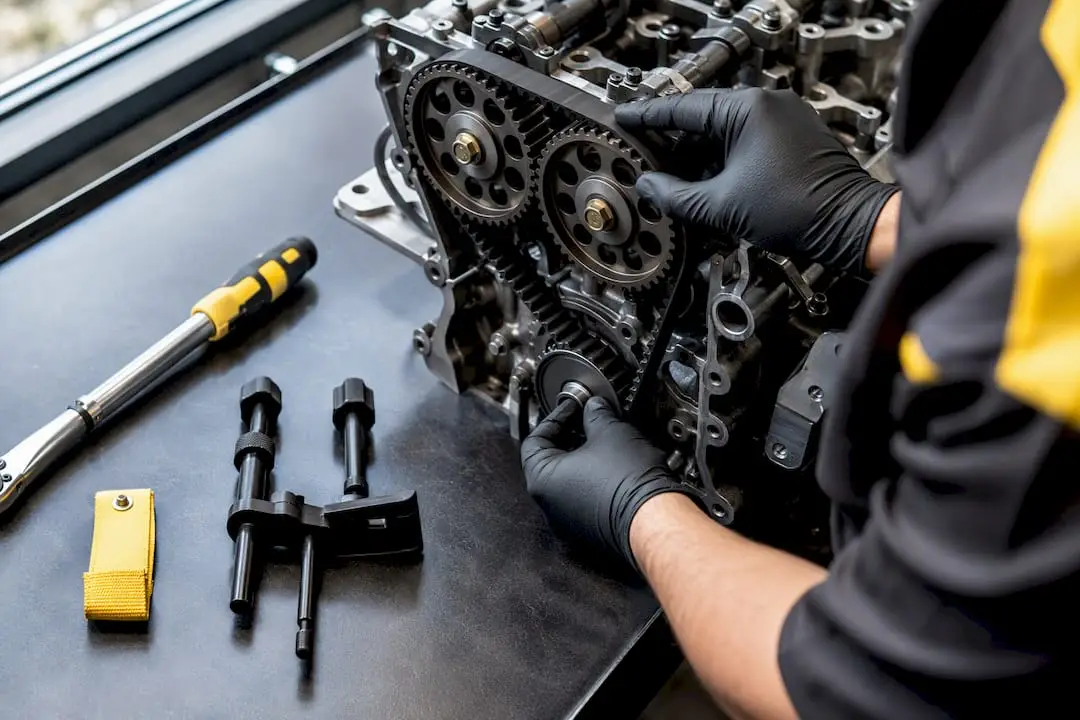
- Pulling the timing cover itself, then using specialized tools to lock the camshafts and crankshaft in place so the timing marks don’t shift during the swap.
Once everything is opened up, most shops recommend replacing the tensioners, idler pulleys, and related seals or gaskets at the same time as the belt. It’s the same logic as changing a battery terminal while you’re already elbow-deep in the engine bay: the labor to get there is already paid for.
This is also where interference versus non-interference engines matter most. On an interference engine, the belt failing while the engine is running can send a piston into an open valve, and that’s an entirely different repair bill than a stalled car. Expect several hours of labor for timing belt replacement on many vehicles, with the exact time depending on engine design and accessibility.
How Much Does Timing Belt Replacement Cost?
Cost estimates vary by vehicle, region, and how much else gets replaced along the way. For most cars, expect somewhere between $400 and $1,000 for a standard timing belt service. Jobs on complex or parts-heavy engines, particularly ones where the water pump replacement adds significant labor, can run $1,000 to $1,500 or more.
A few things move that number up or down:
- Belt-only versus belt kit versus full service. A belt-only job is cheaper up front but leaves worn tensioners in place. A full kit with the water pump costs more initially but avoids paying for the same labor twice later.
- Dealer versus independent shop. Labor rates differ, and dealers sometimes charge more for the identical OEM part an independent shop can also source.
- Regional labor rates. The same job can price differently across markets, even for the same vehicle.
- Parts brand. OEM versus aftermarket parts affect both cost and, in some cases, warranty coverage.
When you’re comparing quotes, ask for an itemized breakdown: parts listed individually, labor hours stated up front, and any warranty terms in writing. A number with no detail behind it is hard to evaluate against another shop’s estimate.
Should You DIY a Timing Belt or Hire a Professional?
Timing belt work is not a typical driveway job, and getting it wrong carries real consequences. Incorrect timing, even off by one tooth on the belt, can bend valves or damage pistons on an interference engine the moment it starts.
The job requires cam and crank locking tools specific to your engine, exact torque specs for the tensioner and covers, and a clear understanding of where the timing marks need to align. If you’ve done engine work before, own a full tool set, and have the factory service manual for your exact engine, DIY is realistic. If any of that is missing, the risk isn’t worth the savings, which is why most guidance points toward a trusted repair shop rather than attempting it solo.
Pro Tip: Ask any shop, including Kwik Kar of Midlothian, whether their mechanics are ASE-certified and whether the estimate is itemized before you approve the work. A shop that explains its pricing clearly is usually the same shop that documents the job correctly.
How Can You Save Money on Timing Belt Service?
A little planning here pays off later. Since the labor to access the belt is the expensive part, ask the shop to replace the water pump and tensioners in the same visit rather than waiting for one of them to fail down the road.
Before you approve any work:
- Request a written, itemized estimate with labor hours and parts listed separately.
- Get quotes from at least two independent shops if you’re not sure the price is fair.
- Ask what brand of parts they’re using and what warranty covers labor versus parts.
- Ask what testing they do after the job, like checking timing alignment or running the engine before you leave the lot.
A shop that answers these questions without hesitation is usually one worth trusting with the job.
How Should You Prepare for a Timing Belt Appointment?
A little prep makes the visit faster and the estimate more accurate.
- Have your VIN ready, or bring the owner’s manual, so the shop can confirm the exact interval for your engine.
- Note any symptoms you’ve noticed and when they started, plus your recent maintenance history.
- Arrange alternate transportation, since the job typically takes several hours.
- Confirm the coolant drain and refill is included if the water pump is being replaced, and ask for documentation of the timing marks or photos for your own records.
A Shop-First Take on Timing Belt Work
Timing belt jobs reward shops that slow down and document the work. Kwik Kar of Midlothian’s ASE-certified mechanics walk customers through transparent estimates before touching the engine, because the biggest complaint we hear about this repair isn’t the price. It’s not knowing what you’re paying for. Bring your VIN and maintenance records, and we’ll give you a straight answer.
— Kwik Kar
Get Your Timing Belt Checked at Kwik Kar of Midlothian
Some shops handle timing-belt service with ASE-certified mechanics, a written estimate before any work starts, and no surprise line items when you pick up the keys. That’s the real difference between guessing at a repair online and having someone actually look at your engine.

Our full range of maintenance and repair services covers everything from timing-belt work to the water pump, tensioners, and cooling system components that often need attention at the same time. If you’re trying to time the job around your budget, check our current specials before you book. Bring your VIN, note any noises or starting trouble you’ve noticed, and schedule an appointment so we can give you a firm answer instead of a guess. If it’s been a while since your last checkup, it’s also worth reviewing how often you should change your oil, since both jobs run on the same idea: catch it on schedule, and it stays cheap.
Sources
- RepairPal — Timing belt replacement estimate
- Consumer Reports — Make your car last 200,000 miles
- Edmunds — What is a timing belt?
- Kelley Blue Book — Timing belt replacement prices & cost estimates
FAQ
How Much Will It Cost to Replace a Timing Belt?
Most vehicles run $400 to $1,000 for a standard timing belt service, with more complex or parts-heavy jobs reaching $1,000 to $1,500 or more. The final price depends on your engine, whether the water pump is replaced at the same time, and your region’s labor rates.
What Are Signs of a Bad Timing Belt?
Common signs include ticking or clicking noises, rough idle, misfires, difficulty starting, and an illuminated check engine light. Visible cracks or glazing on the belt itself are also warning signs if it’s accessible for inspection.
Is It Worth Replacing the Timing Belt?
Yes, especially on interference engines, where a snapped belt can cause the piston and valves to collide and cause serious internal damage. Replacing it on schedule, often every 60,000 to 100,000 miles, is far cheaper than repairing an engine after a failure.
How Do I Know If My Timing Belt Needs Replacing?
Check your owner’s manual or a VIN-based lookup for your manufacturer’s mileage and time interval, since belts age even on low-mileage cars. If you’re near that interval or noticing warning signs, Kwik Kar of Midlothian can inspect the belt, tensioners, and water pump to give you a clear answer.