




If the fan in your car stopped pushing air through the vents, the cause is usually one of a few things: a blown fuse, a failed blower motor resistor, a worn motor, or something stuck in the blower housing. The fuse is the cheapest thing to check, and a few simple observations will tell you which of the others is likely. Below, we walk through what to look for, what you can safely check yourself and when it’s time to hand the car to a shop.
TL;DR
- No air at any fan speed points first to a fuse, then to the motor, its connector or the control circuit. Air on only one speed (often high) usually points to the resistor or module.
- Noise, a burning smell or a fan that only works after a bump are warning signs. Don’t ignore them.
- A blown fuse is often a symptom, not the root problem. A motor that draws too much current can blow the fuse again.
- Replacing the motor right away can be the wrong call. Voltage testing separates a bad motor from a bad fuse, connector or control module.
- If you smell burning or see smoke from the vents, stop using the fan and have the car inspected. Call us at (972) 775-5945.
Table of Contents
- What the blower motor does
- Signs your blower motor is failing
- Why the blower suddenly stopped
- Quick checks you can do safely
- How a technician tells a motor from a fuse, resistor or wiring
- Blower problems by symptom
- When to stop troubleshooting
- What a repair visit looks like
- Our perspective
- Get your blower and A/C checked
- Preventing blower trouble
- FAQ
- Book your blower diagnosis
- Sources
What the blower motor does
The blower motor is an electric fan, usually tucked behind the glove box or under the passenger side of the dash. It pushes air across the heater core or the A/C evaporator and out through your vents. Your heat and A/C can be working perfectly and you’d still feel nothing if the fan isn’t moving air.
That’s why a blower problem often looks like an A/C or heater problem. If the air is weak or absent, the fan is the first thing to rule out. If the air is moving but isn’t cold, that’s a different issue, and our guide to what to tell your mechanic about a car A/C that isn’t cold will help.
Signs your blower motor is failing
Blowers rarely die without warning. Look for these, roughly in the order they tend to show up.
- Noise from the dash. Squeaking, rattling, whining or grinding, often near the passenger footwell. The NRF technical article on interior blowers lists squeaking, rattling or vibration and a burning smell as typical warning signs, and says aging and wear are the most common causes of failure.
- Weak airflow. Air that’s much softer than it used to be, even on the highest setting.
- A burning or hot-electrical smell. MAHLE’s technical resource lists odor along with loud noise, poor performance and complete fan failure as symptoms of an interior-blower problem.
- A fan that works only sometimes. If the blower comes back after a bump in the road or a tap on the dash, the motor is usually wearing out internally. It’s a sign to schedule a check, not a fix.
- No air at all. The fan is silent at every setting.
If you’re searching for blower motor failure symptoms, this list covers the ones that matter most for everyday drivers.
Why the blower suddenly stopped
A sudden stop usually means something electrical gave out, not that the motor wore away overnight. Here are the usual suspects.
A blown fuse
The blower circuit has its own fuse, and it’s the first thing to check when no air comes out at any speed. A service bulletin hosted by NHTSA for International trucks lists fuse problems among the causes of a cabin blower that doesn’t operate, alongside a physically stuck motor, a damaged power module, missing control signals and loose wiring.
A fuse can blow for a reason that matters. A Subaru service bulletin from December 2019 explains that water getting into the blower can rust and corrode the motor. The motor then pulls more current, which can damage the fuse or the blower resistor. Replace only the fuse and you may be back in the same spot within days.
A failed resistor or control module
Many cars control fan speed with a resistor block. When it fails, you often lose the lower speeds and keep only high, or lose the fan completely. A GM bulletin says overheating, moisture and contaminants can damage the blower resistor module or its connector. The result can be a blower that doesn’t work or works only on certain settings, sometimes with a burning smell or smoke.
If your fan only runs on high, treat that as a clue to the speed-control side rather than the motor itself.
A damaged connector or wiring
Heat at the connector is a known problem on some vehicles. A Honda safety recall bulletin describes a blower-motor connector that can overheat and melt its insulation. That can blow the blower fuse and leave the fan working only on high speed. In rare cases there was a fire risk. Kia has also documented a fuse-terminal problem: a 2024 campaign bulletin says long periods of high-speed HVAC use can damage multi-fuse terminals and leave the blower inoperative on certain 2021 to 2022 K5 vehicles.
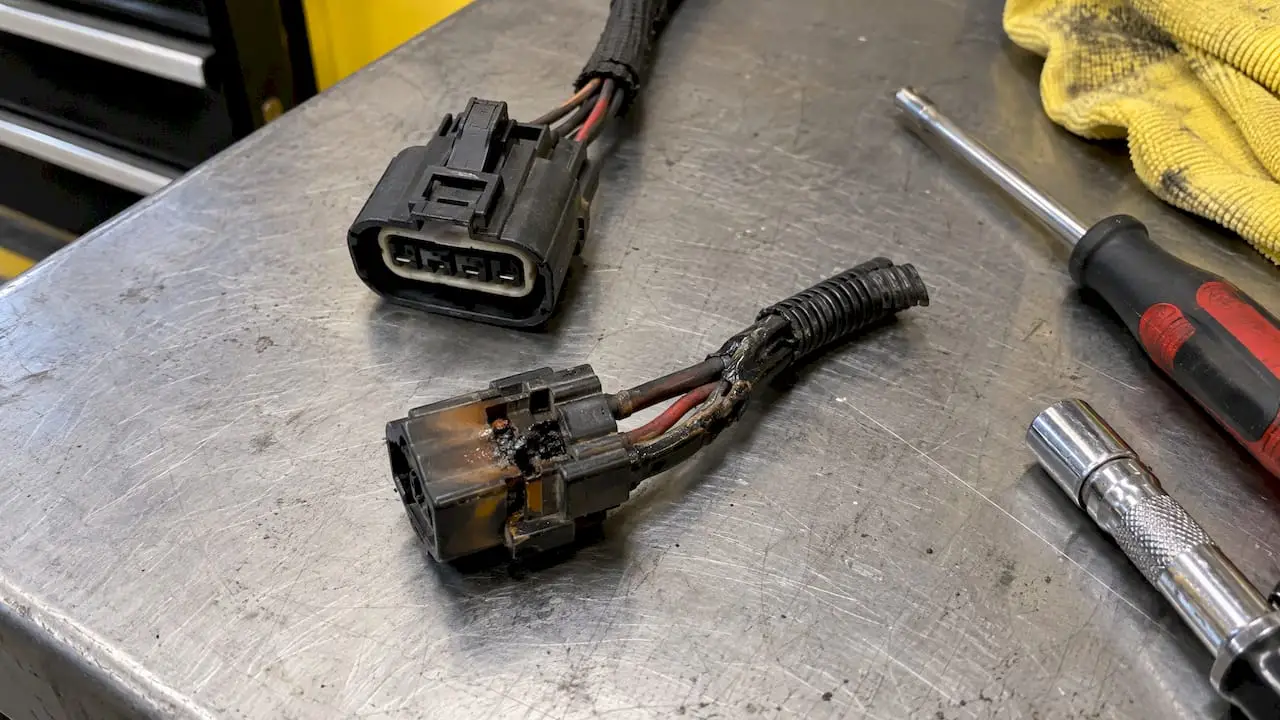
These are model-specific, so don’t assume your car has the same issue. They do show that a dead blower isn’t always a dead motor.
A worn-out motor
Brushes and bearings wear, and eventually the motor stalls or stops turning. This is the most common cause of a gradual decline, and it usually announces itself with noise first.
Debris or a stuck fan wheel
Leaves, animal hair, rodent nests and an overdue cabin filter can all restrict airflow. A technical guide on insufficient dash airflow also lists a loose or incorrectly rotating wheel and leaking ducts or door seals. A Ford bulletin for some 2013 to 2017 Escapes connects blower noise or vibration, sometimes with reduced airflow and odor, to small animals or foreign material in the blower housing.
If the fan is noisy but moving air, debris is a good suspect. A rattle that changes with fan speed is a classic sign.
Quick checks you can do safely
You don’t need tools for most of these, and none of them require getting under the dash.
- Cycle through every fan speed with the engine running. Note which speeds work, if any. Write it down, since a technician will want to know.
- Listen. Put the fan on high with the radio off. A hum with no air suggests a stuck wheel or blocked housing. Total silence suggests no power reaching the motor.
- Check your owner’s manual for the fuse box location and which fuse runs the blower. Pull it and look at it. If the metal strip inside is broken, it has blown.
- Replace a blown fuse only with the same amperage. A higher-rated fuse can let wiring overheat. If the new fuse blows right away, stop. Something is drawing too much current.
- Check the cabin air filter if your car has an accessible one. A clogged filter cuts airflow, though it won’t usually stop the fan entirely.
- Smell for burning. Any burnt-plastic smell or smoke from the vents means turn the fan off and get the car looked at.
Can you reset a blower motor? There’s no reset button on a typical car blower. Replacing a blown fuse is the closest thing, and it only helps if the fuse was the real problem. A fan that kicks on after a bump isn’t reset, it’s a motor on its way out.
How a technician tells a motor from a fuse, resistor or wiring
This is the part that saves money. Swapping a motor is often the most expensive guess, and it isn’t always right.
The International bulletin mentioned above shows the logic: with the ignition and HVAC on, a technician checks signal and battery voltage at the control module, then checks the harness and fuse connections while measuring voltage, then measures voltage at the motor. That sequence can separate a failed motor from a control-module, fuse, connector or wiring fault.
An industry trade article, A/C Update from TechShop, recommends measuring motor voltage at every fan setting, then checking the fuse, relay, resistor, switch or control head and wiring. Battery voltage showing up at the resistor suggests an open circuit in the resistor.
In plain terms:
- Power reaches the motor but it doesn’t spin: the motor is likely bad.
- No power at the motor: the problem is upstream, in the fuse, relay, resistor, switch or wiring.
- Power on high only: the speed-control part is the likely culprit.
Some repairs also come with their own checks afterward. A Chrysler technical tip for replacing a blower resistor, for example, has the technician run the blower on high for at least two minutes after the repair. That’s the kind of follow-through to expect from any shop.
Blower problems by symptom
| What you notice | Likely area | What to do |
|---|---|---|
| No air, no sound, any speed | Fuse, relay, motor, wiring | Check the fuse; if it’s fine, get a voltage test |
| Works only on high | Resistor or speed-control module | Have the speed control tested |
| Squeal, grind or rattle | Worn motor bearings or debris | Schedule a check soon |
| Works after a bump | Worn motor brushes | Plan a diagnosis; failure is coming |
| Weak air, fan sounds normal | Clogged cabin filter, blocked ducts | Check the filter and have airflow inspected |
| Burning smell or smoke | Overheated connector, resistor or motor | Turn the fan off and have it inspected now |
When to stop troubleshooting
Stop and book a diagnosis if any of these apply:
- A new fuse blows again.
- You smell burning, see smoke or find melted plastic.
- The fan works only on one speed and you’re not sure why.
- The noise gets worse over days.
- The fan quits in hot weather or when you need the defroster. Airflow matters for clearing a fogged windshield, so this is about visibility as well as comfort.
Burning smells deserve respect. A Ford recall supplement for certain 2015 to 2017 Expedition and Navigator vehicles lists an inoperative blower, excessive noise and burning smell or smoke as symptoms, and notes a possible interior-fire risk while the ignition is on. That’s one model, but the principle applies broadly: hot electrical smells aren’t something to drive with.
It’s also worth asking whether your car is part of a recall or manufacturer campaign. Some blower problems are covered by them, and eligibility is confirmed by VIN. The Kia fix mentioned earlier, for instance, moves the blower fuse to a circuit position with a wider terminal. Ask the shop to check your VIN for open campaigns.
What a repair visit looks like
When you bring a car in for a dead blower, you should expect a straight answer about what failed and why. Our service pages cover A/C services and general maintenance and repair, and a blower diagnosis falls in that territory. A good visit usually includes:
- A conversation about what you’ve noticed, including which fan speeds work.
- Checks of the fuse and the electrical supply to the motor.
- Testing of the resistor or control side if the symptoms point there.
- An inspection of the blower housing and cabin filter for debris.
- A clear explanation of what failed, what it will take to fix it and whether anything else needs attention, such as moisture getting into the housing.
The point of step five is to avoid fixing the symptom and missing the cause. Subaru’s bulletin, for instance, describes improved blower units with added sealing and a newer-style cabin filter to go with them. Those details matter when water is the root problem.
A weak electrical system can also look like a blower problem. If you’ve had other electrical oddities, such as dim lights or slow cranking, read our page on battery, alternator and starter service.
Our perspective
Most blower complaints we hear start the same way: the fan was a little noisy for a while, then one hot afternoon it stopped. By then the driver has often tried a new fuse or two. We understand why. A fuse costs little and it feels like the logical first move.
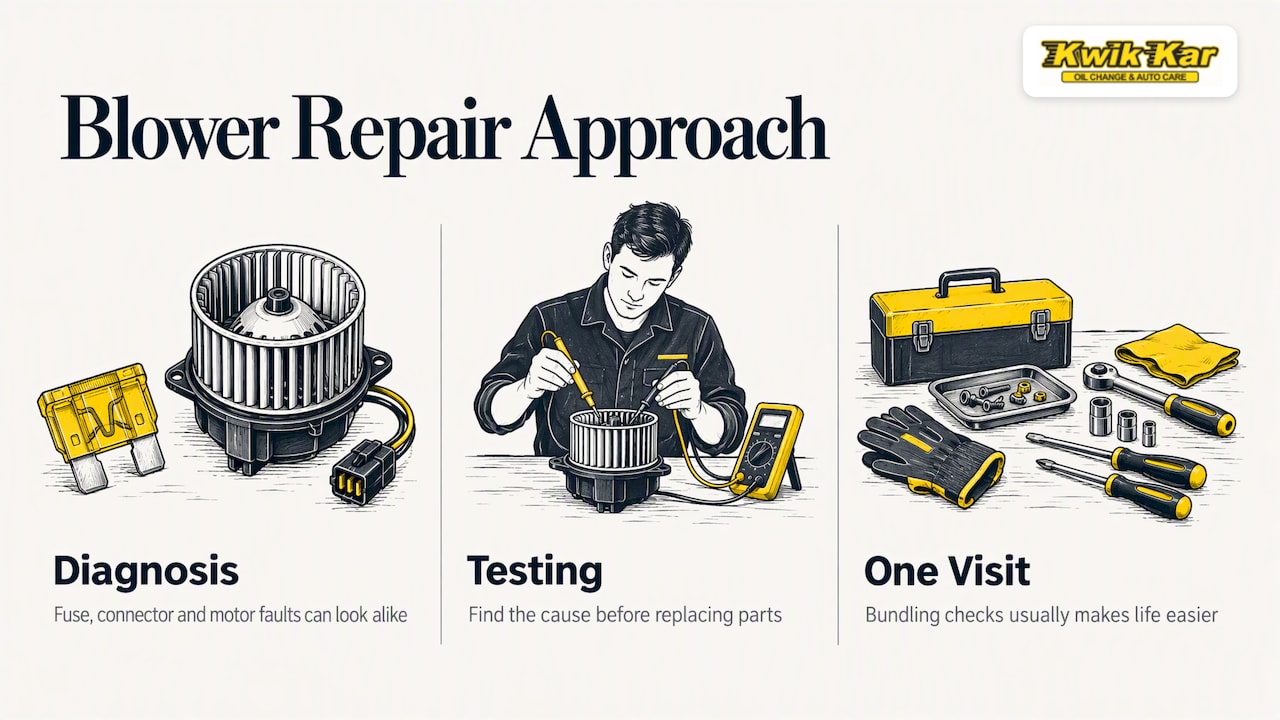
Our view is that the first fix should be the right one. That means finding out why the blower stopped before parts get replaced. A blown fuse, a warm connector and a tired motor can all look alike from the driver’s seat, and they don’t have the same repair. We’d rather explain what the testing shows and let you decide, with ASE-certified mechanics doing the work and clear communication throughout.
And if the blower is only one of several small things you’ve been putting off, tell us. Bundling checks into one visit usually makes life easier.
— Kwik Kar
Get your blower and A/C checked
If your fan isn’t moving air, or you’ve noticed noise or a burning smell, we can diagnose it and tell you what’s going on. Our team handles A/C and heating-related work, electrical checks and general repair at our Midlothian shop. You can see what we offer on our services page.

If you have a coupon in mind, check our specials page for what’s currently offered. We don’t publish prices for blower work, so we’ll explain the cost after diagnosis, before repairs begin.
Preventing blower trouble
You can’t make a blower motor last forever, but a few habits help.
- Replace the cabin air filter on schedule. Follow your owner’s manual. A clogged filter makes the motor work harder.
- Keep the area under the windshield clear. Leaves and debris can get into the air intake and the housing.
- Fix leaks promptly. Water in the blower housing corrodes the motor and can damage its electrical parts.
- Don’t ignore early noise. A squeak you hear now is cheaper than a dead fan later.
- Mention the fan during regular service. It’s easy to add a quick check to a visit you already have planned. Our guide to habits that extend the life of your car covers more of these.
FAQ
Why did my car blower suddenly stop working?
A sudden stop usually points to something electrical: a blown fuse, a failed resistor or control module, or a damaged connector. A motor that’s been wearing out can also finally quit. Check the fuse first, and if it’s intact, have the voltage tested before buying a motor.
How do I tell if the blower motor is bad?
A bad motor often gets noisy first, with squealing, grinding or rattling from the passenger side of the dash. Then it may work only after a bump, and finally not at all. A technician confirms it by checking that power and ground reach the motor and that it still won’t spin.
Why does my heater blower work only on high?
That’s a common sign of a failed blower resistor or speed-control module, which handles the lower speeds. The motor itself is often fine. Have the speed-control parts and connector tested, since heat damage at the connector can be involved.
Can a blower motor be reset or made to kick on?
There’s no reset for a typical car blower. Replacing a blown fuse is the closest equivalent. If the fan only starts after a bump or tap on the dash, that’s a warning that the motor is failing, so plan a diagnosis rather than relying on it.
Is it safe to drive with a broken blower?
You can drive, but you lose the ability to defog and defrost quickly, which affects visibility. If you smell burning or see smoke from the vents, turn the fan off and have the car inspected before driving much further.
Book your blower diagnosis
Don’t wait for the fan to quit on the hottest day or the foggiest morning. Call us at (972) 775-5945 to schedule a diagnosis, and tell us what you’ve noticed so we can start in the right place.
Sources
- International service bulletin SB-10052444-5650 (NHTSA)
- Subaru service bulletin, 2019 (NHTSA)
- Kia campaign bulletin, August 2024 (NHTSA)
- Honda safety recall bulletin, 2010 (NHTSA)
- GM bulletin on blower resistor modules, 2012 (NHTSA)
- Ford bulletin on blower noise, 2017 (NHTSA)
- Ford Safety Recall 22S56 supplement, 2023 (NHTSA)
- MAHLE TechTool: interior blower
- NRF technical article: interior blowers
- Technical guide: insufficient airflow from dash
- TechShop: A/C Update, bad A/C blowers and fuses
- Chrysler technical tip TT9001064